
by Juan Inoriza
… because they are more than just for entertainment, they are the testament of time and history.
More than mere pastimes – they are living echoes of culture, history, and community.
When people today think of board games, classic names such as Chess, Backgammon, Ludo, Cribbage or Snap often come to mind.
But in Vietnam, the world of board games extends far beyond these familiar titles. The country boasts a rich tapestry of traditional games, many with histories spanning centuries, offering not only entertainment but a window into Vietnam’s cultural heritage, social customs, and communal values.
While some of these age-old games are no longer played as widely as before, they remain powerful symbols of identity and continue to unite generations. Join us as we explore some of Vietnam’s most cherished and enduring board games – timeless gems that tell the story of a nation.
Cờ Tướng (Chinese Chess)

Cờ Tướng (Vietnamese: Cờ Tướng; Chinese: 象棋 – Xiàngqí), commonly known as Chinese Chess, is one of the most popular traditional board games in Vietnam, deeply embedded in the country’s cultural and intellectual life.
What is Cờ Tướng?
- Cờ Tướng literally means “elephant chess” or “general’s chess” in Vietnamese.
- It is the Vietnamese variant of Xiàngqí, a strategic board game similar to international chess but with distinct rules, pieces, and symbolism.
- It is widely played across Vietnam in parks, cafés, street corners, and even formal competitions.
- The game reflects Eastern philosophies, especially Sun Tzu’s “Art of War”, focusing on tactics, territory, and positioning.
The Board and Setup
- The board is made up of 9 vertical lines (files) and 10 horizontal lines (ranks).
- The two sides are separated by a central space called the “river” (sông), which affects movement for certain pieces.
- Each player controls 16 pieces:
- 1 General (Tướng)
- 2 Advisors (Sĩ)
- 2 Elephants (Tượng)
- 2 Horses (Mã)
- 2 Chariots (Xe)
- 2 Cannons (Pháo)
- 5 Soldiers (Tốt)
How to Play Cờ Tướng
- The goal is to checkmate your opponent’s General (Tướng).
- Each type of piece has specific rules:
- General (Tướng): Moves one step at a time within the palace and cannot face the enemy General directly across the board.
- Advisors (Sĩ): Only move diagonally within the palace.
- Elephants (Tượng): Move two points diagonally and cannot cross the river.
- Horses (Mã): Move like knights in chess but are blocked if the adjacent point is occupied.
- Chariots (Xe): Move like rooks (orthogonally any number of spaces).
- Cannons (Pháo): Move like rooks but must jump over exactly one piece when capturing.
- Soldiers (Tốt): Move forward one step. After crossing the river, they can also move sideways.
Cờ Tướng in Vietnamese Culture
- It is especially popular among older generations, though it’s also enjoyed by young enthusiasts and professionals.
- Commonly played in public parks and urban spaces, often drawing crowds of spectators.
- Some provinces and cities host annual tournaments.
- In Vietnam, Cờ Tướng is seen not only as a game but also a test of wisdom, patience, and strategic thinking.
Competitive Scene
- Vietnam has produced strong players in the international Xiàngqí scene.
- The game is included in various Asian sporting events.
- Online platforms and mobile apps have boosted its popularity among the youth in recent years.
Ô Ăn Quan (Vietnamese Mancala)

Ô Ăn Quan is a traditional Vietnamese children’s game, closely related to the Mancala family of “count-and-capture” games found across Africa and Asia. It is widely played in rural areas of Vietnam and forms an important part of childhood memories and cultural heritage.
What is Ô Ăn Quan?
- The name Ô Ăn Quan roughly translates to “game of eating the mandarins” (ô = square, ăn = to eat/capture, quan = mandarin/noble piece).
- It’s a two-player strategy game involving counting, capturing, and redistributing stones or seeds.
- The game is a mix of calculation and tactics, aimed at capturing as many pieces as possible.
- Traditionally played in the dirt, on a wooden board, or on paper drawn with chalk or charcoal.
Game Equipment
- A board consisting of two rows of five squares (ô) each and two larger semicircles at either end called “Quan” squares (representing mandarins).
- A total of 50 small stones or seeds (called dân or commoners) and 2 larger pieces (called quan or mandarins).
Board Layout
- Each of the 5 smaller squares on each side starts with 5 small stones.
- Each “Quan” (semicircle) starts with 1 large stone.
How to Play
- Players take turns, choosing one of their own small squares (ô) to start from.
- All the stones in that square are picked up and distributed one by one clockwise into each subsequent square, including the Quan and opponent’s side.
- When the last piece is placed:
- If the next square is not empty, the player picks up its contents and continues sowing.
- If the next square is empty but the one after it contains pieces, the player captures the contents of that further square (a move called ăn).
- The Quan squares can also be captured but are strategically protected, as losing them brings a penalty.
How to Win
- The game ends when all pieces are captured.
- Each player counts their captured stones, with the Quan pieces worth more points.
- The player with the highest total score wins.
Cultural Significance in Vietnam
- A staple of Vietnamese childhood, especially in rural areas where children draw the board in the dirt.
- Taught in schools and sometimes revived in cultural festivals as a way to preserve folk traditions.
- Emphasises mental arithmetic, planning, and strategy from a young age.
- Has been featured in Vietnamese folk tales, poetry, and children’s literature.
Cờ Cá Ngựa (Horse Racing Game)

This game originated from the Indian game Pachisi, introduced to America and became Parcheesi. The French called it Petits chevaux (little horses), and finally introduced it to Vietnam and called it the Horse Racing Game .
Cờ Cá Ngựa (literally Horse Chess) is a popular and beloved traditional board game It’s a fun, fast-paced game often played by children and families, combining elements of chance, strategy, and competition.
What is Cờ Cá Ngựa?
- The name means “Horse Racing Chess”.
- It simulates a horse race, with players racing their pieces (horses) around a board shaped like a racetrack.
- The game is similar in concept to Ludo or Parcheesi, with simple rules but plenty of excitement.
- Typically played by 2 to 4 players.
Equipment
- A square board divided into a racetrack with coloured paths (usually 4 colours).
- Each player has 4 horse pieces of the same colour.
- A single six-sided die (dice) is used to move the horses.
Objective
- Be the first player to move all four of your horses from your stable (starting area) around the track and into the home area (finish line).
Board Layout
- The board has four coloured “lanes” or paths forming a square.
- Each lane is divided into spaces along which the horses move.
- There are also safe zones (usually marked by special symbols) where horses cannot be captured.
How to Play
- Starting the game:
Each player rolls the dice. Usually, you need to roll a 6 to bring a horse out of your stable and onto the starting point of your lane. - Movement:
On your turn, roll the dice and move one horse forward by the number shown. - Capturing opponents:
If your horse lands exactly on a space occupied by an opponent’s horse, you capture (send) that horse back to its stable. - Rolling a 6:
Rolling a 6 gives you an extra turn, and allows you to bring a new horse onto the track or move an existing one. - Winning:
Move all four horses completely around the board and into your home zone before your opponents.
Cultural Notes
- Cờ Cá Ngựa is especially popular at family gatherings, festivals, and among schoolchildren.
- It’s a great game to develop basic counting skills, turn-taking, and simple tactics.
- The race theme makes it exciting and easy to learn, contributing to its lasting popularity in Vietnam.
Cờ Vây (Go Game)

Cờ Vây, known internationally as Go, is a classic and deeply strategic board game that originated in ancient China over 2,500 years ago and is widely played in Vietnam. It is renowned for its elegant simplicity paired with profound strategic depth.
What is Cờ Vây?
- Cờ Vây literally means “encircling game” in Vietnamese.
- It is a two-player abstract strategy game where the objective is to control more territory on the board than your opponent.
- The game is played with black and white stones placed on a grid.
- It emphasizes balance, territorial control, and tactical skill rather than direct conflict.
The Board and Equipment
- The standard board is a 19×19 grid of intersecting lines, but smaller sizes (9×9 or 13×13) are also common for beginners.
- Each player has an unlimited number of stones: one plays black, the other white.
- Stones are placed on the intersections (points) of the grid, not inside the squares.
How to Play Cờ Vây
- Starting the game:
Black plays first, placing one stone on any intersection on the board. Players alternate turns, placing one stone at a time. - Objective:
The goal is to surround more territory than your opponent by the end of the game. - Capturing stones:
Stones or groups of stones that are completely surrounded by the opponent’s stones with no liberties (empty adjacent intersections) are captured and removed from the board. - Territory:
Empty points surrounded by a player’s stones count as that player’s territory. - Ending the game:
The game ends when both players pass consecutively, indicating no more beneficial moves. - Scoring:
Players count their surrounded territory plus any captured stones. The player with the higher total wins.
Strategic Highlights
- The game balances attack and defence, influence and territory.
- Despite simple rules, it offers immense complexity, requiring deep foresight.
- Cờ Vây has inspired philosophical and artistic reflections throughout East Asia.
Cờ Vây in Vietnam
- It enjoys growing popularity among intellectuals, students, and strategy enthusiasts.
- Clubs, tournaments, and online platforms support a vibrant community.
- It is often considered a mind sport that sharpens concentration, patience, and strategic thinking.
Bầu Cua Tôm Cá (Vietnamese Dice Game)

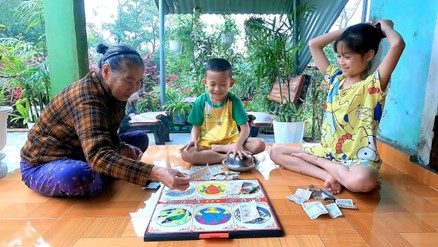
Bầu Cua Tôm Cá (literally “Gourd-Crab-Shrimp-Fish”) is a traditional Vietnamese dice gambling game, commonly played during Tết (Lunar New Year). It’s a colourful and lively game of chance, full of excitement and festive spirit.
What is Bầu Cua Tôm Cá?
- It’s a dice-based betting game involving six symbols:
Bầu (gourd), Cua (crab), Tôm (shrimp), Cá (fish), Gà (rooster), and Hươu (deer). - The game is often played on a specially printed board featuring these six images.
- It is similar to games like Crown and Anchor or Sic Bo, but with Vietnamese cultural imagery.
Equipment
- A square board or cloth showing the six symbols.
- Three dice, each printed with the same six images (one image per face).
- Small objects for betting: coins, tokens, or paper money.
How to Play
- Placing bets:
Players place their bets on one or more of the six symbols on the board. - Rolling the dice:
The dealer shakes the three dice inside a bowl and then reveals the outcome. - Determining winners:
If one or more of the images a player bet on appears on any of the three dice, they win:- 1 match = 1x payout
- 2 matches = 2x payout
- 3 matches = 3x payout
If none of the dice show the symbol you chose, you lose your bet.
- Repeat:
The game continues with new rounds of betting and rolling.
Cultural Significance
- Bầu Cua Tôm Cá is a staple during Vietnamese Lunar New Year festivities.
- Often played casually among family and friends, more for fun than serious gambling.
- Children enjoy using fake money or sweets to play at home.
- The colourful symbols and chance-based nature make it easy to learn and inclusive.
Final Thoughts
From the cerebral depths of Cờ Tướng and Cờ Vây to the lively chaos of Bầu Cua Tôm Cá, Vietnam’s board games offer a fascinating blend of strategy, culture, and communal bonding. Whether played in quiet contemplation or festive exuberance, they remain enduring symbols of Vietnam’s rich heritage.