
by Juan Inoriza
Abstract
This article examines the symbolic centrality of the dragon (rồng) in Vietnamese cultural consciousness, from its mythological origins to its contemporary manifestations. In contrast to Western perceptions of dragons as destructive and fearsome, the Vietnamese rồng is associated with benevolence, water, fertility, and sacred authority. Drawing on mythology, imperial history, material culture, and modern urban design, the article argues that the rồng functions as a durable symbol of unity, resilience, and spiritual ecology within Vietnam’s cultural heritage.
Introduction
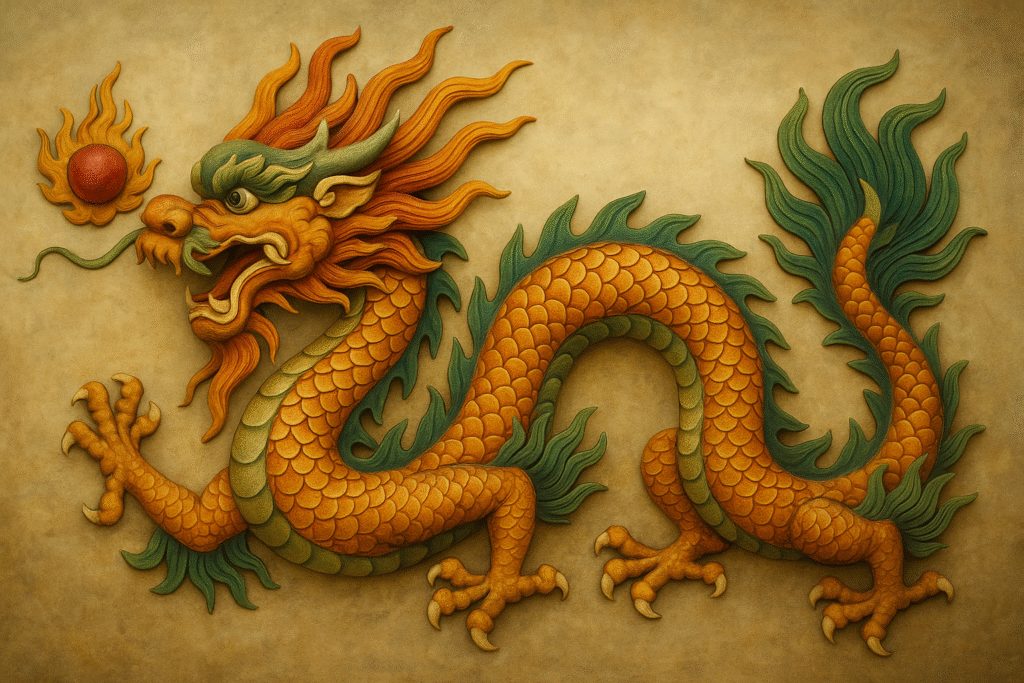
In Vietnamese cultural tradition, the dragon (rồng) occupies a preeminent and multifaceted role. Far from being a mere mythical beast, the rồng serves as an enduring emblem deeply embedded in the nation’s historical memory, cosmology, and socio-political imagination. Unlike the menacing, fire-breathing dragons of Western lore, the Vietnamese dragon is a sacred and benevolent figure, intrinsically associated with water, fertility, and divine protection. This article explores the evolving significance of the dragon across different historical and cultural contexts—from mythic narratives and dynastic symbolism to its enduring presence in place names, performance traditions, and modern Vietnamese infrastructure. It contends that the rồng constitutes a core symbol of Vietnamese cultural resilience, unity, and ecological harmony.
1. Mythological Foundations: The Dragon as Progenitor and Symbol of Unity
At the heart of Vietnamese ethnogenesis lies a foundational myth centred on the dragon. The union of Lạc Long Quân, a dragon lord of the seas, and Âu Cơ, a celestial mountain fairy, gave rise to one hundred offspring—regarded as the ancestors of the Vietnamese people. Their separation, with Lạc Long Quân leading fifty children to the coast and Âu Cơ guiding the remaining fifty to the mountains, symbolises not division, but complementary unity. One of these children would become the first Hùng King, founding the Hồng Bàng dynasty and initiating the nation’s monarchical lineage.
This myth performs several vital cultural functions. Firstly, it identifies the dragon as the paternal ancestor (cha rồng), thus embedding dragon imagery at the very roots of national identity. Secondly, it symbolises the unity of a people dispersed across a diverse topography—coastlines, deltas, mountains, and rivers—while maintaining a shared origin (Bọc trăm trứng, “from one hundred eggs”). Lastly, the myth forges a lasting spiritual bond between the Vietnamese and the natural elements, particularly water, with the dragon embodying a guardian of these life-giving forces.
2. Dragons and Dynastic Legitimacy: Imperial Mandates and Authority
The dragon’s association with sovereignty and divine authority became central during Vietnam’s dynastic periods. Emperors invoked dragon symbolism to affirm their legitimacy under Thiên Mệnh (the Mandate of Heaven), positioning themselves as divinely sanctioned rulers. A pivotal historical moment occurred in 1010 CE when Emperor Lý Thái Tổ relocated the capital to Thăng Long (“Ascending Dragon”), now Hanoi. According to imperial annals, he witnessed a golden dragon rising from the Red River—a heavenly omen interpreted as confirmation of his rule and the prosperity to come.
Such symbolism permeated courtly aesthetics. Dragon motifs adorned imperial regalia, thrones, seals, and architectural elements. Hierarchies of representation were strictly enforced: four-clawed dragons (rồng bốn móng) were reserved for the emperor, while dragons with fewer claws were allocated to mandarins and nobility. While indebted to Chinese traditions of imperial iconography, Vietnamese dragons developed unique features: more serpentine, fluid in motion, and closely linked to water—reflecting local geography, belief systems, and artistic sensibilities.
3. Aquatic Guardians: The Dragon as Sustainer of Agrarian Life
One of the most distinctive aspects of the Vietnamese dragon is its deep association with water. Unlike dragons in many cultures, which often breathe fire or wreak havoc, the rồng governs rivers, rainfall, storms, and agricultural fertility. For a civilisation historically dependent on rice cultivation and hydraulic systems, the dragon is not merely a symbolic figure, but a functional one—a guardian of environmental balance.
This role is prominently displayed in múa rối nước (water puppetry), a traditional performance art in which dragons appear frequently, spouting water as a metaphor for irrigation, renewal, and divine guardianship. Legends also reinforce this protective role. The name Hạ Long Bay (“Descending Dragon”) derives from a myth in which a celestial dragon and her offspring defended Vietnam by creating a barrier of limestone karsts from their jewels. Similarly, the Mekong Delta, known poetically as Cửu Long (“Nine Dragons”), reflects the river’s nine distributaries and the vital life they bring to the south.
These narratives and geographies underscore the dragon’s intimate association with water and its ecological, agricultural, and spiritual importance in Vietnamese life.
4. Spatial and Cultural Imprints: The Dragon in Place, Object, and Ritual
The dragon’s resonance extends far beyond mythology and imperial symbolism, permeating place names, cuisine, material culture, and ritual performance. Cities, provinces, and geographical features frequently bear names honouring the dragon: Long Xuyên (Dragon River), Long An (Peaceful Dragon), Vĩnh Long (Eternal Dragon), Bình Long (Calm Dragon), and Long Hải (Dragon Sea). Such naming practices reflect a deep-seated symbolic geography in which the dragon signifies strength, longevity, and spiritual protection.
Cultural artefacts reinforce this omnipresence. In cuisine, dishes such as thanh long (dragon fruit), bánh rồng (dragon cake), chè mắt rồng (dragon eye dessert), and gạo rồng đỏ (red dragon rice) employ the dragon metaphor to connote auspiciousness, vitality, or quality. In material culture, objects such as the dao rồng (dragon knife), trống rồng (dragon drum), and lư hương rồng (dragon incense burner) frequently appear in homes and temples, acting as conduits for protection and prosperity.
Rituals and festivals continue to celebrate the dragon’s power. The múa rồng (dragon dance), central to the Lunar New Year (Tết) and other public festivals, invokes good fortune and community cohesion. The dragon’s graceful, undulating motion is not only visually arresting but symbolically potent—embodying continuity, strength, and spiritual vitality.
5. Contemporary Expressions: Dragons in the Vietnamese Urban Imagination
Far from being a relic of the past, the dragon remains a potent symbol in contemporary Vietnam. Its image graces commercial logos, luxury brands, and public art, often signifying prestige, prosperity, and cultural pride. Perhaps the most iconic modern expression is Cầu Rồng (Dragon Bridge) in Đà Nẵng—a gleaming, serpentine structure spanning the Hàn River. Uniquely, this bridge is not only architectural but performative: on weekends and holidays, the dragon “breathes” fire and water, drawing crowds and reaffirming the symbolic vitality of the rồng in the national psyche.
This synthesis of ancient symbol and modern technology exemplifies how the dragon continues to evolve, maintaining cultural relevance in an urban and globalised Vietnam. It reflects the ability of Vietnamese cultural symbols to adapt while retaining their foundational meanings.
Conclusion
The Vietnamese dragon (rồng) endures as a symbol of extraordinary cultural richness and continuity. Rooted in origin myths, consolidated through dynastic legitimacy, and perpetuated in performance, place, and ritual, the dragon functions as an emblem of unity, ecological harmony, and national identity. From the ancestral Lạc Long Quân to the fire-breathing bridge of Đà Nẵng, the rồng continues to embody the Vietnamese people’s spiritual connection to nature, their resilience in the face of change, and their reverence for tradition.
As a cultural icon, the dragon exemplifies the capacity of myth to shape national narratives and bind communities across generations. In Vietnam, the rồng is not merely remembered—it lives, breathes, and flows with the rhythm of the land itself.
Related Vietnamese Proverbs:
- “Rồng gặp mây”: “Dragon meets clouds” – implies favourable conditions.
- “Đầu rồng đuôi tôm”: “Dragon’s head, shrimp’s tail” – means good in the beginning and bad at the end; something which starts well but ends badly.
- “Rồng bay, phượng múa”: “Dragon flight, phoenix dance” – is used to praise the calligraphy of someone who writes Chinese ideograms well.
- “Rồng đến nhà tôm”: “Dragon visits shrimp’s house” – an expression used by a host to or about his guest: the host portrays himself as a humble shrimp and his guest as a noble dragon.
- “Ăn như rồng cuốn, nói như rồng leo, làm như mèo mửa”: “Eating as dragon scrolls, talking as dragon climbs, working as cat vomits” – a criticism of someone who overeats and talks a lot, but is lazy.
“The dragon image reflects people’s desire to free themselves from restrictions and limitations. It [the dragon] can fly in the sky, hide in the clouds, swim, walk and crawl. The dragon symbolises human aspiration for strength and freedom to live a better life. Đặng Văn Bân, Vietnamese cultural researcher and folklorist
References:
- Chapuis, O. (1995). A history of Vietnam: From Hong Bang to Tu Duc. Greenwood Press.
- Chiu, C. (2008). Art and myth in contemporary Vietnam. Asia Art Archive.
- Cooke, N. (1994). Water puppets and rice farmers: Vietnamese cultural continuity. Asian Folklore Studies, 53(1), 23–45.
- Đặng, N. V. (2003). Vietnamese popular religion. The Gioi Publishers.
- Đặng Văn Bân. (2013). Sacred animals in Vietnamese culture and architecture, https://vovworld.vn/en-US/culture/sacred-animals-in-vietnamese-culture-and-architecture-166542.vov
- Luong, H. V. (2010). Tradition, revolution, and market economy in a North Vietnamese village, 1925–2006. University of Hawai’i Press.
- McHale, S. (2012). Print and power: Confucianism, communism, and Buddhism in the making of modern Vietnam. Journal of Asian Studies, 71(1), 111–130.
- Pelley, P. M. (2002). Postcolonial Vietnam: New histories of the national past. Duke University Press.
- Taylor, K. W. (2013). A history of the Vietnamese. Cambridge University Press.
- Taylor, P. (2007). Modernity and re-enchantment: Religion in post-revolutionary Vietnam. ISEAS–Yusof Ishak Institute.