
Supervising Vietnamese Social Bonding
Abstract
This article explores the Vietnamese tradition of đi nhậu—a social ritual centred on drinking and communal dining. Examining its historical roots, cultural significance, etiquette, linguistic features and modern variations, the article aims to provide a comprehensive account for readers unfamiliar with Vietnam’s convivial drinking culture.
1. Introduction
In Vietnam, social interaction often revolves around shared meals and drinks. At the heart of this custom is đi nhậu, literally “going to drink.” Far from a casual pint after work, đi nhậu combines culinary pleasure, group solidarity and nuanced etiquette. This practice permeates family gatherings, friendship circles and even corporate environments, serving as both a social glue and a business networking tool.
2. Historical Background
• Origins: Drinking rituals in Vietnam derive from ancient rice-wine ceremonies tied to agricultural worship. Over centuries, the practice evolved into informal quán nhậu (open-air eateries) where local communities gathered.
• French and Chinese Influences: French colonial rule introduced beer (bia) on a large scale, while centuries of interaction with Chinese linage enriched the array of rice-based spirits (rượu).
3. Cultural Significance
- Social Cohesion: Đi nhậu fosters camaraderie; regular outings strengthen bonds among peers.
- Business Etiquette: Accepting invitations to nhậu is often indispensable for forging trust with colleagues and clients.
- Celebration and Release: Birthdays, promotions and stress relief all find expression in boisterous nhậu sessions.
4. Typical Structure of a Nhậu Gathering
- Timing: Sessions typically commence around 6–7 p.m. after work.
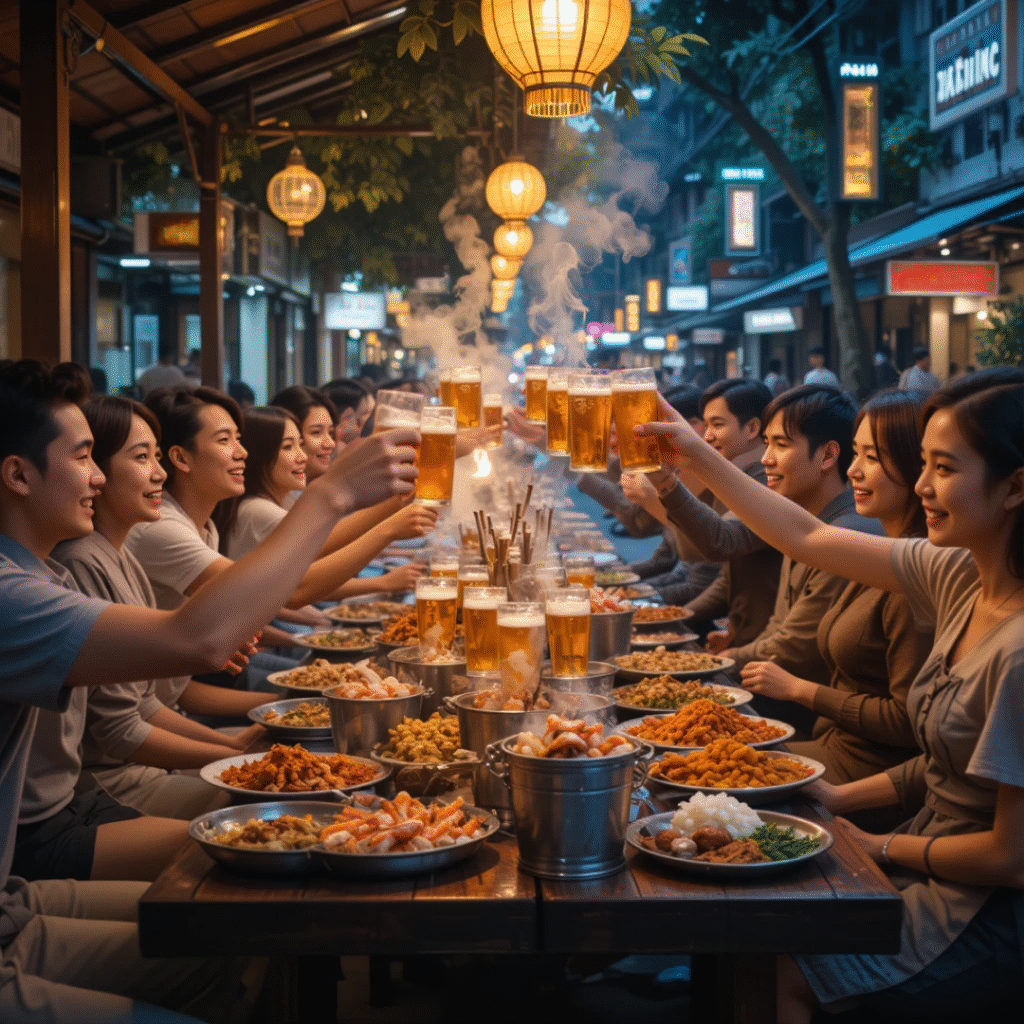
- Venue: Quán nhậu are often open-air, bustling establishments focused on beer and shared dishes.
- Ordering: Large platters of grilled seafood, spicy salads, hotpots and deep-fried snacks arrive throughout the evening.
- Drinks: Ice-filled buckets of local beer are the norm; rice wine appears on special occasions.
5. Etiquette and Unwritten Rules
Understanding nhậu etiquette is key to respectful participation:
• Inviter Pays: The person extending the invitation or the senior in rank traditionally settles the bill.
• The Pour: Younger people or those of lower status typically pour drinks for elders or superiors, always using both hands as a sign of respect. Glasses are rarely left empty for long.
• Mandatory Toasting: Before any drink, participants pair up to toast, exclaiming “Dzô!”. Declining requires a polite explanation.
• The Toast: Make eye contact when toasting and clinking glasses. When toasting someone senior, hold your glass slightly lower than theirs. Simple, sincere wishes are best.
• Ronda Brindis: Frequent rounds encourage reciprocal toasts, often accompanied by “cạn ly” (drink it dry).
• Pace Yourself: It’s a marathon, not a sprint. The focus is conversation and food, not rapid consumption. Eating plenty of mồi (snacks) is expected and helps moderate the effects of alcohol.
• The Group is Paramount: Đi nhậu is inherently collective. Dominating conversation, ignoring others, or focusing solely on your drink or food goes against the grain. Engage with everyone.
• Graceful Exit: Leaving early requires a polite excuse to the host and often a final, small shared drink as a farewell gesture to the group.
• Pace and Respect: While some chant “uống 100%” (drink it all), guests regulate pace to honour the host’s generosity.
6. Surviving the Nhậu: Essential Phrases for Going Out Drinking in Vietnam
- Greetings and Opening
o Chào mọi người! (Chao moi ngui) → Hello everyone!
o Rất vui được nhậu với mọi người! (Zat vui duk nhau voi moi ngui) → Delighted to be drinking with you all! - Toasting
o Dzô! (Yo) → Cheers!
o Một… hai… ba… dzô! (Mot hai ba yo) → One… two… three… cheers!
o Uống hết nhé! (Uong het nhe) → Let’s finish the drink! - Phrases to Accompany
o Ăn đi! (An di) → Have a bite!
o Món này ngon quá! (Mon nay ngon qua) → This dish is delicious!
o Cạn ly! (Can li) → Bottoms up! - If You Can’t Drink Alcohol
o Xin lỗi, tôi không uống được bia (Sin loi, toi khong uong duoc bia) → Sorry, I can’t drink beer.
o Tôi sẽ uống nước ngọt nhé (Toi se uong nuoc ngot nhe) → I’ll have a soft drink, please.
o Nhưng tôi vẫn muốn nhậu với mọi người (Nhung toi van muon nhau voi moi ngui) → But I’d still like to join in. - When It’s Over
o Cảm ơn mọi người, hôm nay rất vui! (Cam on moi ngui, hom nay rat vui) → Thanks everyone, it’s been a great evening!
o Hẹn gặp lại! (Hen gap lai) → See you next time!
7. Variations and Modern Trends Variations and Modern Trends
• Karaoke Nhậu: Combining singing rooms with drinks has become popular in urban centres.
• Fusion Menus: Some quán nhậu now serve European tapas alongside Vietnamese finger food.
• Moderation Movements: Health-conscious groups opt for low-alcohol beers and alternative beverages.
8. Tips for Foreigners
• Accept with Gratitude: Even if you don’t drink, join to show respect.
• Know a Few Phrases: Using “Dzô!” or “Cảm ơn” in Vietnamese endears you to locals.
• Observe Before Drinking: Watch when others toast to understand the rhythm.
9. Conclusion
Đi nhậu epitomises Vietnam’s spirit of conviviality and mutual respect. More than a drinking session, it represents shared memories, professional rapport and cultural continuity. Embracing its customs—however unique—offers profound insight into the social fabric of modern Vietnam.