
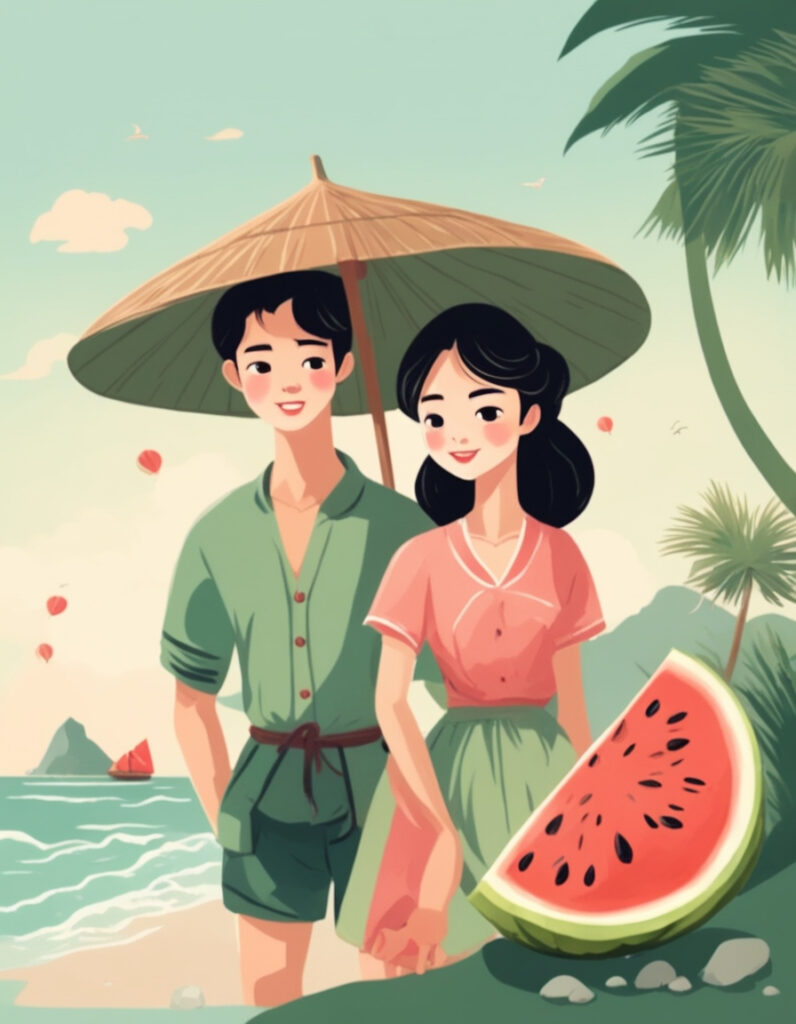
Centuries ago, during the reign of King Hùng Vương the Third in Vietnam, a benevolent and generous ruler, the king, having only one daughter, chose to adopt a son to ensure the continuity of his lineage.
He chose An Tiêm, a bright and capable young man from a distant and impoverished family. An Tiêm was raised with love and care, growing into a wise and skilled individual who earned the admiration of the entire kingdom, including the king himself.
Recognising their maturity, the king arranged a marriage between An Tiêm and his daughter, confident in An Tiêm’s ability to govern the land after his passing. The couple enjoyed a lavish wedding and lived in one of the king’s most splendid castles. Their union was blessed, and they soon welcomed two beautiful children.
However, the king’s favouritism towards An Tiêm sparked jealousy among some courtiers. Over time, their envy turned to malice, and they began to spread false stories portraying An Tiêm as a traitor plotting to usurp the throne. These baseless rumours eventually reached the king. Despite his affection for An Tiêm, the king felt compelled to protect his realm and exiled An Tiêm and his family to a remote, desolate island.
Cut off from the luxuries they once enjoyed, An Tiêm and his wife worked tirelessly to survive. They built a shelter, fished for food, and did everything they could to provide for their children. One hot morning, while searching for food, An Tiêm noticed a flock of birds pecking at strange black seeds. Curious, he gathered a handful and brought them home. Hoping they would grow into something useful, he scattered the seeds around their hut.
Months later, tender shoots sprouted, spreading across the ground. The plants bore fruits as large as a human head, with smooth skin and a sweet fragrance. When they cut one open, they found juicy red flesh with a sweet taste. An Tiêm named the fruit ‘dưa đỏ,’ meaning red melon. Interestingly, the sweetness attracted birds whose calls sounded like ‘tây qua,’ which inspired the family to call the fruit ‘watermelon.’
The family harvested the fruits, keeping enough for themselves and saving the seeds to plant again. Over time, they grew an abundance of watermelons, which they traded with passing sailors for essentials such as food, clothing, spices, and toys for their children.
Back at the palace, the king deeply missed An Tiêm and his daughter, unaware of their fate. Meanwhile, An Tiêm, reflecting on life’s unpredictability, carved his name into a watermelon and set it adrift in the sea, curious to see where it might go. By chance, the current carried the watermelon back to the kingdom, where it was found and presented to the king. Recognising An Tiêm’s name, the king was overjoyed to learn they had survived. Acknowledging An Tiêm’s ingenuity and resilience, the king sent envoys to bring the family back.
Upon their return, An Tiêm presented the watermelons to the king. Impressed by An Tiêm’s resourcefulness and leadership, the king bestowed the crown upon him. An Tiêm ruled the country wisely for the rest of his days.
Having realised how worthy his son was to rule, the king offered An Tiêm his crown. From then on, An Tiêm ruled the country wisely until the end of his days.
The watermelon, known as ‘dưa hấu,’ became a symbol of good fortune and is traditionally exchanged as a gift during Tết, the Vietnamese Lunar New Year.