
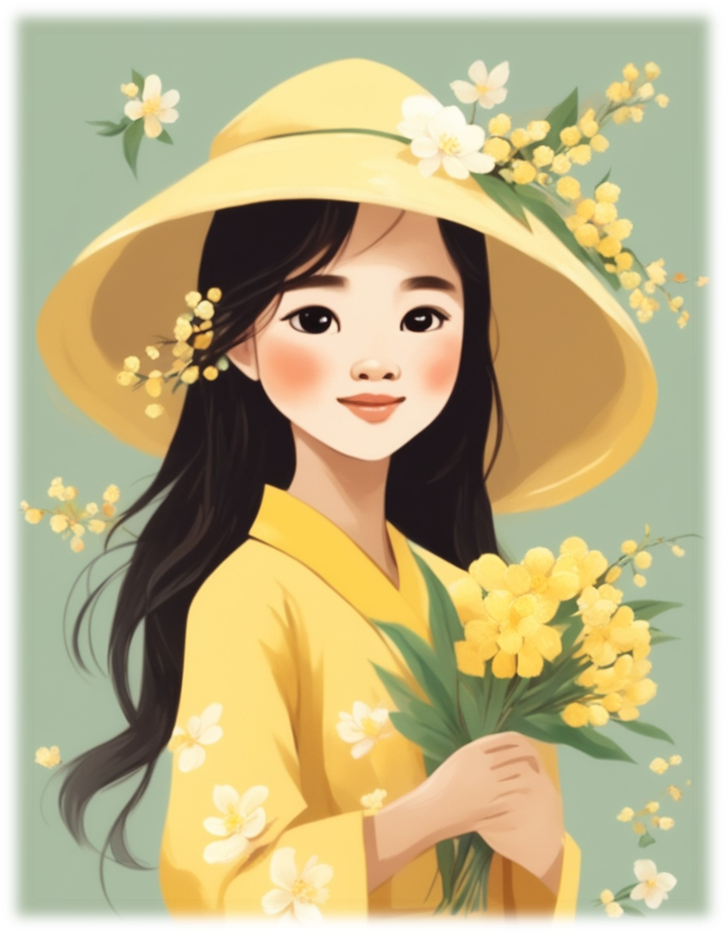
Once upon a time, in a quiet and peaceful village nestled between rolling green hills and meandering rivers, there lived a small, kind-hearted, and courageous girl.
Mai had a heart full of love for her family, her neighbours, and even for the Kitchen Gods, mysterious beings who risked their lives daily in the roaring flames of the kitchen to prepare meals for the villagers.
Among the three Kitchen Gods, the eldest, with his wise and gentle eyes, often stepped out of the fire to chat with Mai and her younger sister.
She knew that on the 23rd day of the twelfth lunar month, the eldest Kitchen God needed a carp to ride back to heaven and report to the Jade Emperor. So, a year later, the sisters set out together, determined to catch the finest carp they could find.
After a long day of work, they finally succeeded. With joy in their hearts, they presented the fish to the Kitchen God, saying, “We offer you this carp, great Kitchen God!”
The carp vanished into the flames, and that evening, they watched as the Kitchen God rode it into the heavens. Mai’s heart swelled with pride at having aided him on his sacred journey.
Her father, a renowned and respected hunter, known for his bravery and strength, had taught her to hunt even when she was only five years old. Her determination impressed everyone, including the Kitchen Gods, who often watched the brave child practice.
A year later, a terrifying monster appeared in the village. It had the head of a man and the body of a wild leopard. The villagers trembled with fear, but Mai and her father prepared to fight it.
With their combined courage and skill, they defeated the beast. As a sign of gratitude, she offered another carp to the Kitchen God and prayed for peace in the village.
As time passed, her father grew weaker, and the village was threatened once more—this time by a new monster with the head of a man and the body of a giant python. The villagers cried out for help, but the courageous girl would take the lead.
“I will go, Father,” Mai said. “You may come, but only to support me.”
Her mother and sister were filled with worry, but she reassured them: “Though I am small, I will succeed. Father and I will return together.”
Before they set off, her mother asked, “What colour would you like me to dye your shirt, my dear?”
“Yellow,” Mai replied, her eyes sparkling with determination.
Her mother carefully dyed the shirt with turmeric, and when she wore it, Mai shone as brightly as the rising sun: brave, strong, and full of purpose.
Before leaving, she offered another prayer to the Kitchen Gods, promising, “I will return and tell you how I defeated the monster.”
The battle was fierce and lasted two long days. The python monster was powerful and relentless, and over time, her father grew too weak to fight.
On the third day, Mai devised a plan. “I will tie its tail to one tree trunk and its body to another,” she said. “Once it’s trapped, we can deliver the final blow.”
Her father, though weak, nodded in agreement. “It’s a good plan, but be careful, the tail is dangerous.”
The brave girl’s plan worked. The monster was trapped, but just as they were about to strike the final blow, the tail broke free, lashed out, and struck her.
Mai fell to the ground, lifeless, and her father, overcome with grief, buried her nearby. The villagers, deeply saddened by her loss, built a temple in her honour to remember her courage and love for her people.
Yet, her spirit could not rest. She longed to return to her family and be with them once more. She prayed to the Earth God, who, moved by her devotion, transformed her into a radiant yellow bird.
She flew straight to the Kitchen Gods and pleaded, “Please, please, ask the Jade Emperor to bring me back to life. My family needs me.”
The Kitchen God, filled with compassion, promised to help. On the 23rd day of the twelfth lunar month, he flew to heaven to speak with the Jade Emperor.
Five days later, he returned with news. “The Emperor has heard your plea,” the Kitchen God told Mai’s family. “But he says your time in this world is over. He can only allow you to return for nine days.”
Suddenly, Mai appeared, dressed in her yellow shirt, and ran into her family’s arms.
“Papa! Mama! Sister!” she cried. Her family, overjoyed, held her tightly. For nine wonderful days, they were reunited.
But on the ninth night, as the sun began to set, she embraced her family one last time and vanished, returning to the heavens.
The following year, on the 29th day of the twelfth lunar month, she returned, dressed in her yellow shirt.
From that year on, Mai visited her family every spring, spending nine days with them, bringing them joy and peace.
Over time, her parents and sister passed away, and she no longer returned as a human. Instead, she transformed into a beautiful apricot tree that grew near the temple built in her honour.
Every year, during the Lunar New Year, the tree blossomed with radiant yellow flowers that lasted for nine days before gently falling to the ground.
To this day, the people of Central and Southern Vietnam cherish apricot blossoms during Tet.
These vibrant flowers brighten their homes and are offered to their ancestors, carrying the legacy of Mai’s love, courage, and devotion.
The blossoms also symbolise the banishment of evil spirits, a reminder of her selflessness and bravery, which continue to inspire all who hear her story.