
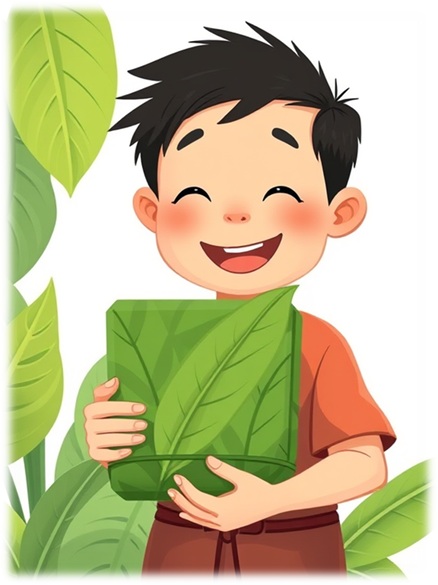
Emperor Hùng Vương, a wise and benevolent ruler, had many sons. Some were scholars, their minds sharpened by the classics, while others were warriors, their bodies honed by the art of combat. Yet, the youngest prince, Tiết Liệu, stood apart.
He had no desire for the court’s grandeur or the thrill of battle. Instead, he found solace in the countryside’s simplicity, where he lived with his devoted wife and their children, working side by side to cultivate the land.
One crisp winter morning, as the year waned and the first whispers of spring lingered in the air, the Emperor summoned his sons to the grand palace.
The hall was adorned with shimmering silk banners, and the scent of incense wafted through the air. With a voice that carried the weight of authority, the Emperor declared:
“The one who presents me with the most extraordinary and meaningful dish shall inherit my throne and become the new Emperor.”
The princes, eager to prove their worth, scattered across the kingdom in search of the rarest and most exquisite delicacies.
Some ventured deep into the forests, where the trees whispered ancient secrets and returned with pheasants, wild boar, and exotic mushrooms.
Others braved the tempestuous seas, their ships cutting through frothy waves, to bring back treasures from the ocean’s depths: lobsters, abalone, and fish that glimmered like jewels.
Tiết Liệu, however, remained true to his roots. He returned to the countryside. As he walked through his land, he paused by a field of glutinous rice.
He plucked a few grains and held them in his palm, feeling their warmth and inhaling their earthy, sweet aroma.
At that moment, he was struck by an idea: a way to honour not only his father but also the land and the people who toiled upon it. With the help of his family, Tiết Liệu harvested the rice.
His wife, her hands skilled and steady, ground the grains into a fine flour, while their children gathered banana leaves to wrap the cakes.
Together, they worked late into the night, their laughter and chatter filling the humble kitchen.
The round cake, made from glutinous rice, was soft and chewy, a symbol of the heavens. The square cake, filled with rice and mung beans and wrapped in leaves, represented the earth.
Tiết Liệu named them Bánh Dày and Bánh Chưng, respectively. The family marvelled at their creations, their hearts swelling with pride.
On the first day of spring, the princes gathered in the palace courtyard, their offerings displayed on ornate platters. One presented a dish of steamed fish and forest mushrooms, its aroma rich and inviting.
Another unveiled a roasted peacock, its feathers fanned out in a dazzling display. When Tiết Liệu stepped forward, he carried the Bánh Chưng in his hands, while his wife followed with the Bánh Dày.
The other princes exchanged smirks and whispered among themselves, dismissing the humble rice cakes as unworthy of the Emperor’s attention.
But Tiết Liệu stood tall, his heart steady with quiet confidence. The Emperor tasted each dish, his expression thoughtful. When he finally sampled the Bánh Chưng and Bánh Dày, his eyes lit up with understanding.
He turned to his sons and declared, “Tiết Liệu’s gifts were not only pure but also deeply meaningful, embodying the values of humility and gratitude.
He has used rice, the sustenance of our people, to create something that honours both the heavens and the earth. His humility and wisdom make him worthy of the throne.”
With those words, the Emperor abdicated his throne and placed the crown upon Tiết Liệu’s head. The other princes, humbled by their brother’s wisdom, bowed in respect. From that day forward, Bánh Chưng and Bánh Dày became symbols of the Lunar New Year, reminding everyone of the importance of humility, family, and gratitude for the land that sustains us.