
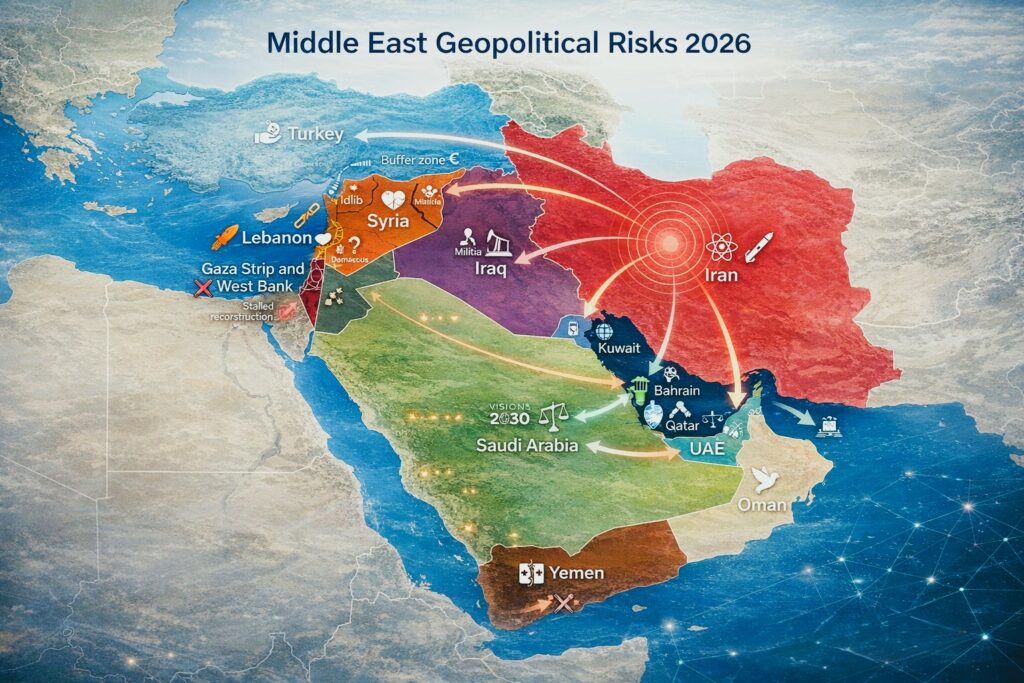
On 28 February 2026, the Middle East witnessed one of the most consequential escalations in recent decades as the United States and Israel launched coordinated military strikes against Iran. Characterised in official statements and open-source reporting as large-scale pre-emptive operations targeting Iranian military and governmental infrastructure, the strikes represent a critical inflexion point in a protracted confrontation shaped by nuclear anxieties, regional proxy conflicts and strategic deterrence calculations.
I. The Immediate Crisis: Operational Context and Strategic Objectives
The joint offensive—referred to in various accounts under operational designations such as Operation Lion’s Roar and Operation Epic Fury—reportedly struck multiple high-value targets in Tehran and other urban centres during the early hours of 28 February. These included military command facilities, intelligence installations and sites associated with Iran’s ballistic missile programme. The scale and coordination of the strikes indicate a deliberate attempt to degrade Iran’s strategic capabilities rather than to conduct a symbolic or limited punitive action.
Tehran responded rapidly with ballistic missiles and unmanned aerial vehicles directed towards Israeli territory and United States military installations across the Gulf region, including bases in Bahrain, Qatar, Kuwait and the United Arab Emirates. Several states temporarily closed civilian airspace, and emergency protocols were enacted within Israel. The reciprocal nature of these actions underscores the transition from covert shadow conflict to overt interstate confrontation.
From Washington and Jerusalem’s perspective, the operation seeks to neutralise what is framed as an existential threat posed by Iran’s strategic weapons development and its support for regional proxy networks. For Tehran, the strikes constitute a violation of sovereignty and a direct challenge to regime stability. This divergence in threat perception renders rapid de-escalation particularly complex.
II. Regional Reactions and Strategic Alignments
a. European Union and Western Allies
The European Union has adopted a measured and predominantly diplomatic posture. Senior EU officials have called for restraint, de-escalation and adherence to international law, reflecting Europe’s enduring commitment to negotiated solutions concerning Iran’s nuclear activities. European capitals are acutely aware that sustained hostilities could destabilise energy markets, intensify migratory pressures across the Mediterranean and undermine continental security frameworks already strained by other geopolitical crises.
While transatlantic solidarity remains a structural feature of European foreign policy, there is visible reluctance to endorse a prolonged military campaign. The European strategic calculus prioritises containment and diplomatic re-engagement over escalation.
b. Gulf Arab States
Member states of the Gulf Cooperation Council occupy a precarious strategic position. Hosting American military assets while maintaining complex economic and political relationships with Iran, they face the dual imperative of deterrence and de-risking. Governments in Saudi Arabia, the United Arab Emirates and Qatar have condemned attacks on their territory but remain cautious about deeper entanglement.
For these states, safeguarding critical energy infrastructure and domestic stability is paramount. A miscalculation could expose oil and gas facilities to retaliatory strikes, with severe domestic and international repercussions.
c. China
China has emphasised opposition to unilateral escalation and reiterated support for diplomatic resolution. Beijing’s strategic priorities are clear: the preservation of regional stability, the maintenance of uninterrupted energy flows, and the avoidance of confrontation with the United States. As a principal trading partner for both Iran and several Gulf states, China possesses economic leverage but exercises it cautiously, mindful of intensifying Sino-American rivalry.
China’s approach is therefore characterised by rhetorical condemnation of escalation combined with pragmatic hedging to protect energy security and commercial interests.
d. Russia
Russia has criticised the U.S.–Israeli action as destabilising and contrary to international norms. Moscow’s regional posture—shaped by security cooperation, arms transfers and strategic access—aligns it broadly with resistance to Western military intervention. Nevertheless, Russia must balance solidarity with Tehran against its broader global strategic considerations, including relations with Gulf energy producers and ongoing geopolitical contests elsewhere.
e. Wider Global South Responses
Several states across Asia, Africa and Latin America have expressed concern regarding the escalation, calling for immediate cessation of hostilities. Countries such as Pakistan have highlighted the humanitarian risks and the destabilising implications for global peace. These responses reflect a broader apprehension within the Global South about great-power confrontation unfolding in strategically vital regions.
III. Broader Implications of a Prolonged Escalation
1. Economic Dislocation and Energy Market Volatility
Iran and the Persian Gulf collectively represent a cornerstone of the global energy system. Any sustained disruption—whether through damage to infrastructure, maritime insecurity in key transit routes, or precautionary supply reductions—could precipitate sharp increases in oil and gas prices. Such volatility would reverberate globally, intensifying inflationary pressures, raising industrial production costs and constraining growth, particularly in energy-importing economies.
Financial markets typically respond to geopolitical instability with heightened risk aversion, currency fluctuations and shifts towards safe-haven assets. Prolonged uncertainty would therefore extend beyond commodity markets into broader macroeconomic instability.
2. Geopolitical Realignment and Shifting Alliances
Extended hostilities could accelerate the reconfiguration of regional security architectures. States may pursue diversified defence partnerships, expand indigenous military capabilities or recalibrate diplomatic alignments. Rival powers might deepen involvement through indirect support, thereby entrenching bloc-based competition.
Such realignment risks institutionalising polarisation across the Middle East and embedding instability into the international system.
3. Humanitarian and Societal Impact
Beyond strategic calculations lies the human cost. Civilian casualties, displacement, infrastructure degradation and economic contraction erode social cohesion and institutional resilience. A protracted war could generate new refugee flows and strain humanitarian agencies already operating under resource constraints.
4. Nuclear Proliferation Risks
Perhaps most concerning is the potential erosion of nuclear non-proliferation frameworks. If diplomatic monitoring mechanisms collapse amidst military confrontation, incentives for regional actors to pursue independent deterrent capabilities may intensify, undermining decades of non-proliferation efforts.
IV. Pathways Towards De-Escalation and Conflict Resolution
Despite the prevailing military dynamic, several avenues remain theoretically viable:
- Multilateral Diplomacy: Revitalising negotiations under the auspices of the United Nations or a contact group, including regional stakeholders, to restore communication channels and establish confidence-building measures.
- Regional Security Dialogue: Developing an inclusive Middle Eastern security framework capable of addressing missile proliferation, proxy conflicts and maritime security.
- Calibrated Economic Mechanisms: Linking sanctions relief or economic incentives to verifiable compliance measures to align strategic restraint with tangible benefits.
- Humanitarian Safeguards: Prioritising civilian protection agreements and maintaining functional communication channels to mitigate humanitarian deterioration.
V. Timeline of Developments Leading up to 28 February 2026
2018–2020: Collapse of Nuclear Diplomacy and Strategic Friction
- 2018: The United States withdrew from the Joint Comprehensive Plan of Action (JCPOA), reimposing sanctions on Iran and triggering a gradual deterioration in diplomatic engagement.
- 2019–2020: Heightened tensions in the Gulf, including tanker incidents and targeted strikes against regional energy infrastructure, increased the risk of miscalculation.
2021–2023: Nuclear Concerns and Proxy Escalation
- Negotiations to revive nuclear constraints stalled intermittently, while Iran expanded uranium enrichment capacity and advanced missile development.
- Proxy confrontations intensified across Syria, Iraq and the Red Sea theatre, involving actors aligned with Iran and security responses from Israel and U.S. forces.
2024: Regional Polarisation and Deterrence Posturing
- Israel reportedly expanded contingency planning for pre-emptive strikes against Iranian strategic infrastructure.
- Gulf states, particularly Saudi Arabia and the United Arab Emirates, accelerated air defence integration amid concerns over missile and drone threats.
2025: Intensified Shadow Conflict
- Increased cyber operations, targeted assassinations and covert disruptions are attributed by analysts to the ongoing U.S.–Israel–Iran rivalry.
- Iran deepened strategic coordination with regional partners and expanded ballistic missile testing.
- Diplomatic channels between Tehran and Western powers remained fragile and largely indirect.
January–Mid February 2026: Escalatory Signals
- Intelligence warnings (publicly referenced in policy discourse) highlighted growing concerns over Iranian missile capability and nuclear latency thresholds.
- Military readiness levels rose across U.S. regional bases in the Gulf, including facilities in Qatar, Bahrain and Kuwait.
- Israel increased civil defence preparedness and emergency coordination.
Late February 2026: Immediate Pre-Crisis Phase
- Reports of heightened intelligence alerts and defensive repositioning across regional actors.
- Diplomatic mediation attempts by European and Asian interlocutors failed to produce a de-escalatory breakthrough.
- 28 February 2026: Coordinated U.S.–Israeli strikes on Iranian targets followed by Iranian missile and drone retaliation across the region, marking a transition from deterrence competition to open military confrontation.
VI. Country-by-Country Breakdown of Economic Exposure to the Crisis
🇪🇺 Europe (European Union)
Exposure Level: High (Indirect but Systemic)
The European Union is heavily exposed through:
- Energy imports (oil and LNG price sensitivity)
- Inflationary pressures linked to energy costs
- Trade disruptions through the Middle Eastern maritime routes
A prolonged crisis could revive inflationary cycles, slow post-crisis economic recovery, and increase defence expenditure across European economies, especially in Mediterranean states.
🇺🇸 United States
Exposure Level: Moderate (Strategic but Resilient)
The United States faces:
- Rising defence expenditure due to sustained regional deployments
- Market volatility and energy price transmission effects
- Risks to overseas military infrastructure
However, relative energy self-sufficiency and diversified supply chains mitigate direct economic vulnerability compared to energy-importing regions.
🇮🇱 Israel
Exposure Level: Very High (Direct Economic Shock)
Israel’s economy is directly affected through:
- Emergency mobilisation costs
- Reduced foreign investment during instability
- Disruptions to tourism, aviation and high-tech exports
Prolonged conflict could strain fiscal balances and redirect public spending towards defence and civil protection.
🇮🇷 Iran
Exposure Level: Severe (Structural and Immediate)
Iran faces the most acute economic exposure:
- Infrastructure damage risks
- Intensified sanctions and financial isolation
- Currency instability and inflation acceleration
Given pre-existing economic constraints, sustained conflict could deepen domestic economic contraction and reduce oil export capacity.
🇸🇦 Saudi Arabia
Exposure Level: High (Energy Infrastructure Risk)
As a leading oil exporter, Saudi Arabia’s exposure lies in:
- Vulnerability of oil facilities to missile or drone attacks
- Market volatility is affecting revenue projections
- Increased defence and security spending
Paradoxically, higher oil prices may boost short-term revenues while increasing long-term geopolitical risk.
🇦🇪 United Arab Emirates & 🇶🇦 Qatar (Gulf Financial Hubs)
Exposure Level: High (Geostrategic and Financial)
These economies face:
- Aviation and logistics disruptions
- Investor risk reassessment
- Threats to critical infrastructure and ports
Their role as global energy and financial hubs makes them highly sensitive to regional instability.
🇨🇳 China
Exposure Level: Very High (Energy Security)
China is one of the largest importers of Middle Eastern energy:
- Oil supply disruptions could affect industrial output
- Shipping instability through key maritime chokepoints
- Increased energy procurement costs
China’s strategic priority is therefore rapid stabilisation to protect long-term economic growth.
🇷🇺 Russia
Exposure Level: Mixed (Strategic Opportunity and Risk)
Russia may experience:
- Potential gains from higher global energy prices
- Increased geopolitical leverage
- Risks of a deeper confrontation with the Western blocs
Economically, Russia could benefit from energy market tightening while facing diplomatic and strategic constraints.
🇮🇳 India and Major Asian Importers
Exposure Level: High (Energy Import Dependence)
Countries such as India, Japan and South Korea depend heavily on Gulf energy supplies.
Consequences include:
- Inflation through energy import costs
- Trade balance deterioration
- Currency pressure in emerging markets
VIII. Global Economic Outlook Under Prolonged Escalation
If the crisis persists beyond the short term, the global economy could experience:
- Sustained oil price shocks and inflation resurgence
- Supply chain instability across maritime trade routes
- Defence-driven fiscal expansion in multiple regions
- Reduced global investment due to geopolitical uncertainty
In systemic terms, the crisis represents not merely a regional conflict but a strategic economic shock node capable of simultaneously affecting energy markets, financial stability, and geopolitical alignment.
Conclusion
The events of 28 February 2026 constitute more than a discrete military episode; they represent a structural rupture in Middle Eastern deterrence dynamics. The shift from calibrated shadow competition to overt interstate confrontation introduces a heightened probability of miscalculation, alliance realignment and systemic economic shock.
Whether this crisis evolves into a contained strategic confrontation or a prolonged regional war will depend on the interplay between military momentum and diplomatic intervention. The durability of international non-proliferation regimes, the stability of global energy markets and the credibility of multilateral institutions are now directly implicated.
In this context, de-escalation is not merely desirable but strategically imperative. Absent sustained diplomatic engagement and credible confidence-building mechanisms, the crisis risks entrenching a new phase of geopolitical fragmentation with enduring global consequences.
Sources
- Al Jazeera, “Multiple Gulf Arab states hosting US assets targeted in Iran retaliation”, 28 February 2026.
- Associated Press, “US and Israel launch major attack on Iran; Tehran responds with counterstrikes”, 28 February 2026.
- Axios, “US and Israel launch major strikes on Iran: Strategic context and implications”, 28 February 2026.
- Canal 26, “La reacción de Irán tensa la situación en Medio Oriente: ataque a bases de EE.UU. en Kuwait, Qatar, Bahréin y Emiratos Árabes Unidos”, 28 February 2026.
- Europa Press, “Consejo de Seguridad de la ONU se reunirá de emergencia para tratar ataques de EEUU e Israel a Irán”, 28 February 2026.
- EuroPress, “Rusia tilda de planeada y no provocada la ofensiva militar de EEUU e Israel contra Irán”, 28 February 2026.
- Hurriyet Daily News, “Iran’s neighbours fear consequences of US-Israeli strikes”, 28 February 2026.
- Reuters, “Israel says it launched pre-emptive attack against Iran”, 28 February 2026.
- Statements and briefings from officials of the United States, Israel, Iran and the European Union released 28 February 2026.
- The Guardian, “Iran vows ‘no leniency’ as it launches reprisal attacks on Israel and US air bases”, 28 February 2026.
- Times of India, “Flights disrupted as airspace closures follow US-Israel strikes on Iran”, 28 February 2026.
- Le Monde, “US strikes on Iran reignite fears of rising oil prices”, 28 February 2026.
- Wikipedia, “Operation Lion’s Roar (2026 Israeli–United States military action against Iran)”, 28 February 2026.