
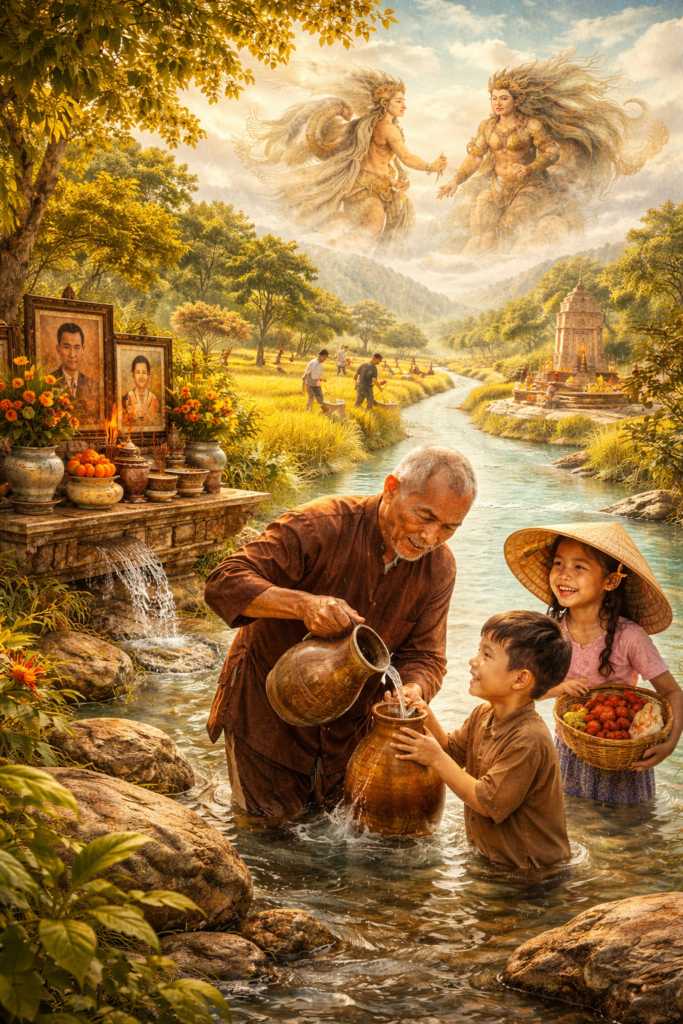
Uống nước nhớ nguồn: Memory, Gratitude, and the Soul of Vietnam
In Vietnam, wisdom often arrives quietly, wrapped in the simplicity of everyday language. A proverb spoken by a grandmother beside a cooking fire, or by a teacher at the end of a lesson, can carry centuries of philosophy within a few words. Among these sayings, one stands out for its depth and beauty: “Uống nước nhớ nguồn.”
Literally translated, it means “When drinking water, remember its source.” Yet for Vietnamese people the phrase is far more than poetic imagery. It expresses an ethical compass, a way of understanding the relationship between past and present, between individual and community. It is a reminder that nothing we enjoy today exists without the efforts, sacrifices, and wisdom of those who came before us.
To drink water without remembering the spring from which it flows would be, in Vietnamese thought, to forget our place in the great current of life.
The Image of Water
Vietnam is a land shaped by water. Rivers thread through its mountains and plains; rice fields depend on delicate irrigation; and the lives of millions unfold along riverbanks and canals.
In the vast waterways of the Mekong Delta, dawn arrives with the quiet rhythm of paddles striking water and the distant hum of boat engines heading toward floating markets. Here, water is not merely a resource; it is a companion to daily life.
Perhaps it is no coincidence that a proverb about gratitude is expressed through the image of water. When villagers once drank from wells or springs, the source of the water was visible and tangible. People knew that the clear stream flowing through their fields began somewhere in the forested hills.
The metaphor naturally evolved: just as water has a source, so too do the blessings of life.
Education has its teachers.
Prosperity has its builders.
Freedom has its defenders.
And life itself has its ancestors.
Roots in Vietnamese Moral Tradition
The principle expressed by Uống nước nhớ nguồn is deeply connected to Vietnam’s moral traditions, influenced by centuries of Confucian philosophy, indigenous spiritual beliefs, and the agricultural rhythms of rural life.
In Confucian ethics, gratitude toward parents and ancestors—known as filial piety—is considered the foundation of moral society. Vietnamese culture adopted and transformed these ideas, blending them with local customs of ancestor veneration.
In nearly every Vietnamese home, one finds an altar dedicated to ancestors. A framed photograph of grandparents or great-grandparents may stand beside incense burners and small offerings of fruit or tea. During important occasions—Tet, weddings, or the birth of a child—families light incense to invite their ancestors to share in the moment.
These rituals are not merely symbolic. They reflect a worldview in which the living and the dead remain connected through memory and respect.
To forget one’s ancestors would be to sever the roots of identity itself.
The Legend of the Nation’s First Ancestors
Vietnamese memory reaches even further back, beyond family lines to the mythical origins of the nation.
According to legend, the Vietnamese people descend from the union of a dragon lord named Lạc Long Quân and a mountain fairy called Âu Cơ.
The story tells that Âu Cơ gave birth to a miraculous sac containing one hundred eggs, from which emerged one hundred children. These children became the ancestors of the Vietnamese people.
Because the dragon belonged to the sea and the fairy to the mountains, the couple eventually separated. Fifty children followed their father toward the coast, while fifty followed their mother into the highlands.
Their eldest son later became the first of the legendary rulers known collectively as the Hùng Kings, who established the ancient kingdom of Văn Lang thousands of years ago.
Whether historical or mythical, this story continues to shape Vietnamese identity. It expresses the idea that all Vietnamese share a common origin—descendants of dragons and fairies, children of both sea and mountains.
And every year, this origin is remembered.
Honouring the Hùng Kings
High in the hills of northern Vietnam stands a sacred complex known as Hùng Temple. Here, among ancient trees and stone stairways, the Vietnamese people honour their earliest ancestors.
Each year, during the Hùng Kings’ Temple Festival, millions of pilgrims travel from every corner of the country to pay tribute to the legendary founders.
Families carry offerings of rice cakes, fruit, and incense. Children follow their parents up the long stairways leading to the temple, learning the story of their origins along the way.
The atmosphere is both solemn and festive. Traditional music echoes through the forested hills, while banners and lanterns sway gently in the breeze.
The message repeated during the celebration echoes the ancient proverb:
“Dù ai đi ngược về xuôi
Nhớ ngày giỗ Tổ mùng mười tháng ba.”
Roughly translated, it means:
Wherever people may travel, they should always remember the tenth day of the third lunar month—the day of the ancestors.
This collective act of remembrance embodies the spirit of Uống nước nhớ nguồn on a national scale.
Remembering Sacrifice
The principle of remembering the source also appears in modern Vietnamese history, particularly in the way the country commemorates those who sacrificed their lives in times of conflict.
One of the most solemn national observances is Vietnam War Invalids and Martyrs Day, dedicated to honouring soldiers and civilians who died in wars throughout the twentieth century.
Across the country, cemeteries are illuminated with candles and incense on this day. Families visit graves, local communities organise ceremonies, and schoolchildren learn about the sacrifices that shaped their nation.
In villages and cities alike, monuments bearing the names of fallen heroes remind people that the peace they enjoy today did not come without cost.
Again, the same moral principle echoes: when drinking the water of peace, remember those who protected its source.
Gratitude in Everyday Life
Yet the proverb does not belong only to temples or national ceremonies. Its deepest influence lies in everyday behaviour.
A student who returns years later to thank a former teacher is practicing Uống nước nhớ nguồn.
A successful professional who supports their parents and extended family reflects the same principle.
Even small gestures—such as remembering those who helped us during difficult times—express this cultural value.
In Vietnamese society, achievements are rarely seen as purely individual. Success is understood as the result of many contributions: parents who worked tirelessly, teachers who guided patiently, friends who offered encouragement.
Acknowledging those contributions is considered both a moral duty and a sign of humility.
Echoes Along the Mekong
The spirit of the proverb can perhaps be felt most vividly in the rural landscapes of southern Vietnam.
Along the winding canals of the Mekong Delta, life unfolds slowly, shaped by tides and seasons. Old wooden houses stand beside fruit orchards, while small boats glide between coconut palms.
Here, generations often live under the same roof. Grandparents tell stories of earlier times—years of hardship, years of rebuilding, years when the rivers were quieter and the skies seemed wider.
In the evenings, incense smoke curls upward from household altars while families gather for dinner. These simple moments connect the present with the past in quiet, unspoken ways.
The elders may not quote the proverb directly, yet their actions embody it. Every meal shared, every story told, every gesture of respect toward ancestors keeps the source of memory alive.
A Universal Truth
Although the proverb belongs to Vietnam, its wisdom resonates far beyond its borders.
Every culture carries its own version of this idea: remembering those who paved the way, honouring the sacrifices that built the present.
Yet the Vietnamese expression stands out for its poetic clarity. Water is essential to life, and its source—often hidden in distant hills—reminds us that what sustains us today began somewhere long before we arrived.
In a rapidly changing world, where cities expand and technology transforms daily life, the proverb remains surprisingly relevant. It reminds people to pause, to look backward even while moving forward.
Without memory, progress loses its meaning.
The River of Time
Perhaps the most beautiful way to understand Uống nước nhớ nguồn is through the image of a river.
A river flows endlessly toward the sea, carrying water through forests, valleys, and cities. At any point along its course, one might scoop a handful of water and drink.
But that water began its journey somewhere else—perhaps in a mountain spring, perhaps from rain falling on distant hills.
Human life follows a similar current. Each generation inherits the achievements and struggles of those before it. Knowledge, traditions, languages, and cultures all flow forward through time like water in a river.
Remembering the source does not mean living in the past. Instead, it means recognising the path that brought us here.
Conclusion
The Vietnamese proverb “Uống nước nhớ nguồn” captures a philosophy of gratitude that extends from family altars to national history and into everyday life.
It reminds people that behind every comfort lies a story, behind every achievement a lineage of effort, sacrifice, and love.
In the quiet act of drinking water, the proverb invites reflection:
Where did this water come from?
Who cleared the path that allows us to stand here today?
In Vietnam, the answer is always the same.
Look to the ancestors.
Look to the teachers.
Look to those who came before.
For somewhere, far upstream in the river of time, lies the source.