
Beliefs and Everyday Practices in Vietnam
Abstract
Superstitions in Vietnam constitute an important dimension of cultural life, reflecting a complex synthesis of indigenous animist traditions, Chinese philosophical systems, and later religious influences, including Buddhism. While modernisation and urbanisation have transformed Vietnamese society, many traditional beliefs concerning luck, spirits, and cosmic harmony remain embedded in everyday behaviour. This article examines the cultural and historical roots of Vietnamese superstitions and analyses their continued presence in daily practices. Drawing on examples from family life, domestic architecture, food customs, pregnancy taboos, and riverine traditions in the Mekong Delta, the article explores how such beliefs function not merely as irrational folklore but as symbolic systems that regulate social conduct, reinforce cultural identity, and mediate relationships between the visible and invisible worlds. Through a wide range of examples—from calling a beautiful baby “ugly” to avoid attracting spirits, to avoiding sweeping during the Lunar New Year, to rituals performed before launching a boat—the article demonstrates how superstition operates as an adaptive cultural framework shaped by centuries of historical experience and environmental context.
1. Introduction
Superstitions have long formed part of the cultural fabric of societies worldwide. In Vietnam, however, such beliefs occupy a particularly distinctive place within everyday life. Rather than existing solely as remnants of archaic traditions, many Vietnamese superstitions continue to influence language, behaviour, and social etiquette even in the modern era.
A complex interaction between multiple philosophical and religious traditions characterises Vietnamese society. Indigenous animist beliefs—rooted in the idea that natural elements such as mountains, rivers, and forests possess spiritual essences—predate the arrival of organised religions. Over the centuries, these beliefs were influenced by Confucianism, Taoism, and Mahayana Buddhism, introduced through cultural exchange with China. The result is a unique spiritual landscape in which ancestral reverence, cosmological balance, and veneration of the spirit coexist.
In this context, superstitions often serve as practical expressions of broader cosmological principles. They are not merely irrational fears but cultural mechanisms through which individuals attempt to maintain harmony with the unseen forces believed to shape human destiny. Many of these beliefs relate to moments of perceived vulnerability—birth, illness, travel, or the start of a new year—when the boundaries between fortune and misfortune appear particularly fragile.
This article explores a wide range of Vietnamese superstitions, examining both their historical origins and their contemporary manifestations. Particular attention is given to examples drawn from the Mekong Delta, a region where riverine life has generated distinctive beliefs associated with water spirits, fishing practices, and navigation.
By analysing these practices within their broader cultural context, the article seeks to demonstrate that Vietnamese superstitions function as symbolic expressions of a worldview in which human life remains intimately connected with the spiritual environment.
2. Historical and Cultural Origins of Vietnamese Superstitions
Understanding Vietnamese superstitions requires consideration of the cultural traditions from which they emerged. Three major influences are particularly significant: animism, Confucianism, and Taoist cosmology.
2.1 Animist Foundations
Before the arrival of organised religions, early Vietnamese communities practised forms of animism in which natural elements were believed to possess spiritual identities. Rivers, mountains, forests, and even large trees were thought to be inhabited by spirits capable of influencing human fortune.
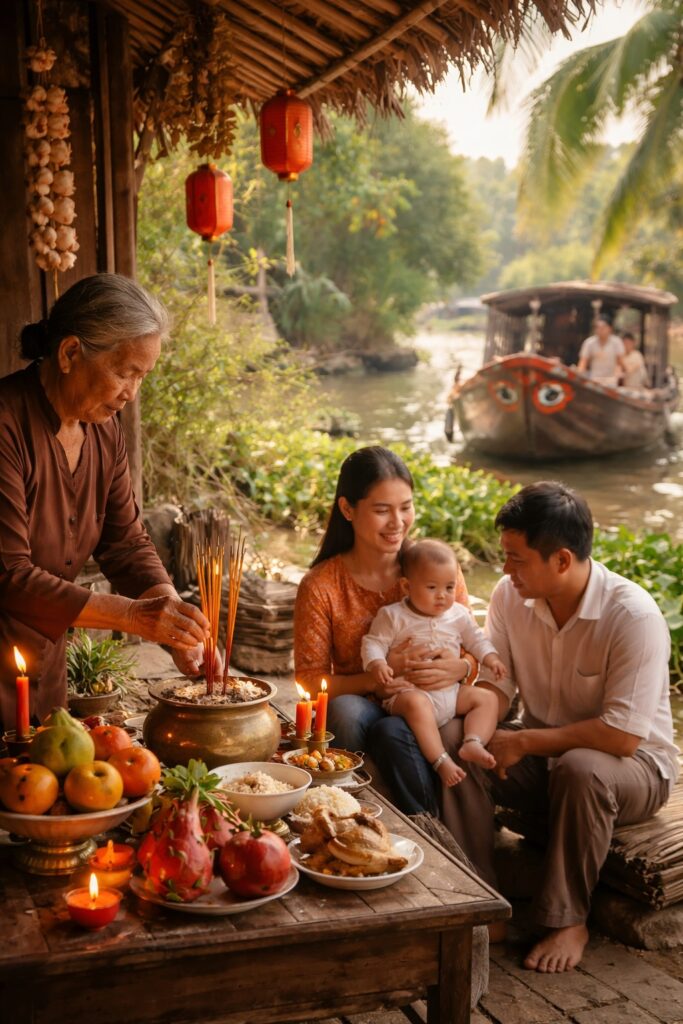
These beliefs remain visible today in the continued practice of offering incense and food to local guardian spirits or household deities. In rural areas, shrines dedicated to village spirits (thành hoàng) continue to play an important role in communal life.
Animist traditions also contribute to the widespread belief that the natural world must be treated with respect. Many superstitions concerning rivers, animals, and agricultural practices originate from this worldview.
2.2 Confucian Influence
Confucian philosophy, introduced during centuries of Chinese administration, emphasised social harmony, hierarchical relationships, and filial piety. One of its most enduring legacies in Vietnam is the practice of ancestor worship.
Within this framework, the deceased are believed to continue influencing the well-being of their descendants. Household altars dedicated to ancestors remain central features of many Vietnamese homes. Offerings of incense, fruit, and food are made regularly to maintain a harmonious relationship with the family’s spiritual lineage.
Superstitions concerning family rituals, funerary practices, and domestic etiquette often derive from these Confucian concepts of continuity between the living and the dead.
2.3 Taoist Cosmology and Feng Shui
Taoist philosophy introduced additional concepts related to cosmic balance and energy flow. Central among these is the notion that the universe operates through complementary forces, often described as yin and yang.
This cosmological framework influenced the development of phong thuỷ, the Vietnamese adaptation of feng shui. The practice involves arranging buildings and interior spaces in ways believed to promote harmonious energy flow.
Superstitions concerning mirrors, doorways, sleeping positions, and household layout often originate from these principles.
3. Superstitions Surrounding Birth and Childhood
The arrival of a newborn child has historically been considered a moment of great vulnerability. Infant mortality rates in pre-modern societies were high, and many cultures developed protective rituals intended to shield infants from supernatural harm.
In Vietnam, several superstitions reflect this concern.
3.1 Calling a Baby “Ugly”
One of the most widely recognised Vietnamese superstitions involves the seemingly paradoxical practice of describing a beautiful baby as “ugly”. According to traditional belief, praising a child’s beauty might attract the attention of jealous spirits capable of causing illness or misfortune.
To avoid this risk, relatives might deliberately use the opposite description. The statement is not meant literally; rather, it serves as a form of verbal protection designed to mislead malevolent forces.
Closely related to this custom is the phrase “trộm vía,“ often spoken after complimenting a baby. The phrase functions as a protective expression similar to the English “touch wood”.
3.2 Protective Silver Jewellery
Another traditional practice involves placing silver bracelets or anklets on infants. Silver has long been believed to possess protective qualities capable of repelling harmful spirits or absorbing negative energies.
In some households, the colour of silver jewellery is thought to reflect the child’s health, with tarnishing interpreted as a sign of illness or harmful influences.
3.3 Pregnancy Taboos
Pregnancy is also surrounded by numerous taboos intended to protect both mother and child. Traditional advice given to expectant mothers may include avoiding funerals, refraining from stepping over hammocks, and limiting visits to temples or certain ceremonial events.
Such restrictions reflect the belief that unborn children remain spiritually sensitive and that the mother’s experiences may influence the child’s future character.
4. Superstitions in Domestic Life
Superstitions also shape various aspects of everyday domestic behaviour, particularly those associated with the organisation of household space and family interactions.
4.1 Mirrors and Energy Flow
Mirrors are believed to influence the movement of spiritual energy within a house. Placing a mirror directly opposite the front door is often discouraged, as it may reflect incoming fortune out of the house.
At the same time, mirrors positioned near entrances are sometimes thought to repel evil spirits by reflecting them away.
4.2 Sleeping Positions
Another common belief concerns the direction in which a person sleeps. Sleeping with one’s feet pointing directly towards the door is considered inauspicious because this position resembles the way bodies are traditionally placed before burial.
The superstition illustrates how cultural associations with death and ritual practices can influence everyday habits.
4.3 Giving Sharp Objects as Gifts
Gifts such as knives or scissors are sometimes avoided because they symbolically “cut” relationships. If such objects are given, the recipient may offer a small coin in return, thereby transforming the exchange into a symbolic purchase and neutralising its negative implications.
5. Superstitions Related to Food and Fortune
Food holds profound symbolic significance in Vietnamese culture. Certain dishes are associated not only with nourishment but also with fortune and cosmological meaning.
5.1 Reversing Bad Luck with Fertilised Duck Eggs
One notable example is the fertilised duck egg known as hột vịt lộn. The word lộn suggests reversal or turning over, leading to the belief that consuming the dish may reverse a period of bad luck.
Tradition suggests that the eggs should be eaten in odd numbers to maximise their symbolic effect.
5.2 The Sacred Status of Rice
Rice occupies a central place in Vietnamese cultural identity. As a result, wasting rice or treating it disrespectfully is considered unlucky.
Some traditions discourage throwing rice into rivers or disposing of it carelessly, reflecting a cultural reverence for the staple crop that sustained generations of farmers.
6. Superstitions Associated with the Lunar New Year
The Vietnamese Lunar New Year, known as Tết Nguyên Đán, represents the most important festival in the Vietnamese calendar. The period surrounding the holiday is characterised by numerous symbolic practices intended to ensure prosperity in the coming year.
6.1 Avoiding Sweeping on New Year’s Day
Homes are typically cleaned thoroughly before the new year begins. However, sweeping the floor on the first day of the year is often avoided because it might remove newly arrived good fortune.
6.2 Choosing Auspicious Visitors
The first visitor to a household during the new year is believed to influence the family’s fortune for the months ahead. Many families, therefore, invite individuals considered lucky, prosperous, or harmonious to visit first.
7. Superstitions in the Mekong Delta
The Mekong Delta represents one of Vietnam’s most distinctive cultural regions. Its extensive network of rivers and canals has shaped both livelihoods and belief systems.
7.1 Respect for River Spirits
Many fishermen believe that rivers possess guardian spirits. Speaking disrespectfully about the river is therefore avoided, as it might provoke storms or accidents.
7.2 Rituals Before Launching Boats
Before using a newly built boat, families may perform rituals involving incense and food offerings. These ceremonies request protection from river spirits and safe journeys for those who will travel on the vessel.
7.3 Fishing Taboos
Stepping over fishing nets is considered unlucky because it symbolically disrespects the tools that sustain a fisherman’s livelihood. Some believe that fish will avoid nets that have been treated carelessly.
7.4 Omens on the River
Sudden silence among birds or unusual behaviour among animals is sometimes interpreted as a sign of approaching storms or supernatural disturbances. Such beliefs may reflect generations of environmental observation.
Floating markets, such as Cái Răng Floating Market, also contain their own commercial superstitions. Vendors often view the first sale of the day as a sign of how successful the day’s trade will be.
8. Animals and the Perception of Spirits
In Vietnamese folklore, animals are frequently believed to possess heightened sensitivity to the spirit world. Dogs howling at night or staring into empty spaces may be interpreted as signs that spirits are nearby.
Such beliefs appear across many cultures and may originate from the observation that animals often respond to subtle environmental cues that humans cannot easily detect.
9. Superstition in Contemporary Vietnam
Despite rapid modernisation, superstitions remain present in contemporary Vietnamese society. Cities such as Ho Chi Minh City and Hanoi have undergone profound economic transformation, yet traditional practices persist alongside modern lifestyles.
Many individuals may not explicitly claim belief in these customs, yet they continue to observe them out of habit or cultural respect. A person might jokingly avoid sitting at the corner of a table, refrain from sweeping on New Year’s Day, or whisper a protective phrase after praising a baby.
Rather than disappearing, superstitions have adapted to contemporary contexts, functioning as cultural traditions rather than strict spiritual doctrines.
10. Conclusion
Superstitions in Vietnam provide valuable insight into the cultural history and worldview of Vietnamese society. Far from being random or irrational, these beliefs form part of a coherent symbolic system rooted in centuries of interaction between animist traditions, philosophical doctrines, and environmental realities.
From household rituals and childbirth practices to riverine customs in the Mekong Delta, superstitions continue to shape behaviour and social etiquette in subtle but meaningful ways.
Even as Vietnam modernises, these beliefs remain significant not only as cultural heritage but also as expressions of a broader philosophy emphasising harmony between humans and the unseen forces of the universe.
In this sense, Vietnamese superstitions illustrate how traditional knowledge systems can persist within modern societies, offering continuity with the past while adapting to new realities.
References
Albanese, C. L. (2007). A republic of mind and spirit: A cultural history of American metaphysical religion. Yale University Press.
Cultural Atlas. (n.d.). Vietnamese culture: Religion and superstition. Retrieved from https://culturalatlas.sbs.com.au
Endres, K. W., & Lauser, A. (Eds.). (2011). Engaging the spirit world: Popular beliefs and practices in modern Southeast Asia. Berghahn Books.
Hoskins, J. (2015). The play of time: Kodi perspectives on calendars, history, and exchange. University of California Press.
Hunt, P. (2018). Vietnam: Culture Smart! The essential guide to customs and culture. Kuperard.
Jamieson, N. L. (1993). Understanding Vietnam. University of California Press.
Kleinen, J. (1999). Facing the future, reviving the past: A study of social change in a northern Vietnamese village. Institute of Southeast Asian Studies.
Luong, H. V. (2010). Tradition, revolution, and market economy in a north Vietnamese village, 1925–2006—University of Hawai‘i Press.
Malarney, S. K. (2002). Culture, ritual and revolution in Vietnam. University of Hawai‘i Press.
Nguyen, V. T. (2015). The Vietnamese worldview and ritual practices. Routledge.
Nguyen, V. H. (1998). The ancient civilisation of Vietnam. The Gioi Publishers.
Taylor, P. (2007). Modernity and re-enchantment: Religion in post-revolutionary Vietnam. Institute of Southeast Asian Studies.
Taylor, P. (Ed.). (2004). Goddess on the rise: Pilgrimage and popular religion in Vietnam. University of Hawai‘i Press.
The Culture Trip. (n.d.). Vietnamese superstitions people still believe. Retrieved from https://theculturetrip.com
Tran, K. (2017). Popular religion and ritual in Vietnam. Social Sciences Publishing House.
Turner, S., & Michaud, J. (2009). Imaginative travel: Culture and tradition in Vietnam. Routledge.
Vo, N. T. (2011). Saigon: A history. McFarland.