
Abstract
Relations between Cambodia and Thailand in 2026 are characterised by a complex interplay of historical grievances, economic interdependence, and evolving geopolitical pressures. While both states remain formally committed to peaceful coexistence under the framework of ASEAN, recent border tensions, maritime disputes, and strategic signalling—particularly through royal diplomacy and military posturing—highlight persistent fragility. This article analyses current dynamics, incorporating recent developments, including border clashes in late 2025, maritime security concerns in the Gulf of Thailand, and the regional implications of Thai diplomatic outreach.
1. Introduction
The bilateral relationship between Cambodia and Thailand has long oscillated between cooperation and confrontation. Rooted in territorial disputes, nationalist sentiment, and asymmetrical economic relations, tensions periodically resurface despite institutional mechanisms for conflict management.
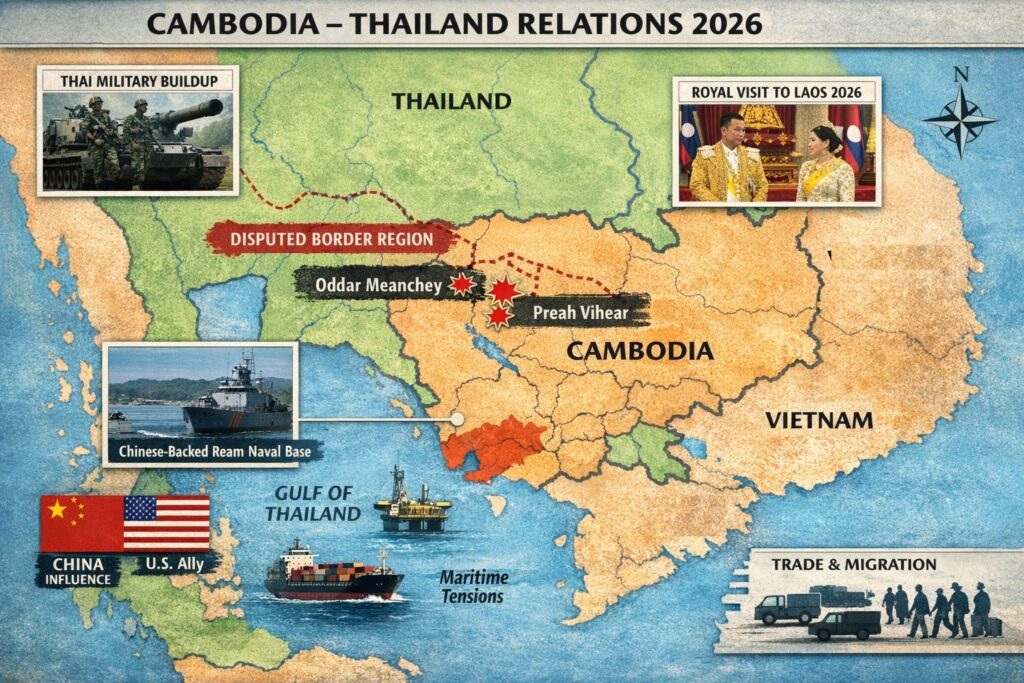
As of March 2026, relations have entered another sensitive phase. Events such as the Thai royal visit to Laos and renewed military preparedness along contested borders have reinforced perceptions in Phnom Penh that Bangkok’s regional diplomacy carries strategic implications beyond symbolic engagement.
2. Historical Context and Structural Tensions
Contemporary frictions cannot be understood without reference to earlier disputes, particularly those surrounding the Preah Vihear Temple. The ruling of the International Court of Justice in 1962, reaffirmed in 2013, granted sovereignty to Cambodia, yet the surrounding territory remains contested.
These disputes have fostered periodic military confrontations and entrenched nationalist narratives in both countries. Despite ceasefire agreements and joint boundary commissions, demarcation remains incomplete in several areas.
3. The 2025–2026 Border Crisis
The most recent escalation occurred in late 2025, involving provinces such as Oddar Meanchey and areas near Preah Vihear. Armed exchanges, troop deployments, and civilian displacement underscored the volatility of the frontier.
Although a ceasefire agreement was reached in December 2025, tensions persist due to:
- Continued military reinforcement on both sides
- Construction of defensive infrastructure, including proposed fencing by Thailand
- Limited progress in joint border demarcation mechanisms
The situation reflects a pattern of “managed instability,” where conflict is contained but not resolved.
4. Maritime Security and the Gulf of Thailand
A significant development in late 2025 was Thailand’s consideration of restrictions on fuel and military-related shipments to Cambodia via the Gulf of Thailand. While not fully implemented, the proposal raised concerns regarding freedom of navigation and economic security.
The Gulf of Thailand is a shared maritime space involving Cambodia, Thailand, Vietnam, and Malaysia. Any unilateral restrictions risk:
- Violating principles of international maritime law
- Disrupting regional supply chains
- Escalating tensions beyond bilateral confines
Cambodia has responded by emphasising preparedness to maintain maritime trade routes and safeguard national sovereignty.
5. Royal Diplomacy and Strategic Signalling
The foreign engagements of Maha Vajiralongkorn, including visits to China (2025) and Laos (2026), are formally framed as cultural and diplomatic initiatives. However, within the regional strategic context, they are interpreted as signalling mechanisms.
The 2026 visit to Laos—Thailand’s first royal visit there in over three decades—focuses on:
- Infrastructure development (e.g., cross-border connectivity projects)
- Trade and investment expansion
- Cultural diplomacy
For Cambodia, such engagements are closely monitored due to their potential indirect effects on regional alignments and economic corridors.
6. Economic Interdependence and Labour Dynamics
Despite political tensions, Cambodia and Thailand maintain significant economic ties:
- Thailand is a major investor in Cambodia’s energy, retail, and agro-industrial sectors
- Cross-border trade remains substantial
- Hundreds of thousands of Cambodian migrant workers are employed in Thailand
This interdependence creates mutual constraints against prolonged conflict. However, it also introduces vulnerabilities, particularly regarding labour policies and border closures during crises.
7. External Geopolitical Pressures
Regional dynamics are further shaped by great power competition and global economic conditions:
- China’s expanding influence in Cambodia through infrastructure and defence cooperation
- Thailand’s more diversified foreign policy balances China, the United States, and regional partners
- Global energy price volatility linked to conflicts in the Middle East
These factors intensify strategic calculations, especially in maritime and logistical domains.
8. ASEAN and Conflict Management
Both Cambodia and Thailand are members of ASEAN, which emphasises non-interference and consensus-based diplomacy. While ASEAN provides a framework for dialogue, its capacity to resolve bilateral disputes remains limited.
Conflict management has therefore relied primarily on:
- Bilateral negotiations
- Military-to-military communication channels
- Ad hoc ceasefire agreements
9. Current Outlook (March 2026)
As of 18 March 2026, Cambodia–Thailand relations can be characterised by three simultaneous trends:
- Strategic mistrust
Persistent suspicion regarding military intentions and diplomatic signalling - Economic pragmatism
Continued trade and labour interdependence act as stabilising factors - Controlled escalation risk
Ongoing military readiness without full-scale conflict
The interplay of these dynamics suggests that while large-scale war remains unlikely, periodic crises will continue.
10. Military Balance and Strategic Posture
The military asymmetry between Thailand and Cambodia remains a central structural factor shaping bilateral relations. Thailand possesses a significantly larger and more technologically advanced armed force, with estimates suggesting over 350,000 active personnel compared to approximately 200,000 in Cambodia
The 2025 border conflict highlighted these disparities. Thailand demonstrated superior capabilities in armour, air power, and logistics, while Cambodia relied more heavily on artillery and defensive positioning. Casualty reports and battlefield outcomes indicate that Thailand was able to secure key tactical positions in contested areas, reinforcing its conventional superiority.
However, Cambodia has adopted several strategies to offset this imbalance:
- Conscription policy (2026): Phnom Penh’s decision to activate long-dormant conscription laws reflects an effort to expand manpower and improve force readiness.
- Defensive territorial strategy: Emphasis on fortified border zones and use of difficult terrain (e.g., Dangrek Mountains)
- External security partnerships, particularly with China
Thailand, by contrast, has leveraged the crisis to reaffirm the political role of its military establishment domestically, reinforcing its influence in national security decision-making
The result is a deterrence imbalance: Thailand maintains escalation dominance, while Cambodia relies on asymmetric resilience and external backing.
11. China’s Role and Strategic Penetration
China has emerged as the most significant external actor shaping Cambodia’s strategic posture. Through infrastructure investment, defence cooperation, and political alignment, Beijing has deepened its influence in Phnom Penh.
A key example is the expansion of Ream Naval Base, widely interpreted by Western analysts as a potential dual-use facility supporting Chinese military access in the Gulf of Thailand.
China’s role in Cambodia–Thailand relations operates on three levels:
1. Strategic Infrastructure and Dependence
Chinese investment in ports, special economic zones, and transport corridors—particularly in Sihanoukville—has increased Cambodia’s economic dependence on Beijing. These projects are closely linked to the Belt and Road Initiative (BRI) and enhance China’s logistical reach in mainland Southeast Asia.
2. Security and Diplomatic Support
China has acted as a mediating actor during the 2025 crisis, participating in diplomatic efforts that contributed to restoring ceasefire conditions.
At the same time, Beijing views instability between Cambodia and Thailand as a risk to:
- Regional supply chains
- Maritime routes near the South China Sea
- BRI-related economic corridors
3. Regional Power Competition
The Cambodia–Thailand dispute intersects with the broader U.S.–China rivalry:
- Thailand remains a long-standing U.S. security partner
- Cambodia is increasingly aligned with China
This creates a geopolitical asymmetry, where bilateral tensions are indirectly influenced by great power competition.
12. Migrant Labour, Economic Interdependence, and Social Vulnerability
Labour migration represents one of the most critical yet underexplored dimensions of Cambodia–Thailand relations.
Before the 2025 crisis:
- Thailand hosted millions of foreign workers, including a large Cambodian population
- Cambodian workers constituted a significant share of labour in the construction, agriculture, and manufacturing sectors
Impact of the 2025 Conflict
The outbreak of hostilities triggered a mass exodus of Cambodian migrant workers, with estimates ranging from 400,000 to nearly 1 million returning home.
This had several consequences:
1. Economic Disruption
- Labour shortages in Thailand are prompting recruitment from alternative countries
- Reduced remittances affecting Cambodian rural households
2. Human Security Concerns
Reports indicate that Cambodian workers in Thailand faced:
- Harassment and violence
- Precarious legal status
- Limited access to protection mechanisms
3. Reintegration Challenges in Cambodia
Returning workers encountered:
- Unemployment
- Food insecurity
- Limited social safety nets
Structural Implications
Labour mobility functions as both:
- A stabilising factor (economic interdependence)
- A source of vulnerability (politicisation during crises)
The fragility of migrant labour systems underscores the need for:
- Bilateral labour agreements
- ASEAN-level protections
- Crisis-response mechanisms
13. Energy Security and Emerging Economic Pressures (2026 Update)
Recent developments in March 2026 further highlight Cambodia’s structural vulnerabilities. The country remains heavily dependent on imported fuel, with over 60% historically sourced from Thailand and Vietnam.
Amid global energy disruptions and regional tensions, Cambodia has:
- Increased fuel imports from Singapore and Malaysia
- Sought alternative suppliers such as Chevron and Total
- Explored LNG partnerships for long-term resilience
This situation reinforces the strategic importance of:
- Maritime access
- Stable relations with Thailand
- Diversification of supply chains
14. Conclusion
Cambodia–Thailand relations in 2026 illustrate a broader pattern in Southeast Asian geopolitics: the coexistence of rivalry and cooperation within a constrained regional order. Border disputes, maritime concerns, and diplomatic signalling—particularly through high-level state visits—continue to shape perceptions and policy decisions.
Ultimately, the durability of peace will depend on:
- Progress in border demarcation
- Adherence to international maritime norms
- Effective use of regional diplomatic mechanisms
Absent these, the relationship is likely to remain in a state of fragile equilibrium.
References (Harvard Style)
- AP News (2025) Cambodia will start military conscription next year as tensions with Thailand persist.
- Asia Centre (2025) Thailand–Cambodia: A war of memories.
- East Asia Forum (2025) Thai military leverages the border crisis to reassert its political influence.
- NUS Asia Research Institute (2026) Thailand–Cambodia conflict and migrant labour impacts.
- ReliefWeb (2026) Market situation update amid Cambodia–Thailand border conflict.
- Reuters (2025) Thailand turning to Sri Lankan workers to cope with Cambodian exodus.
- Reuters (2026) Cambodia says Thai troops still occupy civilian areas.
- Reuters (2026) Cambodia turns to Singapore, Malaysia for fuel imports.
- Special Eurasia (2025) Border clashes between Cambodia and Thailand: implications for China.
- The Khmer Today (2026) Cambodia Watches Closely as Thai Royals Visit Laos. The Khmer Today website (Accessed: 18 March 2026).
- Wikipedia (2026) 2025 Cambodian–Thai border crisis.
- Wikipedia (2025) Ream Naval Base.