
Resilience Amid Global Uncertainty
Abstract
In early 2026, Vietnam’s economy demonstrates notable resilience amid global economic fragmentation, geopolitical tensions, and protectionist trade measures. While many emerging economies have faced significant headwinds stemming from supply chain disruptions, monetary tightening, and declining global demand, Vietnam has sustained strong economic momentum. This paper examines key macroeconomic indicators—including GDP growth, foreign direct investment (FDI), tourism recovery, domestic consumption, and macroeconomic stability—arguing that Vietnam’s performance reflects both structural transformation and strategic adaptability. Particular attention is given to the country’s evolving role within global value chains, its ability to attract high-quality investment, and its proactive policy responses to external risks. The findings suggest that Vietnam is transitioning from a labour-intensive manufacturing hub to a more diversified, innovation-driven economy, positioning itself as a leading example of resilience among emerging markets.
1. Introduction
The global economic environment in 2026 is characterised by heightened uncertainty and fragmentation. The resurgence of protectionist trade policies, particularly those associated with U.S. tariff measures, has reintroduced barriers to international trade flows. Simultaneously, geopolitical tensions—including instability in the Middle East and strategic rivalry between major powers such as the United States and China—have contributed to volatility in energy markets, financial systems, and global supply chains.
Within Southeast Asia, additional regional complexities persist, including maritime disputes and intermittent tensions along land borders. These dynamics have collectively reshaped the global economic landscape, placing pressure on export-oriented economies and complicating investment decisions.
Against this challenging backdrop, Vietnam has emerged as a standout performer among emerging markets. Over the past decade, the country has consistently recorded high economic growth, driven by export-oriented manufacturing, rising domestic consumption, and greater integration into global trade networks. In early 2026, Vietnam’s economic trajectory remains firmly positive, supported by robust macroeconomic fundamentals and a strategic policy framework.
This paper seeks to analyse Vietnam’s economic performance through a comprehensive examination of key indicators and structural trends. It argues that Vietnam’s resilience is not merely a short-term phenomenon but rather the result of sustained institutional reforms, economic diversification, and effective engagement with global economic shifts.
2. GDP Growth and Structural Transformation
Vietnam’s GDP growth continues to rank among the highest globally. Following a strong expansion in 2025, growth projections for 2026 range between 6.5% and 7.5%, reflecting both external demand and domestic economic strength (World Bank, 2025). This performance is particularly noteworthy given the broader slowdown in global economic activity and declining growth rates in several advanced economies.
The composition of Vietnam’s GDP reveals a diversified economic structure. Industry and construction remain central pillars, driven by manufacturing exports and infrastructure development. However, the service sector has grown significantly in recent years, accounting for an increasing share of total output (Vietnam Briefing, 2026). This shift reflects broader structural transformation, as the economy moves beyond reliance on low-cost labour and basic manufacturing.
Manufacturing remains a key driver of growth, particularly in sectors such as electronics, textiles, and machinery. Vietnam has become a major exporter of consumer electronics, benefiting from supply chain diversification strategies adopted by multinational corporations. The relocation of production facilities from higher-cost regions has reinforced Vietnam’s role as a manufacturing hub.
At the same time, there is clear evidence of upgrading within the manufacturing sector. Firms are increasingly engaged in higher-value-added activities, including the assembly of complex products, research and development, and participation in global innovation networks. This transition is supported by government initiatives aimed at industrial modernisation and the adoption of technology.
The service sector has also expanded rapidly, driven by finance, retail, logistics, and digital services. The growth of e-commerce and digital platforms has transformed consumer behaviour, particularly in urban areas. As incomes rise and urbanisation accelerates, demand for services continues to increase, contributing to overall economic resilience.
Importantly, structural transformation has enhanced Vietnam’s ability to withstand external shocks. A more diversified economy is less vulnerable to fluctuations in specific sectors, thereby allowing greater stability during periods of global uncertainty.
Figure 1
Vietnam GDP Growth Rates (2020–2026). Source: Author’s illustration based on World Bank (2025) and Vietnam Briefing (2026).
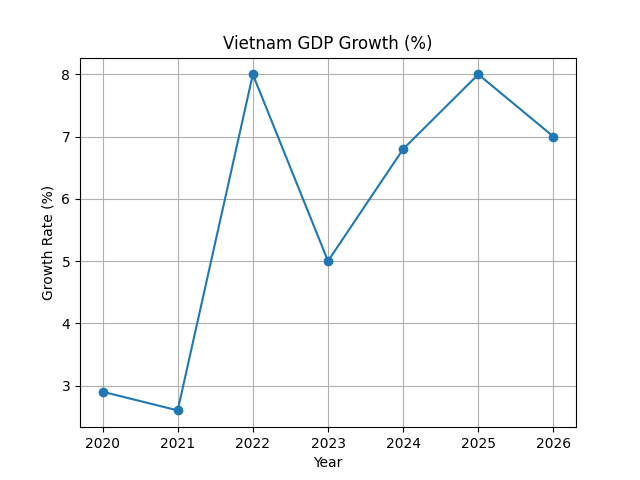
As illustrated in Figure 1, Vietnam experienced a sharp rebound following the COVID-19 slowdown, with growth peaking in 2022 and remaining robust thereafter. The sustained trajectory highlights resilience supported by manufacturing expansion and services growth.
3. Foreign Direct Investment Trends
Foreign direct investment remains a cornerstone of Vietnam’s economic success. In 2025, disbursed FDI exceeded USD 25 billion, marking a record high (KPMG, 2025). This trend has continued into 2026, with sustained investor interest across multiple sectors.
Several factors underpin Vietnam’s attractiveness as an investment destination. First, the country offers a competitive cost structure, including relatively low labour costs compared to regional peers. Second, it benefits from political stability and a favourable business environment. Third, Vietnam has actively pursued trade liberalisation by participating in major agreements, such as the Comprehensive and Progressive Agreement for Trans-Pacific Partnership (CPTPP) and the EU–Vietnam Free Trade Agreement (EVFTA).
A notable feature of recent FDI inflows is the shift toward higher-value-added sectors. Investments in semiconductors, renewable energy, and advanced manufacturing have increased significantly (Vietnam Investment Review, 2026). This reflects broader global trends, including the reconfiguration of supply chains and the growing importance of technological capabilities.
The “China+1” strategy has played a crucial role in shaping investment patterns. As multinational corporations seek to diversify production bases, Vietnam has emerged as a preferred alternative due to its strategic location, skilled workforce, and trade connectivity. Major global firms have expanded their operations in Vietnam, reinforcing its integration into global value chains.
Moreover, FDI has contributed to technology transfer, skills development, and productivity growth. The presence of foreign firms has facilitated knowledge spillovers, enabling domestic enterprises to upgrade their capabilities. This dynamic interaction between foreign and local firms is essential for long-term economic development.
However, challenges remain. Ensuring that FDI contributes to sustainable development requires effective regulation, environmental standards, and support for domestic industries. Vietnam’s policy framework increasingly emphasises quality over quantity in attracting investment, prioritising projects that align with national development goals.
Figure 2
Foreign Direct Investment Inflows into Vietnam (2020–2026). Source: Author’s illustration based on KPMG (2025) and Vietnam Investment Review (2026).
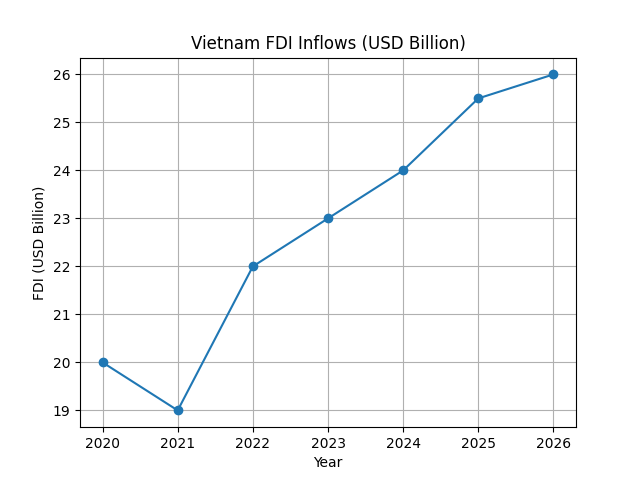
Figure 2 shows a steady upward trend in FDI inflows, reflecting strong investor confidence. The shift towards high-technology sectors reinforces Vietnam’s integration into global value chains.
4. Tourism Recovery and Domestic Demand
Vietnam’s tourism sector has experienced a strong recovery following the disruptions caused by the COVID-19 pandemic. By 2025, international arrivals had approached pre-pandemic levels, and this upward trend has continued into 2026 (Vietnam News Agency, 2026). The revival of tourism has significantly boosted the service sector, generating employment and supporting related industries such as hospitality, transport, and retail.
The government has implemented various measures to promote tourism, including visa liberalisation, marketing campaigns, and infrastructure improvements. These initiatives have enhanced Vietnam’s attractiveness as a destination, particularly for visitors from Asia and Europe.
Domestic tourism has also played an important role in the sector’s recovery. As incomes rise and living standards improve, Vietnamese consumers are increasingly able to travel domestically. This has helped sustain demand even during periods of external uncertainty.
Beyond tourism, domestic consumption has emerged as a key driver of economic growth. Rising incomes, urbanisation, and demographic trends have contributed to the expansion of the middle class. According to OECD projections, Vietnam’s middle-income population is expected to grow significantly over the coming decade (OECD, 2025).
This shift has important implications for economic structure. Increased consumption supports the development of retail, financial services, and digital platforms, creating new opportunities for businesses. It also reduces reliance on exports, enhancing economic resilience.
The expansion of consumer credit and financial inclusion has further supported domestic demand. Access to banking services and digital payment systems has improved significantly, enabling greater participation in the formal economy.
Figure 3
International Tourist Arrivals in Vietnam (2020–2026). Source: Author’s illustration based on Vietnam News Agency (2026).
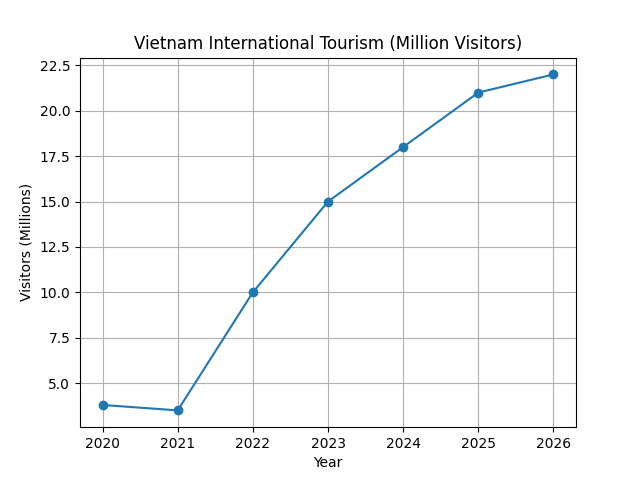
As shown in Figure 3, international arrivals have rebounded significantly, nearing and surpassing pre-pandemic levels. This recovery supports employment and consumption.
5. Macroeconomic Stability
Vietnam’s macroeconomic stability is a critical factor underpinning its economic performance. Inflation has remained relatively contained, averaging around 3–4% in recent years (KPMG, 2025). This reflects effective monetary policy and stable supply conditions.
Fiscal policy has also been managed prudently. Public debt levels remain within sustainable limits, providing the government with fiscal space to support economic growth. Investment in infrastructure, including transport networks and energy systems, has been prioritised to enhance productivity.
The labour market remains strong, with low unemployment rates and steady job creation (Vietnam News Agency, 2026). The expansion of manufacturing and services has generated employment opportunities, contributing to social stability and income growth.
Exchange rate stability has further supported economic performance. While global currency markets have experienced volatility, Vietnam has maintained relative stability, supporting trade and investment flows.
In addition, the government has pursued digital transformation as a key policy priority. Investments in digital infrastructure, e-government services, and innovation ecosystems are expected to enhance efficiency and competitiveness.
6. External Risks and Strategic Response
Despite its strong performance, Vietnam faces several external risks. Protectionist trade measures, particularly those associated with U.S. tariff policies, pose challenges to export-oriented industries. Geopolitical tensions in the Middle East have also contributed to fluctuations in energy prices, affecting production costs.
Regional dynamics add further complexity. Strategic rivalry between major powers and tensions within Southeast Asia have implications for trade routes, investment flows, and political stability.
Vietnam’s response to these challenges has been proactive and strategic. The country has sought to diversify export markets, reducing dependence on any single partner. Trade agreements with the European Union and other regions have expanded market access and mitigated risks (Asian Development Bank, 2025).
At the same time, Vietnam has strengthened its domestic economy, promoting industrial upgrading and supporting local enterprises. This dual approach—external diversification and internal strengthening—has enhanced resilience.
7. Infrastructure and Urban Transformation
Vietnam’s recent economic momentum is closely linked to a visible transformation in physical infrastructure and urban development. Large-scale public investment in transport systems, logistics corridors, and smart urban planning has become a defining feature of the country’s growth model in the mid-2020s.
Figure 4
Modern transport infrastructure and urban development in Ho Chi Minh City including metro systems, elevated roadways, and high-density skyline expansion.
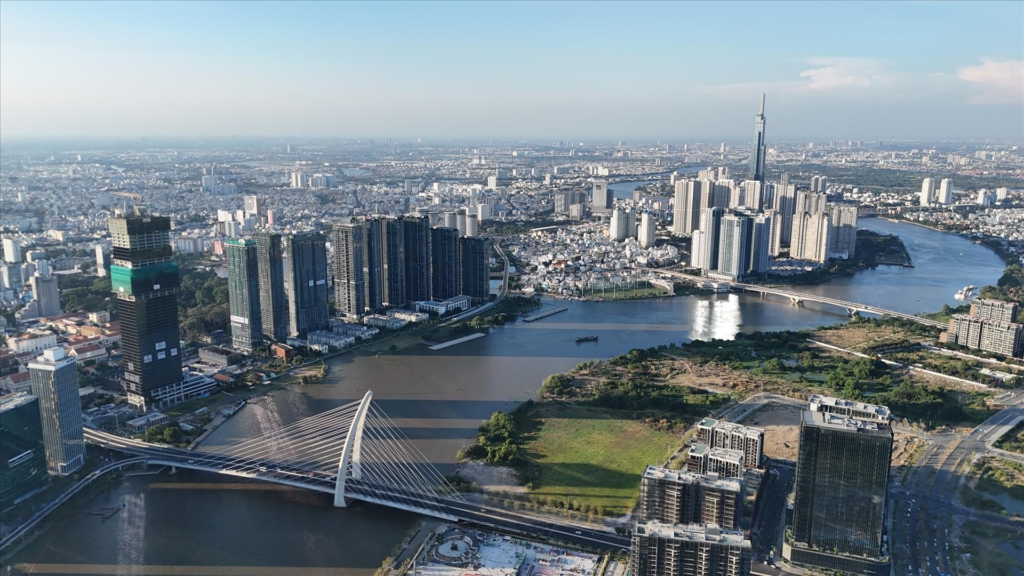
Source: Compiled from Vietnam News Agency, VOV, and infrastructure development reports (2025–2026).
As illustrated in Figure 4, Vietnam’s major urban centres—particularly Ho Chi Minh City and Hanoi—are undergoing rapid transformation. The expansion of metro systems, elevated highways, and integrated transport networks reflects a strategic effort to reduce congestion, improve productivity, and attract investment.
Infrastructure development plays a critical role in enhancing economic efficiency. Improved connectivity reduces logistics costs, facilitates trade, and supports the expansion of industrial zones. At the same time, modern urban planning contributes to the development of high-value service sectors, including finance, technology, and real estate.
These investments are not only economic but also symbolic. They signal Vietnam’s transition towards a modern, middle-income economy with global aspirations. The visible transformation of skylines and transport systems reinforces investor confidence and supports the country’s positioning as a regional hub for manufacturing and innovation.
Diplomatically, Vietnam has maintained a balanced approach, engaging constructively with multiple partners. This has allowed it to navigate geopolitical tensions while preserving economic opportunities.
8. Conclusion
Vietnam’s economic performance in early 2026 highlights the importance of adaptability and strategic vision in an uncertain global environment. The country’s sustained GDP growth, strong FDI inflows, recovery of tourism, and macroeconomic stability demonstrate a high degree of resilience.
More importantly, Vietnam is undergoing a process of structural transformation that is reshaping its economic model. The shift towards higher value-added activities, increased domestic consumption, and technological advancement positions the country for long-term growth.
While external risks remain, Vietnam’s proactive policy responses and diversified economic structure provide a solid foundation for continued success. As such, Vietnam represents a compelling example of how emerging economies can navigate global uncertainty while advancing towards greater economic sophistication.
References (APA Style)
Asian Development Bank. (2025). Asian Development Outlook 2025.
KPMG. (2025). Vietnam economic outlook 2026.
OECD. (2025). Economic outlook for Southeast Asia 2025–2027.
Vietnam Briefing. (2026). Vietnam’s economy in 2025: GDP, FDI, and trade.
Vietnam Investment Review. (2026). Foreign investment trends in Vietnam.
Vietnam News Agency. (2026). Tourism and economic performance update.
World Bank. (2025). Vietnam economic update.