
Introduction
The đàn tranh is one of Vietnam’s most emblematic traditional instruments, renowned for its delicate timbre, expressive flexibility, and deep cultural resonance. Often compared to the Chinese guzheng or the Japanese koto, the đàn tranh has evolved into a uniquely Vietnamese voice—one that reflects the country’s history, regional diversity, and artistic sensibility.
From royal courts to contemporary concert halls, the đàn tranh continues to embody both tradition and innovation, bridging centuries of musical expression.
Origins and Historical Development
The đàn tranh belongs to the family of Asian long zithers, with origins dating back over a millennium. While its early development was influenced by Chinese instruments such as the guzheng, the đàn tranh gradually acquired distinct characteristics within Vietnamese culture.
During the Lý and Trần dynasties, zithers similar to the đàn tranh were already present in court and ceremonial music. Over time, the instrument became integral to both elite and folk traditions, adapting to regional styles and evolving musical practices.
Originally featuring 16 silk strings, the đàn tranh has expanded in modern forms to include 17, 19, or 21 strings, allowing for greater tonal range and expressive capacity.
Structure and Design
The đàn tranh is a long, slightly curved wooden zither, traditionally crafted from resonant hardwoods such as paulownia.
Key features include:
- Strings: Originally silk, now metal or nylon-wrapped
- Movable bridges: Allow precise tuning and modal flexibility
- Convex soundboard: Enhances resonance
- Decorative craftsmanship: Lacquer, inlay, and traditional motifs
Its elegant design reflects both aesthetic refinement and acoustic sophistication.
Playing Technique
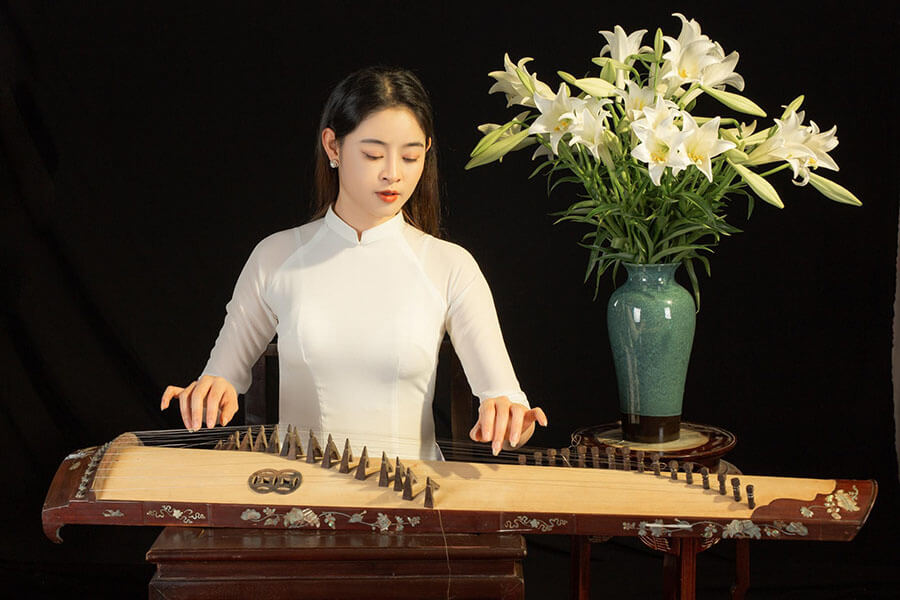
The đàn tranh is placed horizontally on a stand or table. The performer plucks the strings with the right hand, typically using finger picks, while the left hand manipulates pitch and tone.
Common techniques include:
- Pitch bending
- Vibrato
- Glissando
- Ornamentation
This interaction between both hands produces a highly expressive, almost vocal quality, enabling the instrument to convey a wide emotional spectrum.
Musical Styles and Repertoire
The đàn tranh is central to several Vietnamese musical traditions:
Court Music (Nhã nhạc)
A refined genre associated with imperial ceremonies, particularly in Huế.
Chamber Music
- Ca trù (northern tradition combining poetry and music)
- Đờn ca tài tử (southern, improvisatory style)
Folk Music
Widely used to accompany regional songs and storytelling.
Contemporary and Fusion Music
Increasingly present in global and experimental contexts.
Performance Contexts
The đàn tranh appears in diverse settings:
- Ceremonial rituals and festivals
- Traditional theatre (chèo, cải lương)
- Informal gatherings
- Concert performances
- Educational institutions
Its versatility allows it to function across both formal and intimate environments.
Melodic Characteristics
Vietnamese music often employs pentatonic scales, enriched by microtonal inflections.
Characteristic features include:
- Ornamented melodic lines
- Flexible rhythm
- Emotional nuance
- Modal improvisation
Regional styles further shape the instrument’s melodic identity.
Famous Pieces and Repertoire
Traditional Core Repertoire
- “Lưu Thuỷ” (Flowing Water) – graceful and fluid
- “Kim Tiền” (Golden Coin) – lively and rhythmic
- “Nam Ai” / “Nam Bình” – deeply expressive southern melodies
- “Lý Chim Quyên” – lyrical folk-inspired piece
Adapted Vietnamese Works (20th Century)
- Compositions by Văn Cao, such as “Mùa xuân đầu tiên”
- Songs by Trịnh Công Sơn, frequently arranged for đàn tranh
Contemporary Vietnamese Composers
- Nguyễn Thanh Thủy – avant-garde and experimental works
- Đỗ Hồng Quân – orchestral and national-style compositions
- Trần Mạnh Hùng – fusion of traditional and symphonic elements
- Nguyễn Thanh Tùng – expressive contemporary instrumental works
Modern Performance Repertoire
- “Tình ca xứ Huế” – evocative central Vietnamese style
- “Lý Cái Mơn” – southern folk and theatre tradition
- Contemporary fusion works combining đàn tranh with global genres
Famous Đàn Tranh Performers
Traditional and International Figures
- Nguyễn Thị Hải Phượng: A leading international ambassador of the đàn tranh, known for refined interpretations and educational outreach.
Academic and Conservatory Influence
- Vũ Thị Phương Anh: A key figure in the formal teaching and preservation of đàn tranh repertoire.
- Ngô Hồng Quang: A multi-instrumentalist contributing to the contemporary presentation of Vietnamese music.
Contemporary and Experimental Voices
- Nguyễn Thanh Thủy: A pioneer of avant-garde đàn tranh performance and global collaboration.
- Trần Quang Hải: An influential scholar supporting the study and dissemination of Vietnamese musical traditions.
Illustrations: The Đàn Tranh and Its Performance Contexts
Figure 1. The Đàn Tranh – Traditional Instrument View
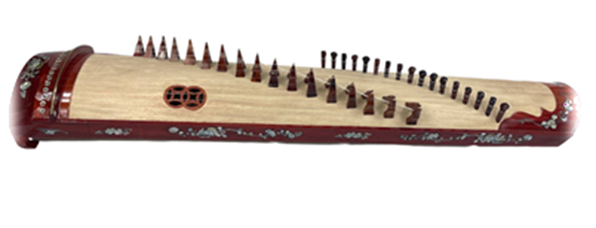
The elegant wooden body of a 16-string đàn tranh, showing traditional lacquer and decorative motifs.
Figure 2. Movable Bridges and Strings
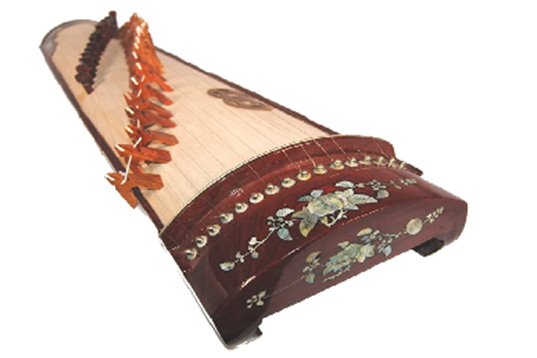
Close-up of the movable bridges and metal strings, essential for tuning and expressive microtonal bending.
Figure 3. Modern 21-String Đàn Tranh
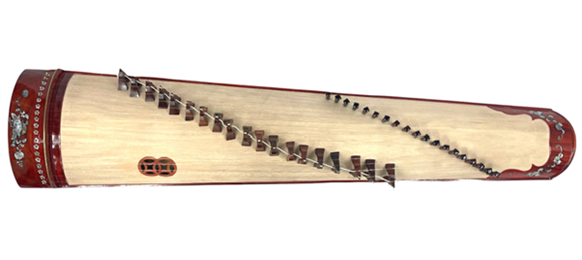
A contemporary version of the instrument with an extended range, allowing for more complex repertoire.
Figure 4. Playing Technique – Right Hand Plucking
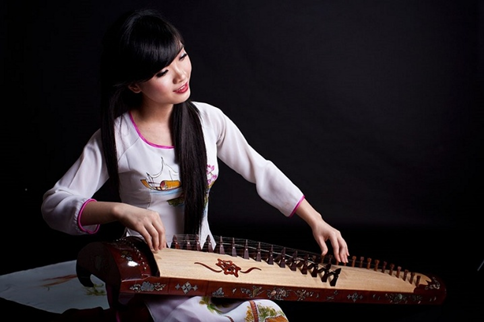
The performer plucks strings with finger picks, demonstrating the precision and delicacy required.
Figure 5. Playing Technique – Left Hand Expression
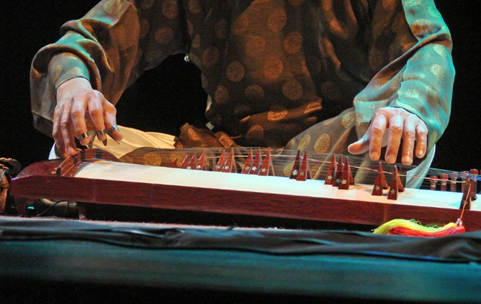
The left hand applies pressure on the strings for vibrato, pitch bends, and expressive ornamentation.
Figure 6. Traditional Performance Context
Classical performance of the đàn tranh in áo dài dress, reflecting court and chamber music traditions.
Recommended Recordings
- Nguyễn Thị Hải Phượng – Vietnamese Traditional Music
- Nguyễn Thanh Thủy – Contemporary and experimental works
- Vũ Thị Phương Anh – Classical repertoire recordings
- Court music recordings of Nhã nhạc (UNESCO Intangible Cultural Heritage)
- Southern đờn ca tài tử performances
Available on platforms such as YouTube and Vietnamese music archives.
Conclusion
The đàn tranh stands as a powerful symbol of Vietnamese cultural identity. Its sound—at once delicate and deeply expressive—captures the emotional and historical richness of Vietnam.
From ancient courts to modern experimental stages, the instrument continues to evolve, sustained by performers, composers, and educators who ensure its relevance in a changing world. The đàn tranh is not merely an artefact of the past, but a living tradition—one that continues to resonate across generations and cultures.
References
Bảo tàng Dân tộc học Việt Nam. (2024). Đàn tranh: Hiện vật và di sản văn hóa [Exhibition catalogue]. Hanoi: Vietnam Museum of Ethnology.
Đặng, T. H. (2007). Vietnamese traditional music. Hanoi: The Gioi Publishers.
Hoàng, T. (2025). Intangible heritage and the digital preservation of Vietnamese zither traditions. Journal of Southeast Asian Arts and Culture, 12(1), 44–61.
Nguyễn Thị Hải Phượng. (Various recordings). Vietnamese traditional music collections.
Nguyễn, T. T. (2015). Preservation and innovation in Vietnamese traditional music. Asian Music, 46(2), 85–102.
Nguyễn, T. T. (2024). Innovation in tradition: Contemporary đàn tranh performance. Hanoi: Nhà xuất bản Âm nhạc.
Phạm, M. H. (2026). The đàn tranh in fusion: New directions in globalised Vietnamese music. Asian Musicology, 38, 102–120.
Trần Quang Hải. (1990). Vietnamese music traditions and transformations. Paris: CNRS.
Trần, Q. H., & Lê, T. H. (2025). Pedagogy and transmission of the đàn tranh in twenty-first-century Vietnam. In T. C. Nguyễn (Ed.), Teaching and learning traditional music in Southeast Asia (pp. 155–172). Singapore: ISEAS Publishing.
Trịnh Công Sơn. (1970s–1990s). Selected songs and adaptations.
UNESCO. (2008). Nhã nhạc: Vietnamese court music. Retrieved from https://ich.unesco.org
UNESCO. (2024). Nhã nhạc: Vietnamese court music – Safeguarding status report. Retrieved from https://ich.unesco.org
Văn Cao. (1976). Mùa xuân đầu tiên.
Viện Âm nhạc Việt Nam. (2025). Tuyển tập các tác phẩm đàn tranh mới [Anthology of new works for đàn tranh]. Hanoi: Vietnam National Institute of Music.