
Tradition, Trade, and Quiet Transformation in U Minh
Introduction
In the southernmost reaches of Vietnam, the swamp forests of U Minh form one of the most distinctive ecological and economic landscapes in Southeast Asia. Dominated by Melaleuca cajuputi, locally known as tràm, these forests are not only environmental assets but also vital sources of livelihood. Traditionally used for fuel, construction, and agriculture, melaleuca wood has long supported rural communities. However, recent developments suggest that this seemingly timeless industry is undergoing subtle but significant change.
The Seasonal Rhythm of Melaleuca Trade
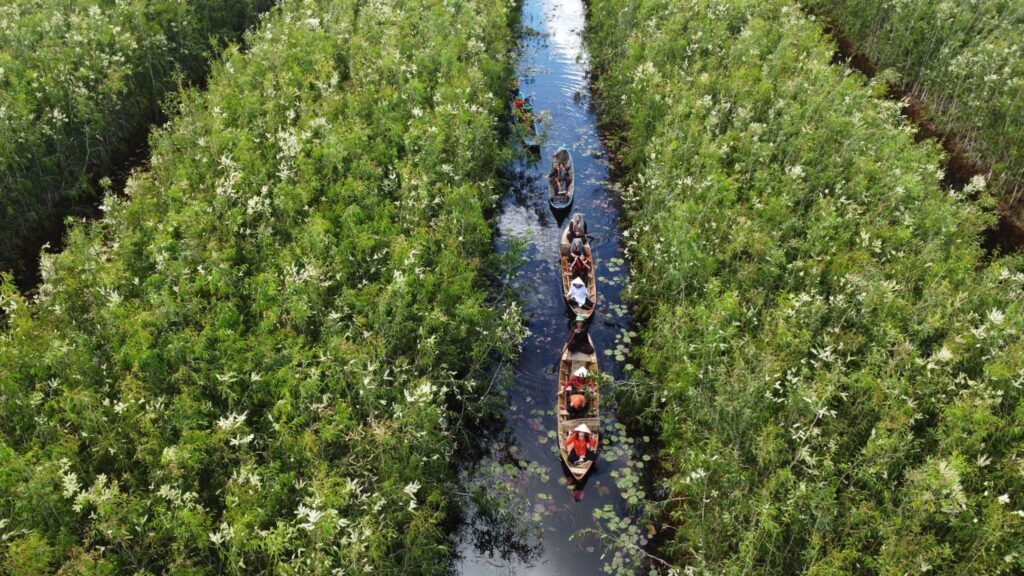
Each year, the dry season signals the peak of melaleuca harvesting and trading in U Minh, particularly in Cà Mau Province. According to recent reporting, waterways become busy corridors filled with boats transporting logs, while traders converge to purchase and redistribute the wood across the region (Tuoi Tre News, 2026).
This seasonal activity reflects a deeply rooted economic rhythm. Melaleuca wood is typically cut, bundled, and transported via canals—an efficient system shaped by the delta’s dense network of waterways. Once harvested, the wood moves quickly through these informal supply chains, reaching local markets and end users with remarkable efficiency.
Economic Importance for Local Communities
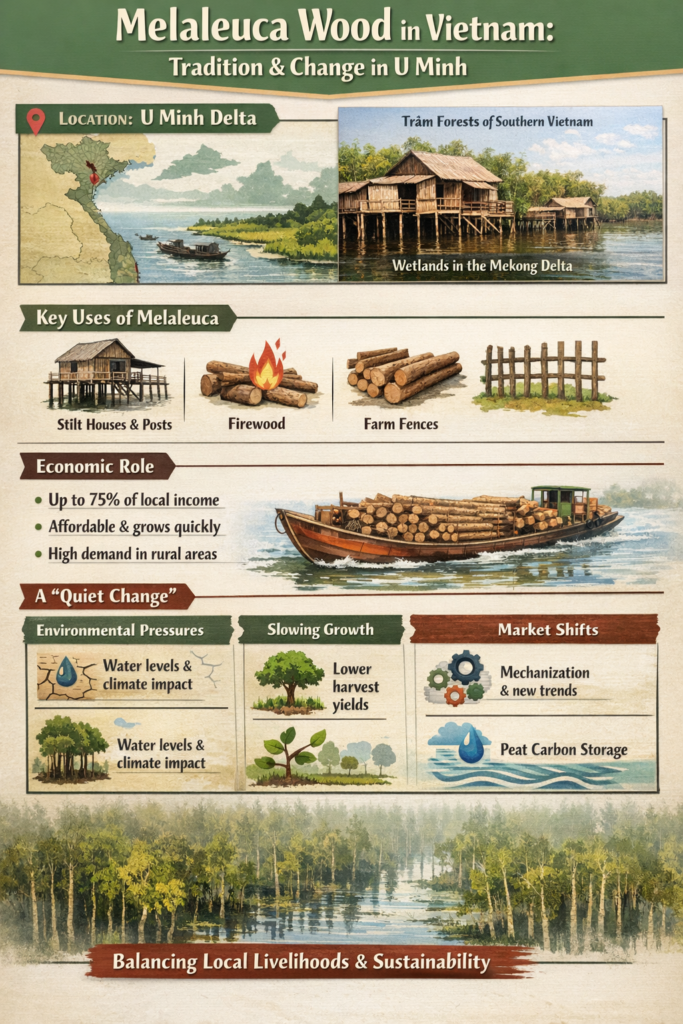
The melaleuca ecosystem has historically been central to local livelihoods. Studies indicate that forest-related activities, including timber harvesting, can account for a substantial share of household income in the U Minh region, in some cases contributing up to 75% of annual earnings (Vietnam Journal of Science and Technology, 2023).
Its economic value lies in several key characteristics:
- Affordability and accessibility: Melaleuca grows quickly in wet, acidic soils where other species struggle
- Durability in waterlogged environments: Ideal for posts and rural construction
- Energy utility: Widely used as firewood due to its high calorific value
This combination has made melaleuca indispensable in the Mekong Delta’s rural economy.
A Changing Landscape: Subtle Shifts in the Industry
Despite the apparent continuity of the trading season, recent observations highlight a “quiet change” unfolding in U Minh. While the visible activity of boats and traders remains, underlying dynamics are shifting (Tuoi Tre News, 2026).
Several factors contribute to this transformation:
1. Environmental Pressures
Melaleuca forests are closely tied to peatland ecosystems, which are highly sensitive to water management and climate change. Alterations in flooding patterns, fire prevention strategies, and soil chemistry can directly affect tree growth and forest health (Danh et al., 2025).
2. Resource Management and Sustainability
Efforts to prevent forest fires—such as maintaining high water levels—have had unintended ecological consequences, including slower tree growth and increased mortality rates in some areas (Danh et al., 2025).
3. Market Evolution
Although not always explicitly visible, the structure of demand and supply is gradually evolving. Mechanisation, changing labour patterns, and alternative materials may be influencing how Melaleuca is harvested, traded, and used.
Beyond Timber: Ecological Significance
Melaleuca forests are not merely economic assets; they are ecological keystones. The wetlands of U Minh are among the most important in the Mekong Delta, supporting biodiversity, regulating water systems, and storing carbon in peat soils accumulated over thousands of years (Dang et al., 2023).
Moreover, these forests provide habitat for numerous species and contribute to environmental resilience in a region increasingly vulnerable to climate change and sea-level rise.
Conclusion
The melaleuca trade in U Minh offers a compelling example of how traditional rural economies persist while adapting to modern pressures. On the surface, little seems to have changed: boats still glide through narrow canals, and timber continues to be traded as it has been for generations. Yet beneath this continuity lies a complex interplay of environmental, economic, and social transformation.
Melaleuca wood remains a symbol of practicality and resilience—perfectly suited to the flooded landscapes of the Mekong Delta. Its ability to grow quickly and circulate efficiently within local markets reinforces its enduring relevance. However, its future will depend on how effectively Vietnam balances economic needs with ecological sustainability in one of its most unique and fragile regions.
References
Danh, M., Thai, L. T., Ngo, T. V., & Tran, T. V. (2025). Assessing the sustainable development of carbon stock and Melaleuca forest growth in U Minh Thuong National Park after big fires in Vietnam. Research in Ecology, 7(4), 125–141. https://doi.org/10.30564/re.v7i4.10232
Dang, A. T. N., et al. (2023). Coastal Melaleuca wetlands under future climate and sea-level rise scenarios in the Mekong Delta. Environment, Development and Sustainability.
Tran, D. B., & Matusch, T. (2017). Restoration of the Melaleuca swamp ecosystem for bird diversity in the Mekong Delta of Vietnam. MOJ Ecology & Environmental Sciences, 2(6).
Tuoi Tre News. (2026, March 26). Busy melaleuca trading season unfolds in Vietnam’s U Minh amid quiet change. Retrieved from https://news.tuoitre.vn/
Vietnam Journal of Science and Technology. (2023). Economic valuation from direct use of the Melaleuca forest in the U Minh region