
Introduction
In contemporary Vietnam, few social phenomena capture the intensity of collective emotion as vividly as “đi bão.” Literally translating as “to go storming,” the phrase describes a uniquely Vietnamese form of spontaneous, large-scale street celebration, most often triggered by major football victories. Yet beyond its surface-level exuberance, “đi bão” represents a complex interplay of national identity, urban space, generational change, and emotional expression.
In early January 2025, following Vietnam’s dramatic 3–2 victory over Thailand in the ASEAN Championship final, millions of people flooded the streets across cities such as Hanoi and Ho Chi Minh City, waving flags, honking horns, and chanting “Việt Nam vô địch!” (Vietnam is champion). This was not merely a celebration—it was a nationwide emotional convergence.
This article examines “đi bão” as a cultural, sociological, and urban phenomenon, incorporating developments up to March 2026. It also reflects the growing debate surrounding the practice, including emerging critical perspectives as the phenomenon continues to evolve.
The Meaning and Evolution of “Đi bão”
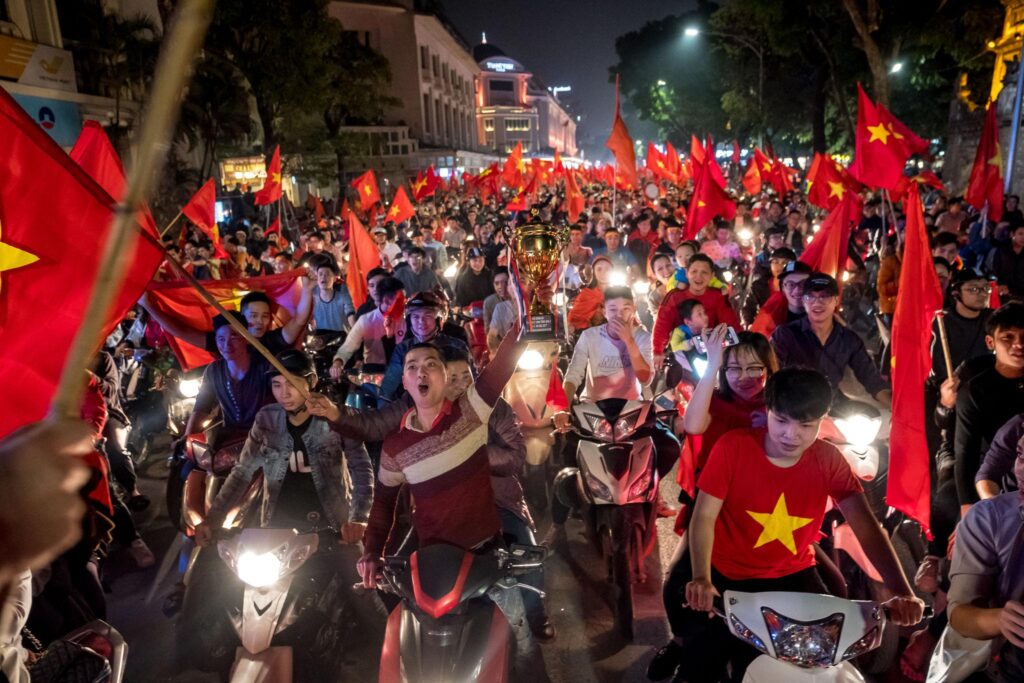
The expression “đi bão” evokes imagery of uncontrollable energy—a storm sweeping through cities. In practice, it refers to mass gatherings of people, predominantly on motorbikes, who circulate through urban streets in celebratory processions.
Although communal celebration has long existed in Vietnam, “đi bão” as a modern term gained prominence in the late 2000s, particularly following Vietnam’s success in regional football tournaments. Over time, it has evolved into a widely recognised cultural practice, closely associated with national sporting triumphs.
By the mid-2020s, “đi bão” had become not just a reaction, but an anticipated ritual—one that reflects the rhythms of contemporary Vietnamese society.
Football as Emotional Infrastructure
Football plays a central role in enabling “đi bão.” It is not merely a sport in Vietnam; it functions as a shared emotional language that transcends regional and social divisions.
Victories by the Vietnam national football team often trigger immediate, large-scale public celebrations. Matches are followed collectively, and the moment of victory sparks a rapid transition from private viewing to public participation.
In this sense, football acts as a form of emotional infrastructure, allowing millions of people to experience and express a shared emotional high simultaneously.
Motorbikes: Technology of Collective Movement
Motorbikes are central to the phenomenon. As the dominant mode of transport in Vietnam, they enable a uniquely mobile form of celebration.
During “đi bão,” motorbikes become more than vehicles—they are tools of expression. Riders wave flags, honk horns rhythmically, and move in large, flowing groups that transform the city into a living spectacle.
This mobility distinguishes “đi bão” from other forms of celebration around the world. Rather than gathering in a single location, participants create a moving, decentralised event that spreads across the entire urban landscape.
Urban Space Reimagined
“Đi bão” temporarily reshapes the very function of urban space. Streets typically associated with order, efficiency, and economic activity are transformed into vibrant arenas of emotional expression and collective identity. In these moments, the city is no longer merely a site of movement and commerce, but a living stage upon which national pride is performed.
From an urban sociological perspective, this transformation can be understood as a form of spatial reappropriation: citizens reclaim public space for symbolic, cultural, and emotional purposes. The everyday infrastructure of the city is repurposed into a shared landscape of celebration.
This dynamic is particularly visible in major urban centres. In Hanoi, areas such as Hoàn Kiếm Lake emerge as focal points, while in Ho Chi Minh City, wide boulevards and busy intersections become flowing rivers of red flags, movement, and sound.
Crucially, this reconfiguration of space remains open and inclusive. Unlike ticketed events or restricted venues, “đi bão” invites participation without barriers, reinforcing its character as one of the most accessible and democratic forms of collective experience in contemporary Vietnam.
Youth Culture and Digital Amplification
Vietnam’s youth are at the heart of “đi bão.” As a highly connected generation, they use digital platforms to coordinate, document, and amplify the experience.
Social media plays a crucial role, turning local celebrations into national—and even global—events. Videos and images circulate rapidly, extending the reach of “đi bão” far beyond the streets where it takes place.
For many young people, participation is also a form of identity expression. It reflects a desire to belong, to be visible, and to engage with public life in dynamic and meaningful ways.
National Identity and Symbolism
The visual and emotional language of “đi bão” is deeply national. The Vietnamese flag is omnipresent, and the colour red dominates the streets.
Chants such as “Việt Nam vô địch!” create a shared emotional rhythm, reinforcing a sense of unity. These moments exemplify what sociologists describe as collective effervescence—a state in which individuals feel connected to something larger than themselves.
In a rapidly globalising world, such expressions of identity take on added significance, reaffirming cultural cohesion.
Global Perception and Cultural Distinctiveness
International observers often describe “đi bão” as both surprising and captivating. Compared to similar celebrations elsewhere, it is often perceived as more inclusive and less confrontational.
Families, young people, and even older generations participate together, creating a multi-generational atmosphere that is relatively rare in large-scale public celebrations.
This has contributed to Vietnam’s growing cultural visibility, presenting an image of a society that is both dynamic and deeply communal.
Order, Regulation, and Emerging Responsibility
As “đi bão” has expanded, so too have concerns about safety and organisation. Large crowds and dense traffic can pose risks, particularly in major cities.
In response, authorities and participants alike have begun to adapt. Public awareness campaigns and informal norms have encouraged more responsible behaviour, including safer driving practices.
This reflects a broader trend: the gradual balancing of spontaneity with structure in an evolving urban society.
Criticism: Tensions and Challenges
Despite its many positive aspects, “đi bão” has increasingly become the subject of criticism—particularly as the phenomenon has grown in scale, intensity, and public visibility. What was once widely perceived as a spontaneous and largely harmless expression of collective joy is now more frequently examined through the lenses of urban governance, public safety, and social responsibility.
Several key concerns illustrate these tensions.
First, issues of public safety remain central. The sheer scale of participation, combined with high-density traffic, increases the risk of accidents and injuries. While improvements have been observed in recent years, the potential for harm continues to be a significant concern.
Second, urban disruption is unavoidable. Major roads become congested, and normal city functions are temporarily suspended. While many accept this as part of the celebration, others view it as a strain on already complex urban systems.
Third, some critics highlight the performative nature of the celebrations. The intense display of national pride, while unifying, may also prioritise symbolic expression over deeper forms of civic engagement.
Fourth, social media introduces new dynamics. The desire for visibility and online recognition can encourage exaggerated or risky behaviour, altering the original spirit of the celebration.
Finally, generational perspectives are not entirely uniform. While many embrace “đi bão” as a powerful and joyful tradition, others question its scale or relevance in a rapidly modernising society.
Taken together, these critiques do not diminish the significance of “đi bão,” but rather reflect its evolution into a complex and sometimes contested social phenomenon.
Emotional Release and Social Cohesion
At a psychological level, “đi bão” serves as a form of collective emotional release. In a fast-changing society, such moments provide a rare opportunity for shared joy and unity.
These experiences strengthen social cohesion, reinforcing connections between individuals and the broader community. In a context marked by rapid development and transformation, this sense of unity is particularly valuable.
Comparative Perspectives
While similar celebrations occur worldwide, “đi bão” remains distinctive. Its reliance on motorbikes, its decentralised nature, and its inclusive character set it apart.
These features highlight the importance of local context in shaping global phenomena.
The Future of “Đi bão”
As Vietnam continues to evolve, so too will “đi bão.” Urban development, technological change, and shifting social norms will all influence its future form.
However, its core elements—spontaneity, collective emotion, and national pride—are likely to endure.
Conclusion
“Đi bão” is far more than a moment of celebration; it is a vivid reflection of contemporary Vietnam itself. Within it coexist unity and tension, joy and complexity, tradition and modernity—revealing a society that is both deeply rooted in shared cultural values and dynamically evolving in response to rapid change. What unfolds on the streets during these moments is not merely festivity, but a powerful expression of how people relate to one another, to their cities, and to the nation as a whole.
At one level, “đi bão” represents an extraordinary form of collective belonging. It brings together individuals across generations, social backgrounds, and regions, dissolving everyday divisions in favour of a shared emotional experience. In a country undergoing continuous economic growth, urbanisation, and global integration, such moments of unity carry particular significance. They reaffirm a sense of national cohesion that the pace and unevenness of development might otherwise challenge.
At another level, however, the phenomenon highlights the inherent tensions of a society in transition. The same spontaneity that makes “đi bão” so compelling also raises questions about safety, urban governance, and the limits of collective expression. Its growing scale and visibility invite reflection on how public space should be used, how civic responsibility is negotiated, and how expressions of national pride evolve in a digital age shaped by visibility and performance.
Importantly, “đi bão” also illustrates the changing role of cities in shaping social life. Urban environments are no longer merely functional spaces of movement and production; they are increasingly arenas of meaning, identity, and emotional exchange. In this sense, the phenomenon speaks not only to Vietnam, but to broader global patterns in which citizens reclaim and redefine public space in new and often unexpected ways.
As both a source of national pride and a subject of ongoing debate, “đi bão” offers valuable insight into how societies channel collective emotion in an increasingly interconnected world. It demonstrates that, even in an era defined by digital communication and global influences, the physical act of coming together—of occupying shared space and expressing shared feeling—remains profoundly important.
Ultimately, “đi bão” reminds us that collective joy is not trivial. It is a social force capable of shaping identity, strengthening cohesion, and transforming the ordinary into something extraordinary. In the sound of horns, the movement of motorbikes, and the sea of red flags, one can glimpse not only celebration, but the pulse of a nation in motion.
References
Drummond, L. B. W., & Thomas, M. (2003). Consuming urban culture in contemporary Vietnam. Routledge.
General Statistics Office of Vietnam. (2024). Statistical Yearbook of Vietnam.
Ngoc Ngan. (2025). Foreigners are captivated by Vietnam’s football victory parade culture. VnExpress International.
Quynh Anh. (2025). “Đi bão”: Vietnam’s unique celebration beyond football victories. Vietcetera.
Turner, V. (1969). The ritual process: Structure and anti-structure. Aldine.
World Bank. (2024). Vietnam economic update. World Bank Publications.
Wikipedia contributors. (2026). Street storming (Vietnam).
Wikipedia contributors. (2026). Football in Vietnam.