
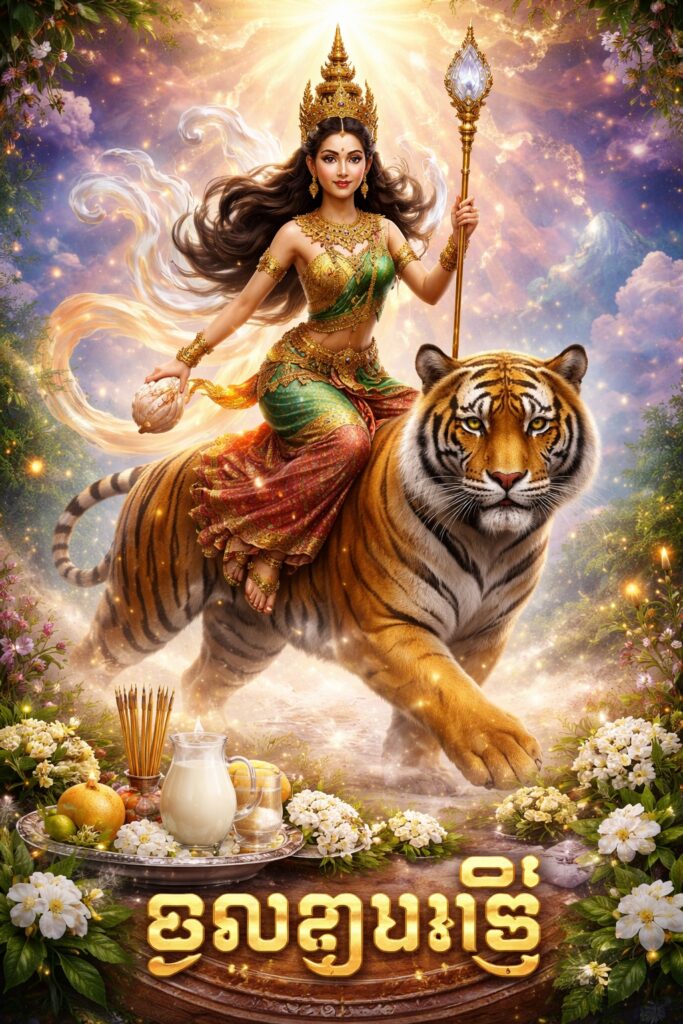
The “descending of the angel” is one of the most distinctive and symbolically rich elements of Chaul Chnam Thmey, the Cambodian New Year. It refers to a deeply rooted cosmological belief explaining how the new year begins — not as a simple calendar change, but as a sacred transition in the spiritual order of the world.
What is the “descending of the angel”?
In Cambodian tradition, the New Year begins at a precisely calculated astrological moment, known as:
Moha Sangkran (មហាសង្ក្រាន្ត)
The exact moment of transition into the New Year
At this moment, a celestial being descends from heaven to Earth to assume guardianship of the coming year.
This being is called a:
Tevada (ទេវតា)
- A guardian deity or celestial angel-like figure
It is important to note that this is not an “angel” in the Western religious sense, but a mythological being rooted in Hindu-Buddhist cosmology, representing divine order and cyclical time.
One Tevada per year
According to Cambodian belief:
- Each year is governed by a different Tevada
- At the moment of Moha Sangkran:
- The previous Tevada withdraws
- The new Tevada descends to take over guardianship of the world
This creates a cyclical vision of time in which celestial beings rotate annually, maintaining cosmic balance. It is, in essence, a ritualised handover of cosmic guardianship.
Tevada of 2026 (Khmer New Year)
For Chaul Chnam Thmey 2026, the descending angel is:
Koreak Tevi (កោរាគទេវី) (transliteration may vary slightly)
She is one of the seven daughters of Kabil Moha Prom, a central figure in Khmer mythology who governs the cycle of New Year angels.
According to legend, each daughter takes turns descending to Earth each year, carrying out the sacred duty of maintaining cosmic order.
Symbolic attributes of Koreak Tevi (2026)
Each Tevada is associated with highly specific symbolic attributes. For 2026:
- Day of arrival: Monday
- Vehicle: Tiger
- Preferred offering: Milk 🥛
- Flower: Jasmine 🌼
- Gemstone: Symbolically associated with purity and light (often white or translucent tones)
- Weapon/object: Ritual staff or symbolic implement (varies in traditional depictions)
These attributes are not decorative. They are symbolic representations of:
– purity
– elegance
– renewal
– calm spiritual energy for the year ahead
How people prepare (very concretely)
In Cambodia and Khmer communities, including those in the Mekong Delta of southern Vietnam, families prepare a home altar to welcome the Tevada.
Typical 2026 offerings include:
- Milk (especially significant this year) 🥛
- Jasmine flowers 🌼
- Incense and candles
- Clean water or tea
- Carefully arranged fruits
- Traditional sweets
Everything is prepared with a clear principle:
- cleanliness, harmony, and visual beauty
A well-prepared altar is believed to attract blessings and ensure a peaceful transition into the new year.
Exact moment of arrival
The Tevada does not arrive at midnight.
Instead:
- The exact moment is determined by traditional astrological calculation
- In 2026, it occurs on 13 April
- The precise hour can vary slightly depending on calculation traditions
At that moment:
- Incense is lit
- Prayers or bows are performed
- The arrival of Koreak Tevi is formally acknowledged
This moment marks the true beginning of the Cambodian New Year cycle.
Mythological background: the seven daughters
Cambodian tradition explains the cycle of Tevadas through a myth involving Kabil Moha Prom:
- He is a powerful celestial figure
- He lost a sacred challenge in mythological lore
- His head is considered too sacred to touch the ground
- Therefore, it must be carried in a divine procession
His seven daughters (Tevadas) take turns each year:
- Carrying his head in ritual cosmology
- Descending to Earth to mark the New Year
- Governing the world for that annual cycle
Each year corresponds to one daughter’s turn in this cosmic rotation
Deeper meaning
The descending angel tradition expresses several interconnected ideas:
1. Renewal of time
The New Year is not a date change, but the beginning of a new cosmic cycle.
2. Moral reflection
The Tevada observes human actions, reinforcing ethical behaviour, merit, and karma.
3. Cosmic order
It reflects a worldview in which:
- Celestial beings govern time
- Human life is embedded in a spiritual universe
- Moral conduct and cosmic harmony are deeply linked
Difference from Thailand (important context)
In Thailand (Songkran), the festival is largely focused on:
- Water rituals
- Family respects traditions
- Public celebration and festive atmosphere
The concept of a descending celestial guardian is not central.
In contrast, in Cambodia, the arrival of the Tevada remains the core symbolic moment, giving Chaul Chnam Thmey a more:
- Cosmological structure
- Ritual precision
- Ceremonial depth
The Mekong Delta (southern Vietnam)
Among Khmer communities in southern Vietnam:
- The same belief in the Tevada is preserved
- Ritual practice is often very precise and conservative
- Pagodas may announce the exact arrival time of Moha Sangkran
- Traditional instructions for offerings are carefully followed
In some cases, these practices are maintained even more strictly than in urban Cambodian settings, as they serve as a strong marker of cultural identity.
In simple terms
At its heart, the tradition can be understood like this:
Every New Year, a new celestial guardian descends from the heavens to take care of the world for one cycle. People welcome her with offerings, respect, and hope, marking not just a new year — but a renewal of cosmic order and human intention.