
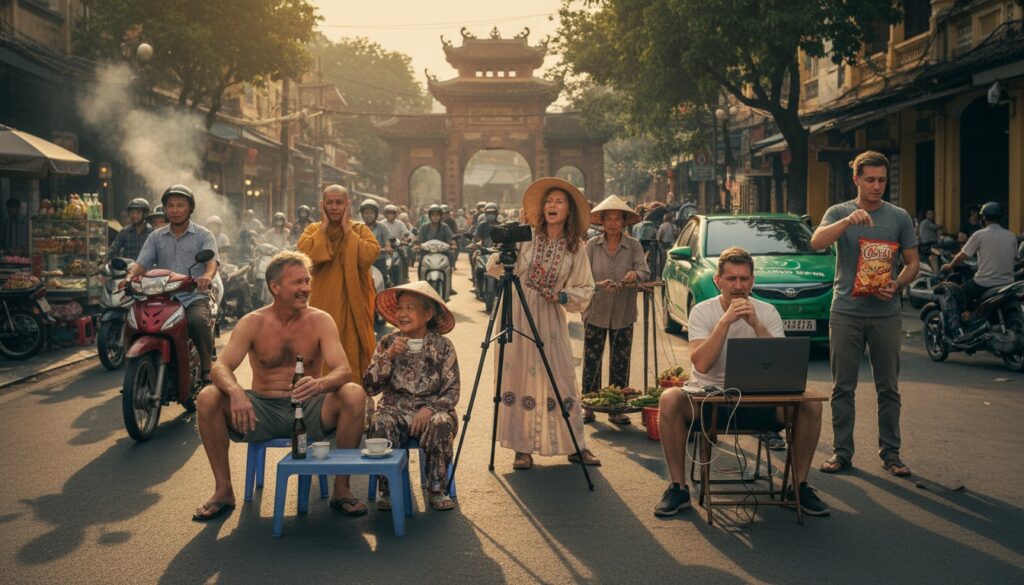
For Those Who May, or May Not, Recognise Themselves
Let me say this up front: I’m a foreigner who made Vietnam my home. Not a two-week ‘Eat, Pray, Lose My Sunglasses’ stopover. A home. I’ve been through the heatwaves, the typhoons, the beautiful lunacy of motorbike traffic, and the quiet, soul-restoring joy of a perfect bowl of phở on a rainy Sunday morning.
Vietnam is not a theme park. It is not a green screen for your Instagram grid. And it is certainly not a place where basic human decency goes on holiday.
Another disclaimer – partly for legal reasons, partly because I’d like to be allowed back into my local café.
I am a foreigner. I’ve lived here for years. I’ve crossed roads that felt like existential philosophy experiments. I’ve eaten food so good it made me question every meal I’d eaten before the age of 25. And I’ve watched, in real time, certain tourists behave as though they’ve been dropped into a live‑action video game designed exclusively for their personal character arc.
This comes from a place of tough love. I ran a business here. And every single day, I watch a very specific brand of tourist arrive at the airport, lose all self‑awareness somewhere between baggage claim and the taxi rank, and proceed to baffle the locals, who are far too polite to tell you to your face that you’re being an absolute nightmare.
Vietnam, for its part, remains magnificently unbothered.
It’s one of the most welcoming places on Earth. That’s not up for debate. But it’s also a country with a long memory, a steady rhythm, and a remarkable ability to smile politely while mentally filing you under ‘Oh, one of those’.
To understand which tourists Vietnam is quietly tired of, I went digging. Online discussion boards, expat forums, and local news reports. I spoke to the bánh mì lady on the corner and the Tây ba lô (backpacker) who’s been here so long he’s forgotten what deodorant smells like – assuming he ever knew.
Based on that research, and a frankly concerning number of years of observation, here is your unofficial, non‑exhaustive, painfully accurate field guide.
1. The ‘But Vietnam is So Noisy’ Human Foghorn
Vietnam is loud. We know. The horns are a language. The karaoke bars bleed into the street. The roosters in central Sài Gòn do not care about your jet lag.
However, there is a specific tourist who arrives in Vietnam and decides that because the environment is loud, they must be louder. They treat the train street in Hà Nội like a football terrace.
They scream over the phở. They whistle. They yell “Bia Hơi! Mot.
Mot Hai Ba!” (badly) at the top of their lungs at 9 am.
The forum verdict: A FB post recently drew attention to what it politely called “unruly behaviour” – including “screaming at the airport” – moments that, while perhaps intended as excitement, are perceived by everyone else as a reason to choose a different departure gate.
But it’s not just the volume. It’s the entitlement. The Human Foghorn often complains that “the locals are staring” or “the service is cold.” They don’t realise that the reason the bún chả place gave them the side‑eye is not that they’re foreign, but because they haven’t stopped shouting since they sat down.
Local perspective: Vietnamese culture values a certain harmony in close quarters. Nhè nhẹ (softly, softly) exists here too.
Tip: You do not need to compete with the traffic noise. The person serving you can hear you. Use your inside voice. You’re on holiday, not at war.
2. The Street‑Crossing Philosopher (or: Man vs. Flow Theory Enthusiast)
Vietnamese traffic has been described in many ways, most of them wrong.
To the untrained eye, it appears chaotic. To the trained eye, it’s choreography – a fluid negotiation between thousands of moving decisions per second.
And then there’s the tourist.
They arrive at the kerb. They stare. They wait for certainty.
There is no certainty.
At this point, locals simply step into the road with the calm of someone entering their own kitchen. Traffic bends. It adapts. It continues.
The tourist, however, has read somewhere that stepping into traffic is “brave but dangerous.”
So they hesitate. Half‑step forward. Retreat. Reconsider life choices. Reopen Google Maps. Eventually, they sprint.
This is not how the system works.
The system requires commitment, not panic. Motorbikes avoid you not because you’re fast, but because you’re predictable. And nothing is less predictable than someone who has just decided they might die.
Vietnamese observers remain impressively calm throughout this performance. They’ve seen it before. They’ll see it again. Possibly later today.
3. The 10,000‑Đồng Economist (or: Micro‑Negotiation Specialist)
In Vietnam, the currency is the đồng, and the zeros are terrifying. But the principle remains.
This individual believes they have discovered a universal truth: everything is negotiable. They apply this belief with the enthusiasm of someone who has just learned addition.
It begins innocently enough. A market stall. A souvenir. A bottle of water.
“How much?”
They hear the price. They respond as though personally insulted by arithmetic.
What follows is a negotiation over a sum that, in their home country, wouldn’t buy a sneeze.
Eventually, after prolonged performance, they achieve victory. A saving of approximately 20,000 đồng (roughly 65 pence).
They walk away satisfied, convinced they’ve participated in a meaningful exchange of economic philosophy.
The vendor, meanwhile, has just spent five minutes explaining reality to someone who will forget this interaction before lunch.
The cold, hard truth: The lady selling you cà phê sữa đá on the pavement makes that 20,000 đồng back in ten seconds. You’re not “winning.” You’re just delaying her service to the next customer.
If 65 pence breaks your budget, you cannot afford this trip.
4. The Café Occupation Unit (or: Co‑Working Colonial Expansion Programme)
Vietnamese café culture is one of the country’s quiet masterpieces. Coffee is not just coffee. It’s infrastructure. It’s social architecture. It’s where entire afternoons dissolve into slow conversation and condensation on glass.
Enter the Tourist.
They arrive with a laptop, a charger, a backup charger, and the emotional readiness for a full workday relocation.
They order one drink. They stay for four hours.
They adjust seating. They test Wi‑Fi speed. They take conference calls at volumes that suggest they’re broadcasting to neighbouring provinces. They plug six devices into the wall socket.
Local business reality: In places like Hà Nội’s Old Quarter, rent is astronomical. Space is currency. When you occupy a table for four hours to charge your phone and eat a bag of crisps you bought from the minimart next door, you are actively taking money from the owner.
The staff remain polite. Vietnamese service culture is often mistaken for acquiescence. It is not. It is simply extremely well‑developed endurance.
Eventually, they leave. They will say: “Such a chill vibe here.”
Yes. It was. Before you moved in.
Etiquette: In Vietnam, you can sit for a long time – it’s a café culture. But you consume. Order a second drink. Order a snack. If you’re on a “no‑spend day,” do it in a public park. Not in a family‑run business where electricity costs money.
5. The Balaclava Biker (or: Sons of Anonymity)
You know them. You’ve seen the YouTube thumbnails.
A group of chaps rent manual motorbikes in Hanoi or Ho Chi Minh City, despite never having ridden anything heavier than a mobility scooter in Magaluf. They buy knock‑off Oakleys and – here’s the Vietnamese special – the full face‑mask and balaclava combo.
Now, wearing a face mask in Vietnam is standard. Pollution, sun, dust. Fine. But these tourists wear the tactical ones. Skull prints. The sort that make them look like they’re about to extract a hostage from a compound in Huế, rather than wobble to a hostel in Đà Nẵng.
They ride in singlets, arms covered in temporary tribal tattoos, revving their 110cc lawnmower‑on‑wheels like they’re leading a Hell’s Angels chapter.
Local perspective: Actual Vietnamese road users – the ones who’ve seen it all before – find this hilarious. To a Vietnamese person, a foreigner dressing like a mercenary while weaving through a herd of buffalo isn’t intimidating; it’s a comedy sketch. As one FB user put it: “Yeah, the locals laugh at them. You aren’t a badass, you’re a clown.”
One expat forum user noted that these riders often crash because they “overestimate their skills on wet roads” while “dressed like they’re in a Mad Max movie.”
The reality: You are not a warrior. You are a soft person in a polyester costume riding a rented Honda Blade. You will get a sunburn in the shape of your backpack straps, and you will be too terrified to cross the roundabout at Ninh Kiều Wharf in Cần Thơ.
Put a shirt on. Wear a proper helmet. And lose the balaclava. You look like you’re about to rob a convenience store, not buy a coconut coffee. The locals aren’t intimidated; they’re trying not to laugh.
6. The Temple Influencer (or: Sacred Background Energy Specialist)
You’ll see them first at religious sites – pagodas, shrines, anywhere faintly photogenic and spiritually inconvenient.
They arrive dressed for what can only be described as “visual storytelling” rather than respect. Flowing garments. Carefully dishevelled hair. A camera that costs more than a local monthly salary. A deep, unwavering belief that enlightenment and good lighting are closely related.
They begin the ritual immediately: pose, adjust, pose again, check phone, sigh dramatically, repeat.
Nearby, someone is actually praying. Quietly. Properly. With intention.
The Influencer doesn’t notice this. Or if they do, they mentally file it under “authentic background texture.”
There is a special category of silence in Vietnam. It’s not absence of sound; it’s absence of disruption. The Temple Influencer tends to misunderstand this as “available space for content creation.”
Nobody confronts them. That would be impolite. Instead, they are observed with the kind of calm detachment usually reserved for weather patterns.
Later, they will post: “Vietnam has such spiritual energy ”
And they’re not wrong. It’s just that none of it came from them.
7. The Apocalypse Costume Historian (or: War Film Immersion Seeker)
This type arrives already pre‑loaded with narrative.
Vietnam, in their mind, is not a country but a setting. A cinematic memory. A backdrop for something they once saw on a screen late at night.
They dress accordingly. Military surplus aesthetic. Neutral colours. Occasional sunglasses worn indoors – which is less practical and more conceptual.
They may reference certain cultural artefacts, often without full awareness of how they land locally. Apocalypse Now, for example, is not a travel brochure.
They are fascinated by “history,” though often selectively so.
Vietnam, however, is not frozen in time. It’s not a museum of someone else’s imagination. It’s a rapidly evolving country with cities like Ho Chi Minh City moving faster than most visitors can process.
Locals don’t react dramatically. That would require emotional investment. Instead, there is quiet confusion, because nothing is more alien than someone trying to step into your present while insisting it’s your past.
8. The Motorbike Enlightenment Candidate (or: Physics Optional Rider)
This individual has arrived at a bold conclusion: a motorbike is just a bicycle with an engine. How hard can it be?
Spoiler: very hard.
They have no training. No caution. Occasionally, no helmet. They watched a five‑minute YouTube tutorial titled “How to Ride a Motorbike in Vietnam” and decided that qualified them for the Hai Van Pass.
They mount a rented bike – often an automatic scooter with barely enough power to frighten a gecko – and immediately enter Vietnam’s traffic ecosystem as if joining a group project halfway through. They have no idea what they’re doing, but they are very confident about it.
Their technique is best described as “interpretative acceleration.” They grab a fistful of throttle, lurch forward, panic, grab the brakes, and nearly get rear‑ended by a truck driver who has been navigating this chaos since before they were born.
Locals observe this with scientific curiosity. The tourist weaves across lanes without indicating. They stop in the middle of an intersection to check Google Maps. They turn left from the far right lane because they “didn’t see the sign.”
The critical distinction from the Balaclava Biker (Type 1): The Balaclava Biker is performing toughness. The Motorbike Enlightenment Candidate genuinely believes they have achieved traffic zen. They are not flowing. They are a liability with a rental agreement.
One expat forum user noted dryly: “They are going to crash. It’s not a matter of if, but when and how spectacularly.”
Wear a helmet. Use your indicators. And for the love of all that is holy, do not stop in the middle of a roundabout to take a photo.
9. The Cultural Time Capsule Visitor (or: ‘Back Home…’ Chronic Condition)
This person arrives with a comparative framework fully installed.
Everything is measured against “back home.” Queues. Prices. Systems. Weather. Gravity, possibly.
They are often well‑meaning but fundamentally anchored elsewhere. Vietnam, in their analysis, is constantly being assessed rather than experienced.
“Back home, we would never…”
“Back home, this costs half as much…”
“Back home, people know how to queue…”
Locals do not respond. They have learned that comparison is not dialogue. It is a projection.
Eventually, this visitor either adapts or leaves early for “somewhere more familiar.” Familiarity, of course, is not the same as understanding.
10. The Rooftop Reality Editor (or: Aesthetic Extraction Specialist)
This individual does not travel through Vietnam. They curate it.
Every moment is filtered through composition, lighting, and shareability. They are often found overlooking cities like Hà Nội at sunset, adjusting framing as if reality itself were slightly misaligned.
They take many photos of the same drink. They do not drink it.
Their memory of Vietnam is stored externally, in cloud backups and caption drafts.
There’s nothing inherently wrong with documenting beauty. The issue is when documentation replaces presence entirely. Vietnam becomes, for them, less a place and more a series of aesthetically approved fragments.
They will leave with a thousand photos and no sense of what the air actually smelled like.
11. The ‘I’ve Been Here Three Days’ Expert (or: Instant Anthropologist Syndrome)
This is perhaps the most consistent figure in the ecosystem.
They have arrived recently. Very recently. But already possess strong opinions. They understand the country. Deeply. Immediately. Intuitively.
At least, they believe they do.
They explain economics, culture, language, and traffic systems with remarkable confidence and minimal data. They often cite “locals say” without specifying which locals, or when.
“The Vietnamese are very…” – finish the sentence with a generalisation that would take a PhD to unpack.
In expat communities, there is a quiet rule: never trust anyone still in their early phase of certainty. Because certainty is usually the first symptom of not yet knowing what you’re talking about.
12. The Costume Offender (The Cultural Hall of Shame)
This one gets under the skin of locals the most.
Vietnam is not a monolith. It has 54 distinct ethnic groups. The áo dài is the national garment – elegant and respected. Then you have the highland regions, like Sa Pa or Hà Giang, home to the H’Mông, Dao, and Tày people.
Enter the “Rare” Tourist.
A recent controversy: a foreign male tourist was filmed wearing a traditional H’Mông woman’s dress – draped around his neck like a scarf – dancing provocatively for TikTok.
A local man, Mr Lò A Lói, expressed his hurt:
“These costumes are also associated with ceremonies, weddings, funerals, festivals… they have a very sacred value to us Mông people. When I see tourists not understanding the meaning of the dress and making funny videos, I feel hurt.”
The archetype: the traveller who buys a traditional nón lá (conical hat) and wears it backwards with a bikini. The person who buys an ethnic H’Mông blanket and wears it as a cape. The individual who treats sacred cultural symbols as dressing‑up box props.
Dr Trịnh Lê Anh, a tourism expert, noted that in Japan or Bhutan, wearing traditional clothes is a ritual of respect. In Vietnam, it’s often seen as a joke.
Stop. You are not “appreciating” the culture. You are trivialising it.
13. The ‘Shirtless Brunch’ Guy (The Humidity Casualty)
We have to include it because it happens constantly.
The humidity is high. You are sweating. We get it.
But there is a line. That line is the door of the establishment.
Yes, Hà Nội has a bizarre niche where “shirtless six‑pack guys” serve coffee as a marketing gimmick (locals find this controversial and often inappropriate). And a mattress brand was fined for having shirtless men on the metro. But the average tourist seems to think the rules don’t apply to them.
The scene: A 50‑year‑old man from Manchester, bright red, walking into a family restaurant in Hội An. No shirt. Flip‑flops. Sweat dripping onto the floor. He sits down next to a Vietnamese grandmother wearing a long‑sleeved silk jacket.
Cultural context: Vietnamese people cover up. Even in blistering heat, they wear sun jackets, gloves, and masks to protect their skin. It’s a cultural norm to be kín đáo (modest and discreet).
Walking around shirtless doesn’t just make you look silly; it makes you look animalistic to a conservative Vietnamese eye.
There is no excuse. Pack a linen shirt. Pack a tank top. Your six‑pack (or keg) is not the attraction you think it is.
14. The ‘But I Saw It on TikTok’ Destination Chaser
A newer breed, accelerated by algorithms and the desperate need for validation.
They do not discover Vietnam. They are told where to go.
Every stop is pre‑approved by an influencer they’ve never met. Every café is visited because someone else made it look good. Every “hidden gem” is no longer hidden and no longer a gem, because three hundred people have already been there that week.
They arrive at a location, take the same photo from the same angle, and leave.
They do not ask: Why is this place special? They only ask: Will this look good on a grid?
The tragedy: They will leave Vietnam having seen a perfect, sanitised, algorithmic version of it. They will never know what they missed around the corner. The phở place with no English menu. The alley where old men play Chinese chess in silence. The random intersection where nothing happens but somehow feels like everything.
15. The Reluctant Eater (or: ‘Do They Have Chips?’ Connoisseur)
This tourist arrives in one of the greatest food countries on Earth and immediately panics.
They find the one Italian restaurant in a city of ten thousand noodle shops. They order pizza. They complain that the pizza isn’t like home.
They refuse bún bò Huế because it “looks spicy.” They refuse chả cá because “what’s that green thing?” They refuse bánh xèo because the crepe is “too yellow.”
Their diet for two weeks consists of bread, beer, and regret.
Local perspective: Vietnamese people are genuinely confused by this. Food is hospitality. Food is love. To reject it is to reject the hand offering it.
The advice: Eat the thing. Whatever it is. Eat it. You are not going to die. You are going to have a story. And you might, just possibly, discover that the world is larger than your childhood dinner plate.
Conclusion: Vietnam is Not a Green Screen
Vietnam has had a tough history. It’s a country of survivors. The people here are resilient, hard‑working, and incredibly forgiving. But that forgiveness is wearing thin for the “rare” tourist – the one who thinks their money buys them the right to be rude, loud, or culturally ignorant.
A note on the ‘Expats vs. Tourists’ debate:
Many long‑term foreigners in Vietnam are defensive. They hate being lumped in with the ba lô crowd. These expats run charities, learn the language (to varying degrees of success), and respect the queue at the supermarket.
But the “Rare” tourist doesn’t see the difference. They assume that because the bia hơi is cheap, the respect should be cheap too.
And so, the pattern repeats.
None of these figures are unique. They are variations of a familiar theme: the assumption that Vietnam is a backdrop rather than a place with its own internal logic.
The truth is simpler.
Vietnam does not reject tourists. It absorbs them. Quietly. Patiently. Without drama.
But it also remembers.
And if there is one thing long‑term residents learn – slowly, often reluctantly – it is this:
You are not the main character here.
You are a visitor.
And the difference matters more than you think.
To the tourist reading this:
You are a guest. Whether you’re riding a motorbike through Hà Giang, eating chả cá in Hà Nội, or getting a tailored suit in Hội An – remember that these are real people. Real lives. Real traditions.
Vietnam doesn’t ask much of its visitors, only that they notice where they are.
Vietnam is the most generous, chaotic, beautiful country in the world. It deserves better than the “rare” tourist. And honestly, so do the rest of us who call it home.