
Resilience, Opportunity and Strategic Balance
Introduction: A Nation Rising Amid Global Uncertainty
In an era defined by geopolitical fragmentation, trade disputes, and shifting alliances, Vietnam has emerged not merely as a survivor—but as one of the most dynamic economic success stories of the early 21st century. Situated at the eastern edge of mainland Southeast Asia, with a population exceeding 100 million and a strategic location along major global shipping routes, Vietnam has quietly transformed itself into a central node in the global economy.
The period spanning 2025 and the first half of 2026 offers a particularly revealing snapshot of this transformation. While the global economy has been buffeted by renewed protectionism under the second administration of Donald Trump in the United States, ongoing tensions in global supply chains, and the reverberations of conflicts affecting energy markets, Vietnam has not only weathered these shocks—it has thrived.
This article examines Vietnam’s economic trajectory over the past year, placing it in the broader context of Southeast Asia, and analysing how its policies, structural advantages, and diplomatic agility have positioned it favourably in relation to both the United States and Europe.
1. Strong Growth in a Challenging Global Climate
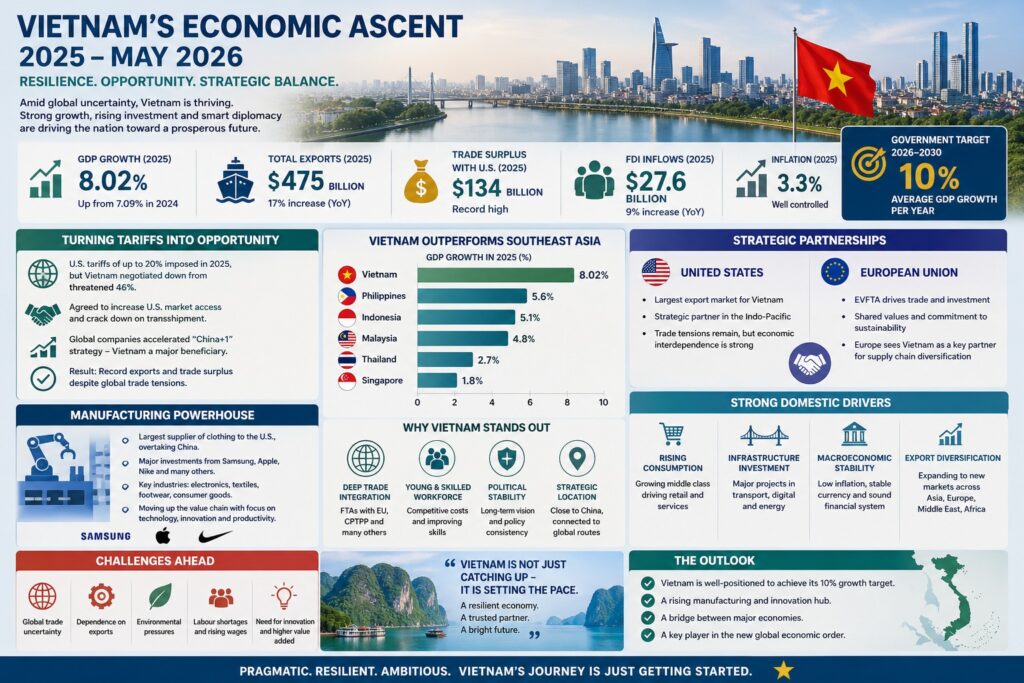
Vietnam’s economic performance in 2025 stands out even by its own high standards. The country recorded GDP growth of approximately 8.02%, accelerating from 7.09% in 2024, placing it among the fastest-growing economies globally.
This growth is particularly remarkable given the global backdrop:
- The reintroduction of high tariffs by the United States, targeting countries with trade surpluses
- Persistent supply chain disruptions
- Climate-related shocks, including severe flooding in Vietnam itself
- Slower growth in major global economies
Yet, Vietnam’s economy expanded robustly across multiple sectors:
- Exports surged by 17%, reaching roughly $475 billion
- Industrial production and retail sales increased by over 9%
- Inflation remained controlled at around 3.3%
- Foreign direct investment rose to $27.6 billion (+9%)
These figures demonstrate not only growth but also macroeconomic stability, a key factor underpinning investor confidence.
By early 2026, Vietnam’s leadership was sufficiently confident to set an ambitious target of 10% annual growth for the period 2026–2030, signalling a shift from recovery to acceleration.
2. Turning Tariffs into Opportunity
At first glance, the return of aggressive U.S. tariff policies in 2025 might have appeared as a direct threat to Vietnam’s export-led growth model. The Trump administration imposed tariffs of up to 20% on Vietnamese goods, with even higher rates initially proposed.
However, Vietnam’s response illustrates one of its defining economic strengths: adaptability.
2.1 Supply Chain Reconfiguration
Rather than collapsing under tariff pressure, Vietnam benefited from a broader restructuring of global supply chains. As tariffs on Chinese goods intensified, multinational companies accelerated their “China+1” strategies—relocating or diversifying production to countries like Vietnam.
By 2025:
- Vietnam became one of the largest suppliers of goods to the United States
- It recorded a trade surplus with the U.S. of nearly $134 billion
Moreover, industries such as textiles and electronics saw significant gains, as companies sought tariff-efficient production bases.
2.2 A Strategic Compromise
Vietnam also demonstrated diplomatic pragmatism. Faced with the threat of a 46% tariff, Hanoi negotiated a reduced rate of around 20% while agreeing to:
- Increase access for U.S. goods
- Tighten controls on transshipment of Chinese products
This approach allowed Vietnam to maintain access to the U.S. market while avoiding escalation, a balancing act that many larger economies struggled to achieve.
2.3 The Paradox of Protectionism
Ironically, U.S. protectionism has often strengthened Vietnam’s position. Rather than reshoring manufacturing to America, tariffs have largely redirected production within Asia—particularly to Vietnam.
In effect, Vietnam has become a primary beneficiary of global trade tensions, absorbing production capacity that might otherwise have remained in China.
3. A Manufacturing Powerhouse in the Making
Vietnam’s rise as a manufacturing hub is not new, but the pace of its expansion in recent years has been striking.
3.1 The Multinational Pivot
Major global corporations—including Samsung, Apple, and Nike—have significantly expanded their operations in Vietnam, attracted by:
- Competitive labour costs
- Political stability
- Integration into global trade agreements
- Improving infrastructure
The result is a deepening industrial ecosystem, particularly in:
- Electronics assembly
- Textiles and garments
- Footwear
- Consumer goods
By 2025, Vietnam had surpassed China as the largest supplier of clothing to the United States, a symbolic milestone in the global manufacturing landscape.
3.2 Moving Up the Value Chain
Crucially, Vietnam is no longer content to remain a low-cost assembly base. Government policy is increasingly focused on:
- Digital transformation
- High-tech manufacturing
- Domestic innovation
Under the leadership of President Tô Lâm, economic strategy has begun shifting towards a “new growth model”, emphasising technology and productivity over cheap labour.
This transition is essential if Vietnam is to sustain high growth rates over the coming decade.
4. Comparing Vietnam with Its Southeast Asian Neighbours
Vietnam’s performance becomes even more impressive when viewed within the ASEAN context.
4.1 Growth Dynamics Across ASEAN
ASEAN economies vary widely in size, structure, and level of development. While countries such as Indonesia and Thailand remain major players, Vietnam has emerged as one of the region’s most dynamic economies.
Historically, ASEAN growth rates have averaged between 3.8% and 7%, but Vietnam has consistently outperformed this range in recent years.
4.2 Competitive Advantages
Vietnam’s edge over regional peers can be attributed to several factors:
1. Trade Integration
Vietnam has signed multiple free trade agreements, including:
- EU–Vietnam Free Trade Agreement (EVFTA)
- Comprehensive and Progressive Agreement for Trans-Pacific Partnership (CPTPP)
These agreements provide preferential access to major markets.
2. Labour Force
Vietnam combines:
- A young, educated workforce
- Competitive wages
- Increasing technical skills
This contrasts with countries like Thailand, where an ageing population poses challenges.
3. Political Stability
Vietnam’s one-party system allows for:
- Long-term economic planning
- Policy continuity
This stability is often attractive to foreign investors.
4. Geographical Position
Located near China, Vietnam benefits from:
- Proximity to existing supply chains
- Access to major shipping routes
4.3 Regional Comparison
While Indonesia boasts a large domestic market and Malaysia offers higher technological capabilities, Vietnam occupies a unique middle ground:
- More competitive than Malaysia in labour-intensive sectors
- More export-oriented than Indonesia
- More stable (politically and economically) than several frontier ASEAN economies
This positioning makes Vietnam a preferred destination for diversified investment.
5. Relations with the United States: Competition and Interdependence
Vietnam–U.S. relations are a study in pragmatic cooperation.
5.1 Economic Interdependence
Despite tariff tensions:
- The U.S. remains Vietnam’s largest export market
- Vietnam is a key supplier of consumer goods to American households
This interdependence limits the extent to which trade conflict can escalate.
5.2 Strategic Alignment
From a geopolitical perspective, the United States views Vietnam as:
- A counterbalance to China
- A strategic partner in the Indo-Pacific
This creates a paradox: even as tariffs target Vietnamese exports, broader strategic considerations encourage continued engagement.
5.3 The Future Outlook
Looking ahead, U.S.–Vietnam relations are likely to remain:
- Economically competitive
- Strategically cooperative
Vietnam’s ability to navigate this duality will be crucial to its continued success.
6. Europe and Vietnam: A Growing Partnership
If relations with the United States are complex, Vietnam’s ties with Europe are more straightforwardly positive.
6.1 The Impact of the EVFTA
The EU–Vietnam Free Trade Agreement has:
- Reduced tariffs on a wide range of goods
- Encouraged European investment
- Strengthened regulatory alignment
As a result, European companies have increasingly turned to Vietnam as a manufacturing base.
6.2 European Strategic Interests
For Europe, Vietnam offers:
- A reliable alternative to China
- Access to a fast-growing market
- A partner aligned with multilateral trade principles
This aligns with broader European efforts to diversify supply chains and reduce dependency on any single country.
6.3 A Complementary Relationship
Unlike the more transactional U.S. approach, Europe’s engagement with Vietnam tends to emphasise:
- Sustainability
- Governance standards
- Long-term cooperation
This complementarity strengthens Vietnam’s global positioning.
7. Domestic Drivers of Growth
While external trade plays a crucial role, Vietnam’s growth is increasingly supported by domestic factors.
7.1 Rising Consumption
Vietnam’s growing middle class is driving:
- Retail expansion
- Service sector growth
- Urban development
7.2 Infrastructure Investment
The government has prioritised large-scale projects, including:
- High-speed rail
- Transport networks
- Digital infrastructure
These investments enhance productivity and connectivity.
7.3 Financial Stability
Vietnam has maintained:
- Moderate inflation
- Controlled credit growth
- Stable currency management
This macroeconomic discipline reinforces investor confidence.
8. Challenges on the Horizon
Despite its impressive performance, Vietnam faces several challenges:
8.1 External Risks
- Global trade tensions
- Dependence on exports
- Volatility in U.S. policy
8.2 Structural Issues
- Reliance on low-cost labour
- Limited domestic innovation capacity
- Environmental pressures
8.3 Labour Market Pressures
Interestingly, Vietnam is beginning to face:
- Labour shortages in certain sectors
- Rising wage expectations
This reflects its transition to a more advanced economy.
9. Vietnam’s Strategic Position in a Fragmented World
In many ways, Vietnam exemplifies the new global economic order:
- Multipolar
- Regionally interconnected
- Less dependent on any single power
Its strategy can be summarised as:
- Diversify partners
- Avoid overdependence
- Maximise opportunities from global shifts
This approach has allowed Vietnam to benefit from:
- U.S.–China tensions
- European diversification strategies
- Regional integration within ASEAN
Conclusion: A Model of Pragmatic Success
Vietnam’s economic trajectory in 2025 and early 2026 offers a compelling case study in resilience and strategic foresight.
At a time when many economies struggle with uncertainty, Vietnam has demonstrated that:
- Openness to trade, combined with careful state planning, can deliver sustained growth
- Geopolitical neutrality, or at least flexibility, can be a powerful economic asset
- Adaptability is perhaps the most important quality in a rapidly changing world
While challenges remain, Vietnam’s current path suggests that it is not merely catching up with its regional peers—it is beginning to set the pace.
For investors, policymakers, and observers alike, Vietnam is no longer just a promising emerging market. It is a central player in the evolving architecture of the global economy.