
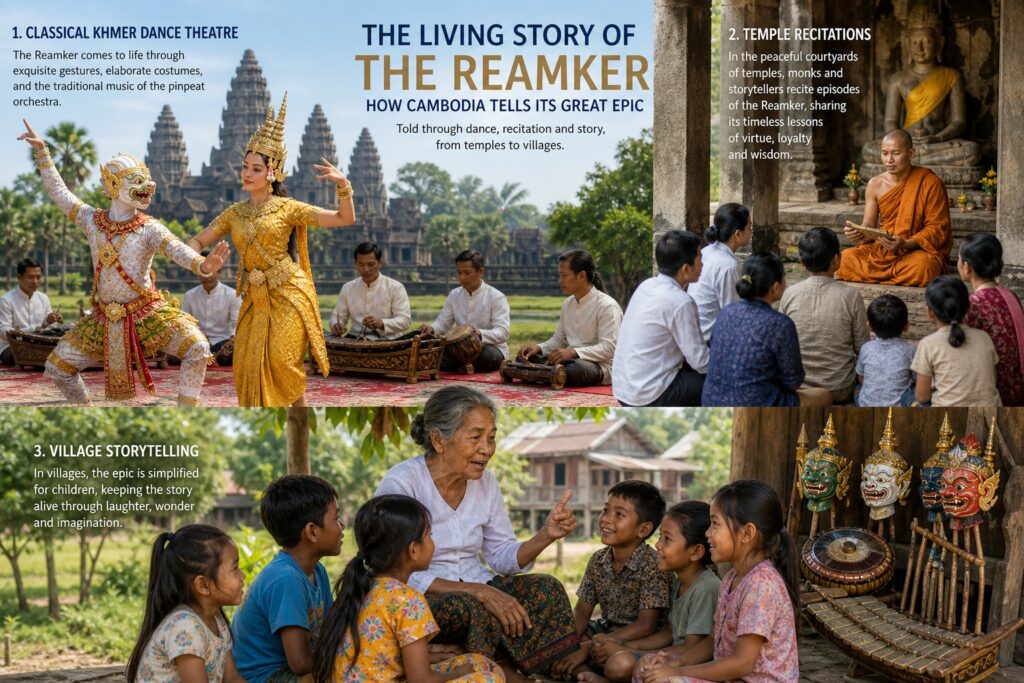
How Cambodia Tells Its Great Epic
In Cambodia, stories are not merely told—they are performed, embodied, and lived. The great national epic known as the Reamker is far more than literature. It is a cultural universe that moves through dance, temple ritual, village storytelling, and childhood education. Every generation encounters it not as a single fixed text, but as a living tradition expressed in multiple artistic forms.
To understand how Cambodians experience the Reamker today is to understand how myth, spirituality, and performance remain inseparable in Khmer culture. This article explores the principal ways the story is transmitted: classical dance theatre, temple recitations, and simplified village storytelling for children—each with its own aesthetic language, symbolic system, and emotional function. But before we examine these forms, it is essential to understand the epic’s origins and what makes the Cambodian version unique.
1. Origins and Unique Khmer Adaptations
The Reamker (the name means “Glory of Rama”) has deep roots in Cambodia. While the story’s presence can be traced back to the 7th century, the earliest surviving texts date from the 16th or 17th century and were composed by multiple authors over several centuries. Some episodes represented in the text are unique to the Khmer version—the most famous being the encounter between the monkey god Hanuman and the mermaid Sovann Maccha, which you will not find in the Indian original.
A core adaptation for Cambodian culture is its Buddhist lens. The Reamker reshapes the original Hindu themes to reflect Buddhist values, focusing on the balance of good and evil in the world, on karma, and on compassion. The story is not simply a heroic tale; it is a moral and philosophical allegory.
The storyline in brief (familiar to any Ramayana enthusiast, yet with a distinct Khmer flavour):
- Preah Ream (Prince Rama) is an incarnation of the god Vishnu. Wrongly exiled from his kingdom for fourteen years, he retreats to the forest with his wife Neang Seda (Princess Sita) and his brother.
- The giant demon king Krong Reap (Ravana) kidnaps Neang Seda.
- With the help of the loyal monkey god Hanuman and his army, Preah Ream rescues her, culminating in a great battle between the forces of good and evil.
Beyond the action, the story explores deeply human themes: trust, loyalty, love, duty, and revenge. This moral richness is why the Reamker has become a pillar of Khmer identity, expressed not only in literature but in every living art form.
2. Classical Khmer Dance Theatre: The Sacred Performance of the Reamker
At the heart of Cambodia’s storytelling tradition lies classical court dance, one of the most refined performing arts in Southeast Asia. Often associated with the Royal Ballet of Cambodia, this art form transforms the Reamker into a slow, ritualised visual poem.
Unlike Western theatre, where dialogue and realism dominate, Khmer classical dance communicates entirely through gesture, posture, costume, and music. Every movement has meaning, and every character is instantly recognisable through symbolic form. Traditionally, this dance-drama was performed by an all-male masked ensemble for the Reamker—a distinctive feature that sets it apart from other repertoires.
The Language of Movement
In the classical performance of the Reamker, dancers do not speak. Instead, they communicate through a codified vocabulary of gestures known as kbach. These gestures are precise and stylised:
- A curved hand may indicate grace or femininity.
- A sharp, angular pose may suggest anger or demonic force.
- Slow, circular arm movements often represent divine or royal presence.
The performance is deliberately slow. Movements are extended beyond natural rhythm, allowing the audience to contemplate meaning rather than simply follow action. This creates a sense that time itself has been suspended.
Characters as Embodied Symbols
Each figure in the Reamker is represented through a strict visual and kinetic code:
- Ream (Rama): calm, upright, symmetrical posture; controlled gestures.
- Neang Seda (Sita): gentle curves, soft hand positions, inward movement.
- Hanuman: energetic, flexible, often playful yet powerful motion.
- Demons (Yeak): angular limbs, exaggerated steps, aggressive stance.
The dancer does not “act” a role in the Western sense; they become a symbolic embodiment of moral forces.
Music as Narrative Structure
The performance is guided by a traditional Khmer orchestra known as the pinpeat ensemble. It includes xylophones (roneat), drums, gongs, and oboes. Music does not simply accompany the dance—it structures emotional time. Each rhythm pattern signals shifts in mood: serenity, tension, battle, sorrow, or divine intervention.
In battle scenes, percussion intensifies, while romantic or sacred scenes are marked by slower melodic cycles. The audience, familiar with these patterns, understands the narrative instinctively.
Sacred Performance Context
Historically, these performances were associated with royal courts and temple ceremonies. Even today, they retain a sense of sanctity. They are often performed during national celebrations, religious festivals, and cultural commemorations.
The proximity of dance to spirituality is essential. In Cambodian tradition, storytelling is not entertainment alone—it is a form of cultural offering, a way of maintaining harmony between the human and spiritual worlds. At major temple sites such as Angkor Wat, artistic representations of the Reamker can be found carved into stone bas-reliefs, visually reinforcing the continuity between ancient mythology and living performance.
3. Temple Recitations: The Reamker as Spiritual Teaching
Beyond the royal stage, the Reamker is also present in religious life. In Buddhist temples, monks and lay storytellers recite simplified versions of its episodes as part of moral teaching. These recitations are not theatrical in the same sense as dance, but they are deeply performative in tone and rhythm.
Storytelling in Monastic Settings
Within temple courtyards, especially during festivals or communal gatherings, monks often recount episodes of the Reamker to illustrate ethical lessons. The narrative is adapted to the audience, emphasising clarity and moral meaning over artistic complexity. For example:
- Ream’s exile becomes a lesson in duty and patience.
- Seda’s trials illustrate purity and loyalty.
- Hanuman’s devotion represents selfless service.
The tone is calm, rhythmic, and repetitive, allowing listeners of all ages to absorb meaning gradually.
Moral Framework of the Narrative
The temple version of the Reamker is not simply entertainment; it functions as a didactic structure grounded in Buddhist ethics. It reinforces key values: karma and consequence, loyalty to family and ruler, humility over pride, and discipline over desire. In this context, storytelling becomes a form of moral cultivation rather than dramatic performance.
Integration with Ritual Life
Temple recitations are often integrated into broader ceremonies. During religious festivals, storytelling may occur alongside offerings, chanting, and communal meals. The story is not separated from daily life; it is embedded within it. Listeners may hear fragments of the Reamker while participating in rituals intended to bring prosperity or protection. Thus, the epic becomes part of a spiritual ecosystem rather than a discrete artistic work.
Village Storytelling: The Reamker for Children and Everyday Life
Perhaps the most widespread form of the Reamker today exists far from royal stages and temple halls. In rural villages, it survives in oral storytelling adapted for children and families. Here, complexity is reduced, humour is introduced, and moral lessons are made immediate and relatable.
The Role of Elders
In many Cambodian households, grandparents are the primary transmitters of cultural memory. At night, after work in the rice fields, stories are told in simple language, often accompanied by gestures or improvisation. The storyteller adapts freely: shortening battles, emphasising animal characters, adding humour or local references, and repeating moral points for emphasis. This flexibility ensures that the Reamker remains alive and accessible.
Hanuman as a Children’s Favourite
Among children, the most popular figure is Hanuman. His stories are often told separately from the full epic. In village versions, Hanuman becomes playful and mischievous; his strength is exaggerated for comic effect; his loyalty to Ream is simplified into clear moral devotion. Children often imitate his movements during play, turning storytelling into physical performance.
Visual Reinforcement: Masks, Puppetry, and Shadow Theatre
In some regions, storytelling is accompanied by simple puppetry or handmade masks. Unlike the refined court costumes of classical dance, village representations are improvised from painted cloth, carved wood, and locally made instruments. Children may wear masks of demons or monkeys, re-enacting scenes of battle in open spaces. This transforms storytelling into communal play.
Beyond these simple forms, Cambodia also possesses a spectacular ancient tradition: Sbek Thom (shadow puppetry). This art uses giant, non-articulated leather puppets that can be up to two metres high. Dancers hold the puppets above their heads against a screen, bringing the epic to life in a dramatic interplay of light and shadow. Once a royal art, Sbek Thom is now preserved by a few masters who continue to handcraft hundreds of puppets from memory—a testament to the story’s enduring power.
Night-Time Narration
Village storytelling often takes place at night, when agricultural work is finished. The rhythm of narration is slow, almost hypnotic, blending with natural sounds of insects and wind. In this setting, the Reamker becomes less of a structured epic and more of a shared emotional experience, where fear, wonder, humour, and morality merge.
5. The Aesthetic Unity of Cambodian Storytelling
Although classical dance, temple recitation, and village storytelling appear different, they share a fundamental principle: the integration of narrative, body, and sound. In all forms:
- Characters are defined by gesture or tone.
- Music or rhythm structures meaning.
- Moral lessons are central.
- Performance is communal rather than individual.
This unity reflects a worldview in which storytelling is not separated from life, religion, or art.
6. Continuity, Revival, and Cultural Preservation
Modern Cambodia continues to preserve these traditions through education, performance institutions, and cultural revival efforts. The Royal Ballet of Cambodia has played a key role in maintaining classical forms, while rural communities continue oral transmission independently.
At Angkor Wat and other heritage sites, the visual presence of the Reamker in stone reliefs reinforces the idea that this is not merely a story—it is a foundational cultural memory. The epic is also adapted into contemporary performances, such as the show “Lights and Shadow”, which blends different classical dance forms. Modern artists create shadow puppetry that reflects current issues, showing the story’s ability to interpret new realities.
The efforts to revive the art of Sbek Thom are particularly urgent. The tradition nearly disappeared during the Khmer Rouge era (1975–1979), when many master artists were lost. Today, surviving masters and their apprentices work tirelessly to ensure that this living epic continues for generations to come.
Conclusion: A Story That Lives in Many Forms
The Reamker survives because it is not confined to text. It exists simultaneously as:
- sacred dance,
- moral teaching in temples,
- oral storytelling in villages,
- shadow puppetry and visual art in ancient monuments.
Each form adapts the story to its environment while preserving its core symbolic structure. In Cambodia, storytelling is not the repetition of a fixed narrative—it is the continuous re-creation of meaning through performance. The Reamker lives because it is always being re-embodied: in movement, in voice, and in community memory.
And so, when a dancer raises a hand slowly on a stage, when a monk recites a moral tale in a temple courtyard, or when an elder tells a child about a monkey leaping across the sky at night, the same epic breathes again.