
Frontier Engineering, Cultural Mediation, and State Formation in Central Vietnam
Abstract
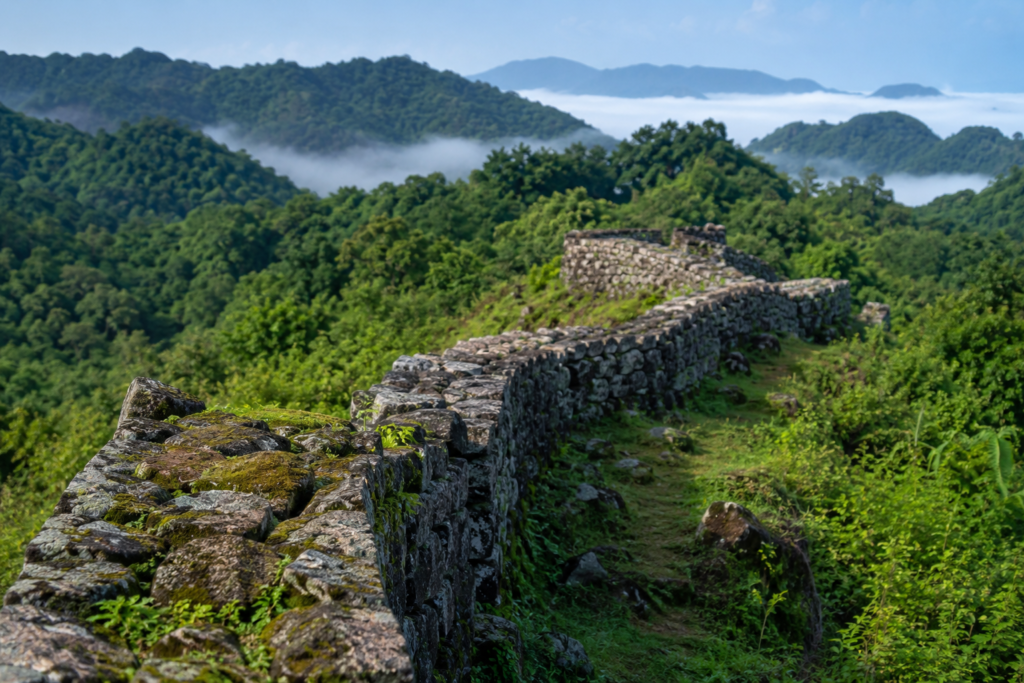
The Trường Lũy Quảng Ngãi, often described as Vietnam’s “Great Wall”, represents one of Southeast Asia’s most extensive yet understudied frontier systems. Extending across the mountainous borderlands of central Vietnam, this rampart network functioned not only as a defensive structure but as an instrument of governance, economic regulation, and intercultural mediation. This article synthesises historical records, archaeological findings, and contemporary scholarship to reassess Trường Lũy as a dynamic socio-political landscape. It argues that the wall exemplifies a model of frontier management distinct from purely exclusionary fortifications, emphasising regulated interaction between lowland Vietnamese (Kinh) populations and highland ethnic groups such as the H’re. Through this lens, Trường Lũy emerges as a critical case study in pre-modern statecraft, territoriality, and cultural exchange in mainland Southeast Asia.
1. Introduction
Large-scale linear fortifications have historically been associated with imperial ambition and territorial control. From the Great Wall of China to Roman limes, such structures are often interpreted as instruments of separation. However, recent scholarship has increasingly challenged this binary understanding, emphasising the multifunctional nature of frontier systems.
The Trường Lũy of central Vietnam provides a compelling example of this complexity. While frequently labelled as a defensive wall, its material composition, spatial organisation, and historical context suggest a broader role encompassing trade regulation, cultural negotiation, and administrative integration.
Despite its scale—estimated between 120 and 200 kilometres—the structure has received limited international scholarly attention. This article seeks to address this gap by situating Trường Lũy within broader debates on frontier theory, state formation, and Southeast Asian history.
2. Historiographical Context
2.1 Early Documentation
References to frontier fortifications in central Vietnam appear sporadically in Nguyễn dynasty records, particularly administrative chronicles such as the Đại Nam thực lục. These sources, however, tend to frame the structures in terms of security and order, reflecting the priorities of the imperial state.
2.2 Modern Rediscovery
Systematic study of Trường Lũy began only in the late twentieth century. Vietnamese scholars, in collaboration with international researchers, initiated surveys that revealed the wall’s extensive reach and complexity.
Notably, archaeological work conducted in the early 2000s documented:
- Over 100 fortification points
- Distinct construction techniques adapted to the terrain
- Evidence of sustained human activity along the wall
These findings prompted renewed interest in the site, culminating in its recognition as a national heritage monument in 2011.
2.3 Contemporary Scholarship
Recent studies have shifted interpretative frameworks from purely military explanations to more nuanced analyses. Scholars now emphasise:
- Frontier hybridity
- Economic exchange systems
- Ethno-political dynamics
This aligns with broader trends in Southeast Asian historiography, which challenge rigid centre–periphery models.
3. Geography and Environmental Context
The Trường Lũy traverses a transitional ecological zone between coastal plains and the Annamite highlands. This region is characterised by:
- Dense tropical forests
- Rugged topography
- Seasonal river systems
Such environmental conditions significantly influenced both the construction and function of the wall.
3.1 Strategic Placement
Rather than imposing a straight line, the wall follows natural contours, suggesting an intimate knowledge of local geography. This adaptive strategy enhanced its defensive capabilities while minimising construction effort.
3.2 Resource Utilisation
Construction materials were sourced locally:
- Stone in mountainous regions
- Compacted earth in lowland areas
This reflects a pragmatic approach consistent with pre-industrial engineering practices.
4. Construction and Chronology
4.1 Early Phases (17th–18th Centuries)
Initial fortifications likely emerged during periods of regional instability, when central authority was fragmented. These early structures were localised and relatively modest.
4.2 Nguyễn Dynasty Expansion (19th Century)
The most significant development occurred under the Nguyễn dynasty, particularly in 1819.
Imperial directives aimed to:
- Consolidate territorial control
- Formalise boundaries between lowland and highland populations
- Enhance administrative oversight
The resulting system transformed Trường Lũy into a continuous and coordinated frontier network.
5. Structural Analysis
5.1 Ramparts
The core ramparts vary in height and thickness, reflecting local conditions. Their primary function was to channel movement rather than provide an impenetrable defence.
5.2 Fortifications
Distributed at strategic intervals, forts served as:
- Military outposts
- Observation stations
- Administrative centres
Their density indicates a high level of organisation and sustained state investment.
5.3 Pathways and Corridors
Integrated pathways facilitated controlled movement along the frontier. These routes were essential for both military logistics and commercial activity.
6. Frontier Theory and Interpretation
Traditional interpretations of walls as exclusionary barriers are increasingly challenged by frontier theory, which emphasises zones of interaction.
6.1 The Frontier as a Contact Zone
Trường Lũy exemplifies what anthropologists describe as a “contact zone”—a space where distinct cultures meet, interact, and influence one another.
6.2 Regulation Rather than Separation
Evidence suggests that the wall functioned to regulate:
- Trade flows
- Migration patterns
- Political authority
This regulatory role distinguishes it from purely defensive structures.
7. Economic Functions
7.1 Trade Networks
The frontier facilitated exchange between:
- Highland communities (forest products, livestock)
- Lowland populations (rice, salt, manufactured goods)
7.2 Taxation and Control
Checkpoints along the wall enabled the collection of taxes and monitoring of goods. This contributed to state revenue and reinforced administrative authority.
8. Ethnic and Cultural Dynamics
8.1 The Kinh–H’re Relationship
The interaction between lowland Vietnamese and highland groups such as the H’re was complex, involving both cooperation and conflict.
8.2 Cultural Exchange
Archaeological evidence indicates:
- Shared material culture
- Trade-related artefacts
- Hybrid practices
This suggests that the frontier was a site of cultural synthesis rather than strict division.
9. Comparative Perspectives
9.1 Global Frontier Systems
Compared to other fortifications, Trường Lũy exhibits unique characteristics:
- Integration of economic and defensive functions
- Adaptation to diverse terrain
- Emphasis on regulation over exclusion
9.2 Southeast Asian Context
Within Southeast Asia, large-scale linear fortifications are relatively rare, making Trường Lũy a distinctive case.
10. Archaeological Evidence
Excavations have revealed:
- Structural remains of ramparts and forts
- Ceramics and trade goods
- Evidence of habitation
These findings support interpretations of the wall as a lived landscape.
11. Preservation and Challenges
11.1 Environmental Degradation
Natural processes, including erosion and vegetation growth, threaten the integrity of the structure.
11.2 Human Impact
Limited awareness and development pressures pose additional risks.
11.3 Conservation Efforts
Recognition as a national heritage site has prompted initiatives aimed at documentation and preservation, though resources remain limited.
12. Tourism and Heritage Management
The site’s relative obscurity presents both challenges and opportunities.
12.1 Sustainable Tourism
Careful development could:
- Promote local economies
- Increase awareness
- Support conservation
12.2 Risks
Unregulated tourism could damage fragile sections of the wall.
13. Discussion
Trường Lũy challenges conventional notions of walls as symbols of division. Instead, it illustrates a model of frontier governance characterised by:
- Flexibility
- Adaptation
- Integration
This has broader implications for understanding state formation in pre-modern Southeast Asia.
14. Conclusion
The Trường Lũy Quảng Ngãi stands as a remarkable example of frontier engineering and socio-political strategy. Its significance lies not only in its scale but in its function as a mediator between cultures, economies, and environments.
Future research should prioritise:
- Detailed mapping and documentation
- Interdisciplinary approaches
- Comparative analysis
In doing so, Trường Lũy may take its rightful place within global discussions of historical frontier systems.
References
- A. Hardy, M. Zolese, and Nguyen Tien Dong (2010). The Long Wall of Quảng Ngãi: Archaeological Survey and Historical Interpretation. Hanoi: Vietnam Academy of Social Sciences.
- Higham, C. (2014). Early Mainland Southeast Asia. Bangkok: River Books.
- Taylor, K. W. (2013). A History of the Vietnamese. Cambridge: Cambridge University Press.
- Lieberman, V. (2003). Strange Parallels: Southeast Asia in Global Context. Cambridge: Cambridge University Press.
- Scott, J. C. (2009). The Art of Not Being Governed. New Haven: Yale University Press.
- Vietnamese Ministry of Culture, Sports and Tourism (2011). National Heritage Listing Documentation: Trường Lũy Quảng Ngãi.
- Recent provincial reports (2021–2025) on conservation and tourism development in Quảng Ngãi.