
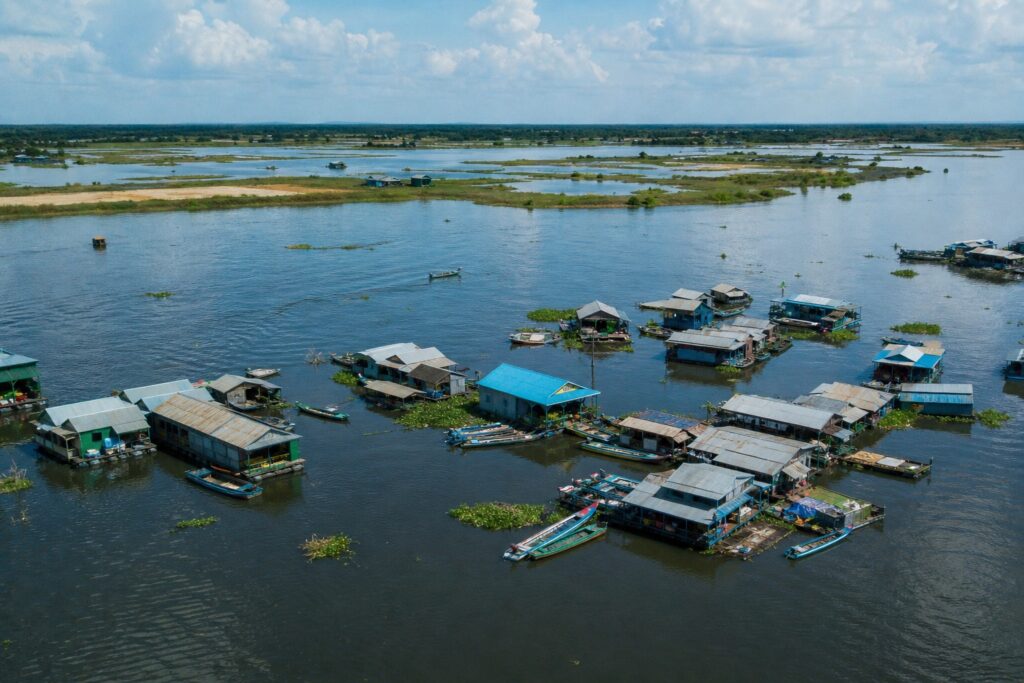
And what happens when that ancient rhythm begins to collapse
Few freshwater systems on Earth are as remarkable as Cambodia’s Tonle Sap. Often called the ecological heart of mainland Southeast Asia, the lake is defined not merely by its size or productivity, but by its rhythm. It is a seasonal pulse that has, for centuries, shaped the lives, livelihoods and cultures of millions.
This rhythm is driven by a rare hydrological phenomenon. Each year, during the monsoon, the Mekong River swells with rain from across its vast basin, forcing the Tonle Sap River to reverse its flow. Instead of draining the lake into the Mekong, water is pushed upstream into the Tonle Sap, expanding the lake to up to five times its dry‑season area. When the rains retreat, the flow reverses again, and the lake drains back into the Mekong, carrying with it a rich cargo of nutrients, sediments and juvenile fish.
This flood‑pulse system has long sustained one of the most productive inland fisheries on Earth. It underpins biodiversity on a global scale and provides food security for Cambodia, where fish is the primary source of animal protein.
But today, that rhythm is faltering.
The Tonle Sap is not vanishing overnight. It is not collapsing in a dramatic, headline‑grabbing disaster. Instead, it is undergoing a quieter, more insidious transformation – gradual, cumulative and deeply consequential. The system’s natural pulse is becoming erratic, less predictable, and increasingly fragile. And as that rhythm weakens, so too does the intricate web of life and human dependence that it supports.
The Ecological Engine of the Mekong Basin
The Tonle Sap is intimately connected to the Mekong River, one of the world’s great transboundary waterways. Stretching over 4,300 kilometres from the Tibetan Plateau to the South China Sea, the Mekong sustains an immense ecological and economic system across six countries.
Within this basin, the Tonle Sap plays a unique role. It acts as a natural reservoir, regulating floods and maintaining dry‑season flows. More critically, it serves as a breeding and nursery ground for hundreds of fish species. During the flood season, fish migrate into the inundated forests and wetlands, where they find abundant food and shelter for spawning.
This process fuels the Lower Mekong Basin’s inland fishery, widely regarded as the largest in the world. Estimates suggest annual production reaches roughly 4–4.5 million tonnes, with an economic value in the tens of billions of dollars.
For Cambodia, the importance of the Tonle Sap is impossible to overstate. It provides approximately 60% of the country’s freshwater fish catch. For millions of rural households, fish from the lake is not merely a dietary staple – it is the cornerstone of daily survival.
The lake also supports agriculture, particularly rice cultivation, through nutrient‑rich sediments deposited during floods. The flooded forests, another key feature of the ecosystem, serve both as ecological buffers and as economic resources for local communities.
In short, the Tonle Sap is not simply a lake. It is a system – a dynamic, interconnected engine of productivity that depends utterly on timing, balance and repetition.
Disruptions to the Flood Pulse
In recent decades, this delicate system has come under mounting pressure. The most critical change is the disruption of the flood pulse itself – the annual cycle of expansion and contraction that defines the lake.
Climate Variability and Changing Rainfall Patterns
Climate change is altering precipitation patterns across the Mekong Basin. Monsoon rains are becoming less predictable, with shifts in both timing and intensity. Some years bring delayed rainfall; others bring intense but short‑lived storms.
These changes affect not only the volume of water entering the Mekong, but also the timing of peak flows. Consequently, the reversal of the Tonle Sap River may occur later than usual, or with diminished force.
Even small shifts in timing can have profound ecological consequences. Fish migration, breeding cycles and plant growth are all finely tuned to the seasonal flood cycle. When that cycle becomes erratic, these processes are disrupted – often invisibly, at first.
Hydropower Development and Upstream Regulation
Perhaps the most significant human‑induced factor affecting the Tonle Sap is the rapid expansion of hydropower dams along the Mekong and its tributaries.
Dozens of large dams have been constructed in upstream countries, particularly China (on the Lancang River) and Laos. These dams store water during the wet season and release it during the dry season to generate electricity.
While such regulation can provide benefits – flood control and renewable energy among them – it fundamentally alters the natural flow regime of the river. Peak floods are often reduced, while dry‑season flows are artificially elevated.
For the Tonle Sap, this means a weaker flood pulse. The volume of water entering the lake during the monsoon may be diminished, reducing the extent of seasonal flooding. At the same time, altered timing of water releases can disrupt the natural reversal of the Tonle Sap River, throwing the lake’s biological clock into disarray.
Sediment Trapping and River Morphology
Dams do more than regulate water – they also trap sediment. Historically, the Mekong carried vast quantities of sediment downstream, enriching floodplains and sustaining agricultural productivity.
When sediment is trapped behind dams, far less reaches downstream ecosystems. The consequences are multiple:
- Reduced nutrient availability in flooded areas
- Altered riverbed dynamics, including erosion
- Increased bank instability in certain reaches
Recent research has also highlighted the role of sand mining in exacerbating these effects. Intensive extraction of sand from the Mekong and its tributaries lowers riverbeds, reduces water levels and weakens the hydraulic forces that drive the flood pulse. Over time, these changes reshape the physical structure of the river system, making it less capable of sustaining the natural dynamics that feed the Tonle Sap.
Local Pressures: A System Under Strain from Within
While upstream developments play a critical role, pressures within Cambodia itself are also contributing to the degradation of the Tonle Sap ecosystem.
Overfishing and Resource Depletion
The Tonle Sap fishery has long been a source of abundance. However, growing population pressures and economic demands have led to intensified fishing activity.
In many areas, fish stocks are declining due to overexploitation. Smaller fish are being caught before they reach maturity, reducing reproductive capacity. Illegal fishing practices – including the use of fine‑mesh nets and electrofishing – further compound the problem.
Loss of Flooded Forests
Flooded forests are essential to the Tonle Sap ecosystem. They provide habitat for fish and wildlife, stabilise shorelines and contribute organic matter to the food web.
Yet large areas of these forests have been cleared for agriculture, fuelwood and development. This loss reduces the availability of breeding and feeding grounds for fish, further suppressing fish populations.
Agricultural Expansion and Land‑Use Change
As Cambodia’s economy grows, pressure on land resources has intensified. Wetlands around the Tonle Sap are being converted into agricultural land, often through drainage or embankment construction.
These interventions disrupt natural water flows and reduce the extent of seasonal flooding. They also increase the use of fertilisers and pesticides, which can lead to water pollution – an additional, often overlooked, stressor on aquatic life.
The Human Dimension: Livelihoods in Transition
The ecological changes affecting the Tonle Sap are not abstract. They are being felt – directly, daily – by the people who depend on the lake.
Changing Fishing Practices
Fishermen report that fish catches are becoming less predictable. Traditional knowledge, painstakingly accumulated over generations, is becoming less reliable as seasonal patterns shift.
In response, some communities are adapting by:
- Diversifying fishing methods
- Fishing in different locations
- Targeting different species
But these adaptations are not always enough to offset declining catches. Many families are working harder for less reward.
Diversification of Livelihoods
An increasing number of households are seeking alternative sources of income. This may include:
- Small‑scale agriculture
- Wage labour in nearby towns
- Migration to urban centres or abroad
While diversification can provide resilience, it also reflects the erosion of traditional livelihoods tied to the lake. The shift away from fishing is not a choice – it is a necessity born of scarcity.
Food Security Concerns
Fish is the primary source of protein in Cambodia. Declines in fish availability have serious implications for nutrition, particularly among low‑income households. An increased reliance on alternative protein sources may lead to higher food costs and reduced dietary diversity, with the greatest burden falling on the most vulnerable.
Slow Violence: Understanding Gradual Environmental Change
The transformation of the Tonle Sap can be understood through the concept of “slow violence” – a term used to describe environmental harm that unfolds gradually, often invisibly.
Unlike sudden disasters – floods, earthquakes, oil spills – slow violence operates over years or decades. Its impacts accumulate quietly, frequently escaping attention until a critical threshold is crossed.
In the case of the Tonle Sap, changes in water flow, sediment dynamics and ecological processes are not always immediately visible. Yet over time, they fundamentally alter the system. This gradual nature makes it difficult to mobilise political will or public action. By the time the full extent of the problem is recognised, reversing the damage may be extremely challenging – perhaps impossible.
Governance and Regional Cooperation
Addressing the challenges facing the Tonle Sap requires coordinated action at multiple levels.
National Institutions
Cambodia has established several institutions to manage the lake, including:
- The Tonle Sap Authority
- The Tonle Sap Biosphere Reserve Secretariat
These bodies have mandates to protect and manage the ecosystem, but their effectiveness depends on adequate funding, political support and cross‑sectoral coordination. Too often, these conditions are not met.
Regional Frameworks
The Mekong River is a transboundary system, making regional cooperation essential. The 1995 Mekong Agreement established the Mekong River Commission (MRC), which provides a platform for dialogue and coordination among member countries.
One of the agreement’s key principles is the maintenance of natural flow patterns – including the reversal of the Tonle Sap River. However, achieving this in practice is complex, especially given differing national priorities and the involvement of upstream countries that are not fully integrated into the MRC framework.
Engagement with Upstream Countries
China, which controls the upper reaches of the Mekong (known as the Lancang River), plays a decisive role in shaping downstream flows. Cooperation through mechanisms such as the Lancang‑Mekong Cooperation framework has improved data sharing and communication. Nevertheless, challenges remain in ensuring transparency and coordination of dam operations. Without real‑time, shared data on releases and storage, downstream countries are left to react rather than plan.
The Limits of Resilience
The Tonle Sap has demonstrated remarkable resilience over centuries. It has adapted to natural variability and continued to sustain life.
But resilience has limits.
Ecosystems can absorb only a certain degree of change before they reach tipping points – thresholds beyond which recovery becomes difficult or impossible. If the flood pulse continues to weaken, the entire system may shift into a new, less productive state, with altered ecological dynamics and diminished capacity to support human communities.
We may already be witnessing the early stages of such a shift. The question is not whether the Tonle Sap will change – it is whether that change will be manageable, or catastrophic.
Conclusion: Protecting the Pulse
The story of the Tonle Sap is not one of sudden collapse, but of gradual transformation. It is a story of a system losing its rhythm – its defining characteristic – and the cascading effects that follow.
Protecting the Tonle Sap requires far more than technical fixes. It demands a profound recognition of the lake’s central role in Cambodia’s economy, culture and food system.
It requires:
- Strengthening national institutions with adequate resources and political backing
- Enhancing regional cooperation, including upstream‑and downstream transparency
- Addressing local environmental pressures – overfishing, forest loss, pollution and sand mining
- Supporting community adaptation through alternative livelihoods and social safety nets
Above all, it requires urgency.
Because once the rhythm of the Tonle Sap is lost – once the pulse becomes too weak to sustain the web of life it has supported for millennia – restoring it will be far more difficult than preserving it. The time to act is not when the lake falls silent. The time to act is now, while it still beats.
References
Arias, M. E., Cochrane, T. A., Lawrence, K. S., Kummu, M., & Piman, T. (2014). Quantifying changes in flooding and hydrological regimes in the Mekong River Basin. Water Resources Research, 50(3), 2401–2418.
Arias, M. E., Holtgrieve, G. W., Ngor, P. B., Dang, T. D., & Piman, T. (2022). Maintaining perspective of ongoing environmental change in the Mekong floodplains. Ambio, 51(1), 1–15.
Best, J. (2019). Anthropogenic stresses on the world’s big rivers. Nature Geoscience, 12(1), 7–21.
Best, J. (2023). Dammed rivers: Fragmentation and flow regulation in the Anthropocene. Nature Reviews Earth & Environment, 4, 1–15.
Campbell, I. C. (2009). The Mekong: Biophysical environment of an international river basin. Academic Press.
Eyler, B. (2024). Mekong floodpulse and Tonle Sap expansion. Stimson Center.
Food and Agriculture Organization (FAO). (2020). The State of World Fisheries and Aquaculture. Rome: FAO.
Kummu, M., & Varis, O. (2007). Sediment-related impacts due to upstream reservoir trapping in the Mekong River. Geomorphology, 85(3–4), 275–293.
Mekong River Commission (MRC). (2021). State of the Basin Report 2021. Vientiane: MRC.
Mekong River Commission (MRC). (2023). State of the Basin Report 2023. Vientiane.
Ngor, P. B., Legendre, P., Oberdorff, T., & Lek, S. (2018). Flow alterations by dams shaped fish assemblage dynamics in the complex Mekong-3S river system. Ecological Indicators, 88, 103–114.
Poff, N. L., et al. (1997). The natural flow regime. BioScience, 47(11), 769–784.
Sabo, J. L., et al. (2017). Designing river flows to improve food security futures in the Lower Mekong Basin. Science, 358(6368).
Stone, R. (2021). The Mekong’s uncertain future. Science, 373(6552), 146–149.
WorldFish. (2022). Fisheries trends and food security in the Lower Mekong Basin.
WWF. (2023). The Mekong’s biodiversity at risk.
Ziv, G., Baran, E., Nam, S., Rodríguez-Iturbe, I., & Levin, S. A. (2012). Trading-off fish biodiversity, food security, and hydropower in the Mekong River Basin. Proceedings of the National Academy of Sciences, 109(15), 5609–5614., 5609–5614.