
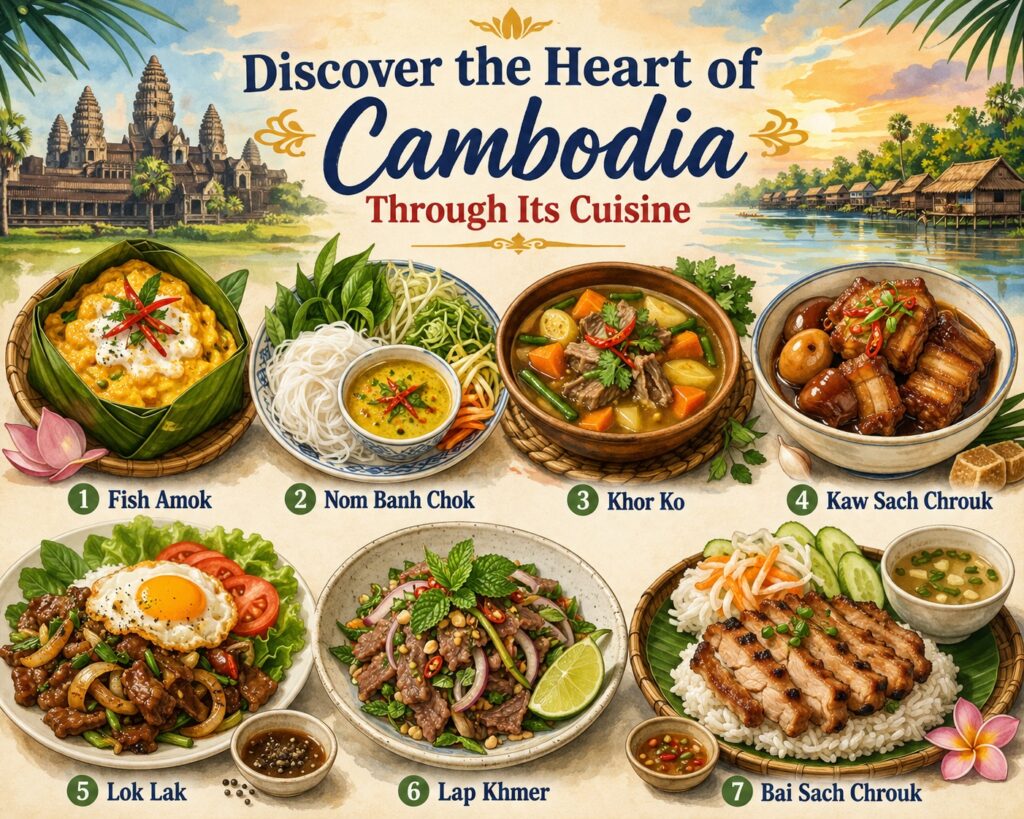
Discover the Heart of Cambodia Through Its Cuisine
When travellers think of Southeast Asian cuisine, they often imagine the vibrant street food of Thailand or the refined balance of Vietnamese cooking. Yet Cambodia quietly preserves one of the region’s oldest and most authentic culinary traditions. Shaped by more than a thousand years of history, influenced by neighbouring cultures while maintaining its own distinctive identity, Khmer cuisine offers an unforgettable gastronomic journey that deserves far greater international recognition.
Cambodian food is built upon harmony rather than intensity. Instead of overwhelming heat or excessive sweetness, Khmer cooking emphasises balance. Fresh herbs, aromatic spices, coconut milk, palm sugar, freshwater fish, fragrant rice and seasonal vegetables combine to create dishes that are subtle, comforting and remarkably complex. Every meal reflects the country’s close relationship with the land, the Mekong River and Tonlé Sap Lake, whose abundant fisheries have sustained generations of Cambodians.
Visitors soon discover that eating in Cambodia is much more than satisfying hunger. Meals are social occasions, often shared by family and friends around several communal dishes. Morning markets burst with colour and fragrance as vendors prepare breakfast before sunrise. Street stalls serve recipes handed down through generations, while restaurants reinterpret traditional flavours with contemporary elegance.
Unlike some culinary destinations where international tourism has dramatically transformed local food, much of Cambodia still offers remarkably authentic experiences. Whether dining in a small family restaurant in Battambang, enjoying breakfast beside the river in Kampong Cham or exploring the bustling markets of Phnom Penh, visitors encounter recipes that remain deeply rooted in Khmer tradition.
Another remarkable aspect of Cambodian cuisine is its accessibility. Exceptional meals are available at surprisingly affordable prices, allowing travellers to sample a wide variety of dishes without exceeding their budgets. Combined with the legendary warmth and hospitality of Cambodian people, the country’s cuisine becomes one of its greatest attractions.
This guide introduces seven essential Khmer dishes that every visitor should experience. Together they represent the diversity, history and character of Cambodian cooking, offering a delicious introduction to one of Asia’s most underrated culinary traditions.
1. Fish Amok
Cambodia’s National Treasure
No introduction to Cambodian cuisine would be complete without Fish Amok, widely regarded as the country’s national dish. Elegant, aromatic and beautifully presented, it perfectly embodies the refined nature of Khmer cooking.
Unlike fiery curries found elsewhere in Southeast Asia, Fish Amok is delicate and creamy. Freshwater fish—traditionally snakehead fish, catfish or other local varieties—is gently steamed in a rich coconut curry infused with kroeung, Cambodia’s famous aromatic spice paste. This carefully balanced blend usually includes lemongrass, galangal, turmeric, kaffir lime zest, garlic and shallots, creating layers of fragrance rather than overpowering spice.
One of the dish’s defining characteristics is its presentation. The curry is steamed inside an intricately folded banana leaf cup, which subtly perfumes the fish while creating an attractive natural serving bowl. The result resembles a delicate mousse, with the fish remaining moist and tender within the silky coconut custard.
Fish Amok has royal origins, with variations once served in Cambodia’s historic royal court. Today it remains a centrepiece at celebrations, family gatherings and restaurants across the country.
Although modern versions sometimes substitute chicken or prawns, fish remains the classic choice, reflecting Cambodia’s rich freshwater resources. Tonlé Sap Lake, the largest freshwater lake in Southeast Asia, has supplied fish to Cambodian households for centuries and continues to influence the nation’s culinary identity.
Visitors should not mistake Fish Amok for an ordinary curry. It is a carefully crafted dish requiring patience and skill. The slow steaming process allows every ingredient to blend harmoniously, producing a gentle sweetness balanced by citrus notes and fragrant herbs.
Served with steamed jasmine rice, Fish Amok offers an unforgettable introduction to Khmer cuisine. It is comforting yet sophisticated, traditional yet timeless, and remains the single dish most closely associated with Cambodia’s culinary heritage.
2. Nom Banh Chok
Cambodia’s Favourite Breakfast
As dawn breaks across Cambodia, thousands of vendors prepare one of the nation’s most beloved breakfasts: Nom Banh Chok.
Often referred to as Khmer noodles, this iconic morning meal consists of delicate rice noodles topped with a light green fish curry and an abundance of fresh vegetables and herbs. It is one of the oldest continuously enjoyed dishes in Cambodia, with recipes passed from generation to generation.
The noodles themselves are made from fermented rice before being freshly pressed into boiling water. Their soft texture perfectly complements the fragrant curry, which is prepared from freshwater fish combined with kroeung, turmeric and coconut milk in some regional variations.
Freshness defines the entire dish. A generous selection of banana blossom, cucumber, bean sprouts, mint, basil, water lily stems and other seasonal vegetables adds colour, crunch and vibrant aromas.
Nom Banh Chok demonstrates one of the defining characteristics of Khmer cuisine: balance. The savoury fish curry contrasts beautifully with the crisp vegetables, while herbs provide refreshing notes that lighten every mouthful.
Across Cambodia, regional differences create fascinating variations. Some provinces prepare richer curries, while others favour lighter broths with stronger herbal flavours. Rural villages often use ingredients harvested only hours before serving, creating extraordinary freshness.
The dish is traditionally eaten early in the morning, making it an ideal breakfast before exploring Cambodia’s temples, markets or countryside. Many travellers remember purchasing steaming bowls from bicycle vendors who travel through villages at sunrise.
Beyond its delicious flavour, Nom Banh Chok also represents Cambodian resilience and continuity. Despite periods of enormous hardship during the twentieth century, families preserved this traditional recipe, ensuring its survival as a symbol of everyday Khmer life.
Simple, nutritious and deeply satisfying, Nom Banh Chok offers visitors an authentic taste of Cambodia before the day’s adventures begin.
3. Khor Ko
Cambodia’s Comfort Stew
Every cuisine possesses dishes that evoke memories of home, family and childhood. In Cambodia, Khor Ko occupies this cherished place.
This slow-cooked stew combines tender meat, seasonal vegetables, aromatic herbs and warming spices into one deeply comforting meal. Rich without being heavy, it reflects the Cambodian preference for balanced, nourishing food prepared patiently over many hours.
Recipes vary considerably between households. Beef is often the preferred meat, although pork and chicken also appear in regional versions. Vegetables such as carrots, aubergines, green papaya, long beans and potatoes absorb the fragrant broth while retaining their individual textures.
The foundation of Khor Ko lies in kroeung, whose mixture of lemongrass, galangal, turmeric and garlic infuses the stew with remarkable depth. Fish sauce contributes savoury richness, while palm sugar introduces gentle sweetness that balances the spices perfectly.
Unlike Western stews thickened with flour, Cambodian versions rely on slowly reduced broth and naturally softened vegetables to achieve their satisfying consistency.
Khor Ko is particularly popular during cooler weather and family celebrations, when large pots simmer gently throughout the day before everyone gathers around the table. Like many Khmer meals, it is served alongside steamed rice, allowing diners to enjoy every spoonful of the fragrant broth.
Travellers exploring smaller towns and rural communities often discover exceptional homemade versions unavailable in tourist restaurants. Each family recipe reflects local ingredients, regional traditions and generations of culinary experience.
More than simply a stew, Khor Ko tells the story of Cambodia’s agricultural abundance. Every ingredient reflects the country’s fertile landscapes, from fresh vegetables harvested nearby to herbs grown in home gardens.
For visitors seeking authentic Cambodian comfort food, few dishes offer a more satisfying experience.
4. Kaw Sach Chrouk
Rich, Tender Braised Pork Belly
Few dishes demonstrate the Cambodian mastery of slow cooking better than Kaw Sach Chrouk.
This indulgent recipe transforms pork belly into melt-in-the-mouth perfection through hours of gentle braising. The meat slowly absorbs palm sugar, garlic, pepper, soy sauce and aromatic spices until every bite becomes rich, tender and intensely flavourful.
Palm sugar plays a particularly important role. Produced from Cambodia’s abundant sugar palm trees, it creates subtle caramel notes without excessive sweetness, distinguishing Khmer braised pork from similar dishes elsewhere in Asia.
During cooking, the pork gradually develops a glossy mahogany colour while layers of fat become silky rather than greasy. The resulting sauce is deeply savoury, slightly sweet and wonderfully aromatic.
Many Cambodian families prepare Kaw Sach Chrouk for special occasions, religious festivals and family gatherings. Because it reheats beautifully, it is also a popular dish for large celebrations where relatives gather over several days.
Hard-boiled eggs are frequently braised alongside the pork, absorbing the rich sauce and adding another layer of texture to the meal.
Served with steamed rice and lightly cooked vegetables, Kaw Sach Chrouk offers remarkable balance despite its richness. Fresh cucumber, pickled mustard greens or stir-fried morning glory provide refreshing contrasts that prevent the meal from becoming overly heavy.
The dish also reflects Cambodia’s historical trading connections. Chinese cooking techniques influenced the slow braising process, while Khmer ingredients and flavour preferences created an entirely distinctive recipe.
Visitors seeking hearty traditional cooking should not overlook Kaw Sach Chrouk. Its comforting flavours reveal another side of Cambodian cuisine beyond curries and noodle dishes.
5. Lok Lak
Cambodia’s International Favourite
Among Cambodia’s most famous dishes, Lok Lak enjoys popularity both at home and abroad. Frequently appearing on restaurant menus throughout the country, it introduces newcomers to Khmer flavours through beautifully cooked beef and fresh vegetables.
Tender strips or cubes of beef are marinated before being rapidly stir-fried over high heat. This quick cooking preserves the meat’s juiciness while creating slight caramelisation that enhances its flavour.
However, the true signature of Lok Lak lies in its famous dipping sauce. Fresh lime juice, salt and Kampot pepper combine to create an extraordinarily simple yet unforgettable accompaniment.
Kampot pepper deserves particular recognition. Grown in southern Cambodia, it is considered among the world’s finest peppers, prized by leading chefs for its exceptional aroma and complex flavour. The pepper’s floral, citrus and slightly sweet characteristics elevate Lok Lak far beyond an ordinary beef stir-fry.
The beef is typically served over crisp lettuce with sliced tomatoes, cucumbers and onions, creating a refreshing contrast to the savoury meat. Many restaurants also include a fried egg on top, allowing the rich yolk to blend naturally with the sauce.
French colonial influence can also be detected in Lok Lak. Some historians believe aspects of the dish evolved through interactions between Khmer cooking traditions and French culinary techniques during the colonial era.
Easy to appreciate yet unmistakably Cambodian, Lok Lak appeals equally to adventurous food enthusiasts and cautious first-time visitors. Its familiar ingredients combined with uniquely Khmer seasoning make it one of Cambodia’s most universally loved dishes.
6. Lap Khmer
A Fresh Celebration of Herbs and Citrus
Cambodian cuisine is not solely about slow cooking and rich curries. Lap Khmer demonstrates the country’s equally impressive ability to create vibrant, refreshing dishes filled with fresh herbs and bright citrus flavours.
This traditional beef salad combines thinly sliced beef with lime juice, fragrant herbs, vegetables and aromatic seasonings. The result is light, colourful and bursting with freshness.
Depending on regional preference, the beef may be lightly cooked or cured in citrus juice, although modern restaurants generally serve lightly seared meat for food safety.
Mint, basil, coriander, spring onions, cucumber, shallots and crisp vegetables create multiple layers of flavour and texture. Fish sauce contributes savoury depth, while lime juice provides lively acidity balanced by a small amount of palm sugar.
Roasted peanuts occasionally add satisfying crunch, while chilli can be adjusted according to individual preference.
Lap Khmer beautifully illustrates Cambodia’s understanding of balance. Every ingredient complements rather than dominates the others. Fresh herbs cool the palate, citrus awakens the senses and tender beef provides satisfying richness without heaviness.
Often served as a starter or shared dish, Lap Khmer pairs particularly well with grilled meats and steamed rice. During Cambodia’s warm climate, its refreshing qualities make it especially popular for lunch or evening meals.
Visitors frequently discover that this salad changes their perception of Cambodian food. Far from being exclusively rich or coconut-based, Khmer cuisine also celebrates freshness, simplicity and the natural quality of locally grown ingredients.
7. Bai Sach Chrouk
The Breakfast Every Cambodian Knows
For countless Cambodians, no morning feels complete without Bai Sach Chrouk.
This seemingly simple breakfast consists of thinly sliced pork marinated in garlic, coconut milk and seasonings before being grilled slowly over charcoal. The caramelised meat is then served over fragrant jasmine rice, often accompanied by pickled vegetables, fresh cucumber and a light bowl of clear soup.
Its simplicity conceals remarkable skill. The pork must be marinated long enough to absorb flavour while remaining delicate and juicy. Charcoal grilling adds gentle smokiness that perfectly complements the natural sweetness created during caramelisation.
Across Cambodia, Bai Sach Chrouk vendors begin preparing long before sunrise. As charcoal fires ignite and aromatic smoke fills the morning air, local residents gather for breakfast before work or school.
The accompanying pickled vegetables introduce refreshing acidity, balancing the richness of the grilled pork. Meanwhile, the light soup cleanses the palate and provides gentle warmth during the early hours.
Affordable, nourishing and consistently delicious, Bai Sach Chrouk represents everyday Cambodian life perhaps better than any other dish. It is not reserved for celebrations or restaurants but enjoyed daily by people from every walk of life.
Travellers seeking authentic local experiences should rise early and visit neighbourhood breakfast stalls rather than hotel buffets. Sitting alongside local families while enjoying freshly grilled pork over rice offers genuine insight into Cambodian daily culture.
Sometimes the simplest meals become the most memorable, and Bai Sach Chrouk proves exactly that.
Why Food Lovers Should Visit Cambodia
Cambodia may still be an emerging culinary destination, but that is precisely part of its appeal. Visitors discover authentic recipes, passionate cooks and remarkably fresh ingredients without the overwhelming crowds found elsewhere in Southeast Asia.
Authentic Khmer Flavours
Cambodian cuisine has preserved its unique identity despite influences from neighbouring countries. Traditional recipes continue to be prepared using techniques refined over centuries, allowing visitors to experience genuine Khmer cooking rather than heavily commercialised versions.
Fresh Local Ingredients
Markets overflow with tropical fruit, aromatic herbs, freshwater fish, vegetables and spices harvested locally each day. Cambodia’s fertile countryside supplies restaurants with exceptional produce, ensuring freshness remains central to every meal.
Rich Culinary Heritage
Khmer cuisine reflects one of Asia’s oldest civilisations. Ancient cooking traditions developed during the Khmer Empire continue to influence modern recipes, creating a fascinating connection between Cambodia’s history and its contemporary food culture.
Affordable Street Food
Excellent food need not be expensive. Cambodia offers extraordinary value for travellers, with delicious breakfasts, snacks and complete meals available at prices significantly lower than many neighbouring destinations. This affordability encourages visitors to sample a wide variety of regional specialities.
Friendly Local Hospitality
Perhaps Cambodia’s greatest culinary ingredient is its people. Visitors are frequently welcomed with genuine warmth, whether eating at family-run restaurants, village markets or busy street stalls. Many cooks proudly explain their recipes, recommend favourite dishes and happily introduce travellers to local flavours.
Final Thoughts
Cambodia’s cuisine deserves a place among the world’s great culinary traditions. Built upon balance, freshness and centuries of cultural heritage, Khmer food offers experiences that are both deeply authentic and wonderfully approachable.
From the elegant coconut curry of Fish Amok to the smoky simplicity of Bai Sach Chrouk, every dish tells part of Cambodia’s story. Slow-cooked stews, fragrant noodle soups, refreshing salads and expertly grilled meats reveal remarkable diversity while sharing a common philosophy of harmony and respect for natural ingredients.
For travellers, exploring Cambodia through its food becomes one of the most rewarding aspects of the journey. Every market, village, riverside café and family restaurant offers opportunities to discover recipes that have nourished generations.
Whether you are an adventurous foodie seeking new flavours or simply someone who appreciates honest, beautifully prepared meals, Cambodia promises unforgettable culinary discoveries. Beyond the magnificent temples of Angkor and the country’s spectacular landscapes lies another treasure waiting to be explored: one of Southeast Asia’s most authentic and underrated cuisines.
The next time you plan a journey through Asia, make sure that tasting Khmer food is as high on your itinerary as visiting the country’s famous historical sites. One meal is enough to understand why so many travellers leave Cambodia not only with unforgettable memories but also with a lasting appreciation for its remarkable culinary heritage.