
The Restaurant by the River
Chapter 1
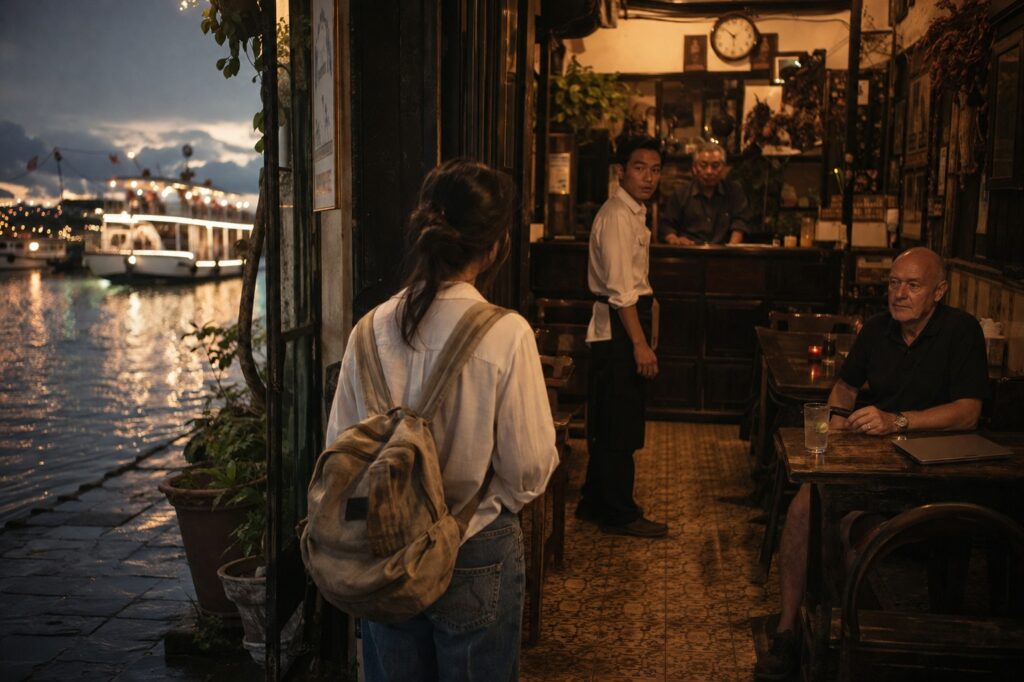
Anyone who had walked along Bến Ninh Kiều often enough would have noticed something curious about the Mekong Restaurant.
It never seemed to change.
Restaurants came and went. Cafés reinvented themselves every few years, changing names, colours and menus with the enthusiasm of people convinced that novelty alone attracted customers. Along Đường Hai Bà Trưng, new hotels had appeared, convenience stores had replaced old family businesses, and coffee chains with air conditioning and minimalist furniture now stood where small shops had once sold nothing more complicated than cigarettes and condensed milk.
The Mekong Restaurant had ignored all of it. It had no reason to become fashionable. It had survived fashions.
A little before three o’clock, Mr Hoàng parked his ageing Honda beside the restaurant.
The afternoon rain had already passed.
The stone pavement along the promenade still shone beneath a pale sky, and the Hậu River moved with the heavy, deliberate confidence that always announced the beginning of the rainy season. Somewhere upstream, beyond places neither Mr Hoàng nor most of his customers would ever visit, thousands of square kilometres of rainwater were already making their slow journey towards the East Sea.
He removed his helmet and stood for a moment looking across the river. Not because he expected to see anything unusual. Simply because he always did.
Then he slipped the helmet onto the motorcycle’s handlebar, took a small bunch of keys from his pocket and walked towards the front of the restaurant.
Two large metal gates separated the dining room from the promenade after closing time.
Nothing elegant.
Nothing decorative.
Just painted steel that had faithfully performed the same task for decades.
Mr Hoàng unlocked the padlock fixed between the two gates.
Then, placing one hand on each side, he pushed them slowly apart. The hinges answered with the familiar groan that everyone who worked there knew by heart.
When the gates finally rested against the walls on either side, there was no entrance to cross.
No door.
No windows.
The restaurant became part of Bến Ninh Kiều again.
The breeze drifted straight in from the river. So did the sounds.
Motorbikes.
Laughter.
The low engines of tourist boats.
A bicycle bell.
Someone calling across the promenade.
Some restaurants tried to keep the city outside.
The Mekong Restaurant had always preferred to invite it in.
Mr Hoàng stepped behind the counter.
Nothing had moved since closing the previous evening. Nothing ever did. The same polished wooden tables. The same dark counter. The same photographs quietly observing the room from the walls.
At the back of the restaurant, the old clock continued measuring time with complete indifference to everyone around it.
He glanced at it automatically.
Ten to three.
Plenty of time.
He picked up a clean cloth and began wiping the tables. Not because they were dirty. Lý had cleaned everything thoroughly before they closed the night before.
This was simply the beginning of another afternoon.
The first table nearest the promenade. Then the second. Then the third. By the fourth table, footsteps approached.
Mr Hoàng did not look up.
“You’re early.”
“Dạ.”
Lý appeared carrying his helmet beneath one arm.
His expression, as always, suggested that life had disappointed him at a very early age and had done little since to improve matters.
Juan once claimed that Lý looked like a hyena. On another occasion he had reconsidered.
“No,” he had said. “More like a Tasmanian devil on Valium.”
Laurent had nearly choked on his beer.
Lý, hearing none of this because the conversation had taken place in English, had continued serving drinks with the same expression he wore every day.
Someone else—Juan could no longer remember who—had christened him Mr Dog. The nickname had survived.
Lý, naturally, never knew.
He placed his helmet beneath the counter.
“Looks like more rain.” Mr Hoàng glanced towards the western sky.
“It wouldn’t be July without it.” That was the end of the conversation. There was rarely any need for more.
Lý disappeared into the kitchen.
A few moments later came the familiar sounds that meant another working day had begun.
Rice being washed. A chopping board placed on the worktop. The rhythmic movement of a knife through spring onions. Metal pans being lifted from their hooks.
The restaurant was waking up.
Mr Hoàng continued arranging the dining room. One chair had drifted slightly away from its table. He pushed it back. A menu lay upside down. He turned it over.
One of the ceiling fans made a faint clicking sound every seventh or eighth rotation.
It had done so for years.
Nobody had ever felt sufficiently annoyed to replace it.
Outside, Bến Ninh Kiều was gradually changing its rhythm.
The hottest hours of the day were over.
Families began appearing.
Couples walked slowly beneath the trees.
A group of teenagers stopped beside the river to take photographs, spending considerably longer deciding how to pose than actually looking at the view behind them.
An elderly man passed the restaurant on his bicycle, exactly as he did almost every afternoon. Mr Hoàng nodded. The cyclist raised two fingers from the handlebars without slowing down. Neither man knew the other’s name. Neither needed to.
Some acquaintances were measured in words.
Others in years.
By half past three everything was ready.
The restaurant entered that curious period between preparation and arrival.
Nothing happened. Which, in the Mekong Restaurant, meant that almost everything important was happening.
Mr Hoàng stood quietly behind the counter looking out towards the river.
Lý emerged from the kitchen carrying a crate of bottled water. He stopped beside the open frontage.
“The river’s higher.” Mr Hoàng nodded. “It always tells you before the weather does.”
Lý looked towards the broad brown water for a few seconds. He never understood how Mr Hoàng could read the river like that.
Then again…
Mr Hoàng had been looking at it almost every day for most of his life.
Perhaps rivers, like people, eventually began talking to those patient enough to listen.
Outside, the first tourists slowed their pace as they glanced towards the restaurant. Some looked at the menu displayed near the entrance. Others peered inside before continuing their walk along the promenade. None came in. Not yet. That would begin shortly after four.
The first customers were almost always local. The foreign residents would arrive later. They always did.
And among them, if the afternoon followed its usual course, one man carrying a laptop would eventually appear from the direction of the statue of Uncle Hồ, glance briefly at the river, sit at his customary table beside the entrance, and discover—once again—that his Gin and Tonic had somehow arrived before he had.
The first customers arrived at four o’clock almost to the minute. They usually did.
Mr Hoàng often joked that Vietnamese pensioners were more reliable than Swiss watches. If they decided to have an early dinner, they would appear with such astonishing punctuality that there was little point looking at the clock.
An elderly couple crossed the promenade together and stepped into the restaurant. Lý acknowledged them with the slightest inclination of his head.
No smile.
There never was.
The gentleman returned the greeting as naturally as if they had seen each other only yesterday. Which, in fact, they had.
Without asking a question, Lý led them to their usual table overlooking the river.
There was no need for menus.
He disappeared into the kitchen.
Less than a minute later, he returned carrying a pot of hot tea.
Again, nobody had ordered it.
Some customers never needed to.
Mr Hoàng watched the scene from behind the counter.
Routine, he often thought, was one of the most underrated forms of kindness.
People spent their lives making decisions.
What to study.
Where to work.
Whether to marry.
Whether to stay.
Whether to leave.
At least here, for an hour or two, they could be spared a few of those choices.
The restaurant already knew.
Outside, another tourist boat eased slowly away from the pier.
The loudspeaker crackled into life.
A recorded welcome in Vietnamese was followed by another in English, inviting passengers to enjoy the sunset cruise along the Hậu River.
The words floated briefly into the restaurant before disappearing beneath the steady murmur of traffic.
One of Lý’s peculiarities was that, when he attempted humour, he delivered it with the same expression he wore while announcing that a customer wanted another bowl of rice.
It took people months to realise he was joking.
Some never did.
The elderly couple’s dinner appeared.
Steam drifted upwards from the bowls.
The woman thanked Lý quietly.
He nodded once.
Nothing more.
Juan often said that Lý could conduct an entire conversation using no more than three words and a movement of his eyebrows.
It was only a slight exaggeration.
A few minutes later, two young backpackers stopped outside.
They studied the menu displayed beside one of the open metal gates.
One pointed uncertainly at several dishes before looking inside.
Lý noticed them immediately.
He waited.
Experience had taught him that tourists generally fell into two categories.
Those who had already decided to come in.
And those who were looking for someone else to decide for them.
These belonged unmistakably to the second group.
After nearly a minute of whispered discussion, they finally entered.
One of them pointed towards the menu.
“This?”
Lý looked where the finger indicated.
He nodded.
“Good.”
The young man hesitated.
“And… this?”
Another nod.
Also good.
The tourists looked at one another.
The decision had apparently been made.
They sat down.
At twenty past four another table filled.
Then another.
The dining room slowly acquired the familiar rhythm that never seemed hurried, no matter how busy it became.
Plates emerged from the kitchen.
Empty glasses disappeared.
Fresh herbs arrived.
Bowls of rice replaced those already finished.
Everything happened with the quiet precision of people who had performed the same movements so many thousands of times that they no longer appeared to think about them.
Outside, the afternoon softened.
The rain had cleared the air, and the sunlight returned cautiously through breaks in the cloud.
Across the river, buildings on the opposite bank shimmered faintly in the humid heat.
Children ran along the promenade chasing one another around the benches.
A balloon seller drifted slowly through the crowd, the coloured balloons floating above him like an improbable tree.
Mr Hoàng looked towards the river again.
Five o’clock was approaching.
He did not check the clock.
He did not need to.
Instead, he looked towards the statue of Uncle Hồ.
A familiar figure had just appeared.
Laptop bag over one shoulder.
Walking neither quickly nor slowly.
Simply walking.
Juan.
He stopped, as he almost always did, for a moment beside the riverside wall.
He looked across the Hậu River.
Nobody knew what he was thinking during those few seconds. Perhaps nothing at all.
Then he resumed walking.
Lý had already reached beneath the counter.
Ice.
Three cubes.
Gin.
Tonic.
A slice of lime.
Nothing else.
By the time Juan stepped into the restaurant, the glass was waiting on his table.
The best table in the house.
The table tucked behind the entrance steps. Right beside the open frontage.
Officially, it belonged to no one.
Unofficially, everyone knew better.
Laurent usually occupied it when Juan was travelling.
Juan stopped beside the table and looked at the waiting drink.
He turned towards Lý.
“I see you’re still refusing to let me make my own decisions.”
Lý looked at him.
“You’d order this.”
“I might have surprised you.”
“No.”
Juan laughed.
“You have far too much confidence in human nature.”
“No.”
Lý paused.
“In yours.”
Mr Hoàng looked up from the counter.
“He’s right.”
Juan placed his laptop on the table.
“I find it slightly worrying that you both know me better than I know myself.”
“You’ve been coming here long enough,” said Mr Hoàng.
Juan sat down and raised the glass.
“To old habits.”
Nobody replied.
They didn’t need to.
Old habits were precisely what held the Mekong Restaurant together.
Juan opened his laptop.
The screen filled with half-finished notes for an article.
He stared at them for perhaps thirty seconds.
Then looked out towards the river instead.
The cursor continued blinking patiently behind him.
Waiting.
It would have to wait a little longer.
Juan closed the laptop.
Not dramatically.
Simply because, once again, it had become impossible to compete with the river.
“It wins every time,” he said quietly.
Mr Hoàng looked up from the counter.
“What does?”
“The view.”
“It usually does.”
Juan leaned back and lifted his glass.
“I’ve been trying to finish the same article for three days.”
“And?”
“The Hậu River objects.”
Mr Hoàng nodded as though that explained everything.
Perhaps it did.
Outside, the afternoon was slowly surrendering to evening.
The sunlight had softened, losing the harsh brilliance of the tropics and settling instead into a warm amber glow that stretched across the promenade. The wet paving stones still reflected the light from passing scooters, while the river carried long ribbons of gold towards the east.
Juan had often wondered why he found this hour so difficult to describe.
Sunsets were easy.
Night was easy.
Late afternoon, however, existed in a world of its own.
It was neither one thing nor the other.
Like many moments in life, it lasted only a few minutes before disappearing unnoticed.
The restaurant was almost full now.
At street level, just to the right of the entrance, stood the restaurant’s other reserved table—the best seat in the house. It was never marked as reserved, yet everyone knew better. It belonged to the long-standing foreign residents who had made the Mekong Restaurant part of their daily lives. Laurent. Aaron. Vincent. Russell. And, now and then, another familiar face. They had long since ceased to be tourists. Like Mr Hoàng, and the old clock on the back wall, they had simply become part of the restaurant.
“I live among dangerous people.”
Lý had already disappeared.
Juan watched him crossing the restaurant.
It was remarkable how someone could move so efficiently while looking permanently unimpressed by the entire human race.
Years earlier, Juan had attempted to photograph him smiling.
After three weeks, he abandoned the project.
“I’ve seen solar eclipses more often,” he had announced.
Laurent had suggested framing the empty photograph anyway.
“It would still be the closest thing to a picture of Lý smiling.”
Even Mr Hoàng had laughed at that one.
Only Lý remained entirely unaware that he had become something of a local legend among the restaurant’s foreign regulars.
Outside, another group of tourists paused to look inside.
One couple entered.
The others continued walking.
A family with two young children stopped briefly to examine the menu before deciding that pizza somewhere else might produce fewer negotiations.
Mr Hoàng watched them leave.
“The children made the decision.”
“They usually do,” Juan replied.
The owner nodded.
“Parents like to think otherwise.”
A boat’s horn echoed across the river.
The evening dinner cruises were beginning.
Slowly, one after another, the brightly decorated vessels eased away from the quay, carrying visitors towards the floating restaurants upriver. Their reflections trembled on the darkening water before dissolving into the current.
Juan followed them with his eyes.
“Do you ever get tired of looking at that?”
Mr Hoàng considered the question.
“No.”
“You didn’t even think.”
“I’ve had fifty years to think.”
Juan smiled.
“Fair point.”
For a while neither man spoke.
They rarely felt any obligation to fill silence with conversation.
That was another reason Juan kept returning to the Mekong Restaurant.
Too many places demanded noise.
This one accepted silence as perfectly respectable company.
A slight movement beyond the open gates caught his attention.
A young woman had stopped beneath one of the trees opposite the restaurant.
She wore faded blue jeans, a pale cotton blouse and carried an old canvas backpack that looked too large for her slight frame.
Nothing unusual about that.
Students often dressed the same way.
She might have been waiting for a friend. Or deciding where to eat. Yet she did neither. She simply stood there. Watching. Not the river. Not the passing boats. The restaurant.
Juan took another sip of his drink.
Five minutes later, she was still there.
He glanced towards Lý.
“Your girlfriend?”
Lý looked in the direction Juan indicated.
“No.”
“You didn’t even look properly.”
“I don’t need to.”
Juan raised an eyebrow.
“You’ve become psychic.”
“No.”
Lý adjusted two chopsticks that had somehow moved a fraction out of line.
“If she knew me…”
He paused.
“…she wouldn’t be waiting.”
Juan laughed.
“There speaks the eternal optimist.”
Lý disappeared into the kitchen.
Juan continued watching the young woman.
There was something curious about the way she looked at the restaurant.
Most people saw a place to eat.
She looked at it as though searching for confirmation that it really existed.
Almost as if she had imagined it for a very long time and feared reality might disappoint her.
She took a tentative step forward.
Stopped.
Looked at the river.
Then back at the restaurant.
Her right hand tightened around the strap of the backpack.
She seemed nervous.
Not frightened.
Apprehensive.
As though crossing those few metres from the promenade required more courage than she had expected.
Juan turned slightly towards Mr Hoàng.
“Have you seen her before?”
Mr Hoàng followed his gaze.
He watched her for several seconds.
Then slowly shook his head.
“No.”
“She’s been standing there quite a while.”
“I know.”
“What do you think?”
Mr Hoàng looked back towards the counter.
“I’ve learned not to guess.”
Juan nodded.
Experience had taught him the same lesson.
The previous year had begun with an ordinary afternoon.
A waiter had left the restaurant.
Everyone had assumed he would return.
He never did.
Since then, they had all become a little more cautious about making assumptions.
Outside, the young woman finally drew a deep breath.
She looked once more at the faded sign above the restaurant.
Then, almost imperceptible, she nodded to herself.
As though a private decision had finally been made. She crossed the promenade. Stepped between the open metal gates. And entered the Mekong Restaurant.
The young woman paused just inside the entrance. Not because anyone had stopped her. Because, for a few seconds, she simply looked.
Slowly.
Almost cautiously.
Her eyes moved from one side of the restaurant to the other.
The counter.
The photographs on the walls.
The kitchen door.
The old clock at the back.
Then the tables.
One by one.
It was not the look of someone choosing where to sit.
It was the look of someone recognising a place she had never seen before.
Lý noticed immediately.
People usually entered a restaurant with a purpose.
Hungry.
Curious.
In a hurry.
This young woman behaved as though she had crossed an invisible border.
He walked towards her.
His expression, as always, revealed nothing.
“Dạ?”
She turned towards him.
For a moment she seemed about to ask a question.
Instead she looked around the room once more.
“Is Mr Hoàng here?”
Lý nodded towards the counter.
“He is.”
Mr Hoàng had already been watching her from the moment she stepped inside.
There was nothing particularly unusual about her.
Perhaps twenty-three or twenty-four.
Dark hair tied back carelessly.
No jewellery except a simple silver bracelet.
A faded canvas backpack that had clearly travelled some distance.
And something else.
An accent.
Soft.
Unmistakably from the Delta.
He could not have said exactly where.
Only that it was not Cần Thơ.
The young woman approached the counter.
She stopped a respectful distance away.
“Cháu chào bác.”
Mr Hoàng inclined his head.
“Chào cháu.”
“I’m sorry to disturb you.”
“You’re not disturbing anyone.”
She hesitated.
“I’ve come from Trà Vinh.”
Juan looked up from his glass.
Trà Vinh.
The name meant nothing unusual in itself.
People came from Trà Vinh every day.
Students.
Families.
Businessmen.
Yet the way she had said it suggested that the journey itself somehow mattered.
Mr Hoàng waited.
Years of running the restaurant had taught him that silence was often more useful than questions.
The young woman reached into her backpack.
She did not remove anything.
Instead she seemed to change her mind.
Her hand emerged empty.
“I wanted to ask you something.”
“Of course.”
She looked directly at him for the first time.
“Were you the owner here… last year?”
Mr Hoàng’s expression remained unchanged.
“Yes.”
“And… did you have a waiter called Phong?”
The name seemed to hang in the warm evening air.
At the nearest table someone continued eating.
A child laughed.
Outside, another tourist boat sounded its horn as it left the quay.
Ordinary life continued exactly as before.
Yet for those who knew the name, the room suddenly felt different.
Juan slowly put down his glass.
Mr Hoàng answered without hesitation.
“Yes.”
“He worked here.”
The young woman lowered her eyes.
She nodded once, almost imperceptibly, as though confirming something she had suspected for a very long time.
“I thought so.”
Neither Hoàng nor Lý spoke.
They had learned, over the past year, never to rush people who came asking about Phong.
Some wanted information.
Some brought rumours.
A few simply wanted to satisfy their curiosity.
This young woman was different.
She had not asked whether Phong had disappeared.
She had not asked what had happened.
She had asked only whether he had worked there.
As though that answer had to come first.
Lý quietly placed a glass of iced tea on the counter.
She looked surprised.
“I didn’t order…”
“You’ve come a long way.”
His voice was as flat as ever.
“The tea is on the house.”
She thanked him softly.
For the first time, Juan noticed that her hands were trembling.
Only slightly.
Enough for the ice cubes to rattle gently against the glass when she picked it up.
She did not drink.
She simply held it.
Mr Hoàng looked at her calmly.
“What is your name?”
“Liên.”
“Have we met before, Liên?”
She shook her head.
“No.”
“Then why have you come here?”
She looked towards the open frontage.
Beyond the restaurant, the Hậu River flowed past Bến Ninh Kiều exactly as it had the previous summer.
Boats.
Lights.
Voices.
Everything looked unchanged.
She wondered whether places remembered people.
Whether this restaurant remembered him.
Finally she looked back at Mr Hoàng.
“I wasn’t looking for the restaurant.”
She paused.
“I was looking for the people who knew him.”
Silence.
It was Juan who broke it.
Gently.
“You knew Phong?”
Liên turned towards him.
She had noticed the foreigner when she entered, but had assumed he was simply another customer.
She nodded.
“Only for a few hours.”
Juan frowned.
“Only a few hours?”
“He saved my life.”
No one moved.
Lý’s eyes remained fixed on her.
Mr Hoàng’s hands rested quietly on the counter.
Juan felt the familiar tightening in his stomach that always came just before a story took an unexpected direction.
Liên drew a slow breath.
“It happened almost a year ago.”
She looked down at the untouched tea.
“I never knew his full name.”
“He never told me where he worked.”
“I didn’t even know if Phong was his real name.”
Another pause.
“But before we said goodbye…”
A faint smile crossed her face.
“…he told me that if I was ever in Cần Thơ…”
Her voice almost disappeared.
“…I should visit the Mekong Restaurant.”
She looked around once more.
“I promised him I would.”
Outside, the lights of the riverboats shimmered on the dark water.
Inside the restaurant, no one spoke.
Because each of them was thinking exactly the same thing.
Phong had never had the chance to say goodbye to anyone.
Except, perhaps…
to the young woman now standing before them.