
Khmer Dance Traditions and Youth in Vietnam’s Mekong Delta
Introduction
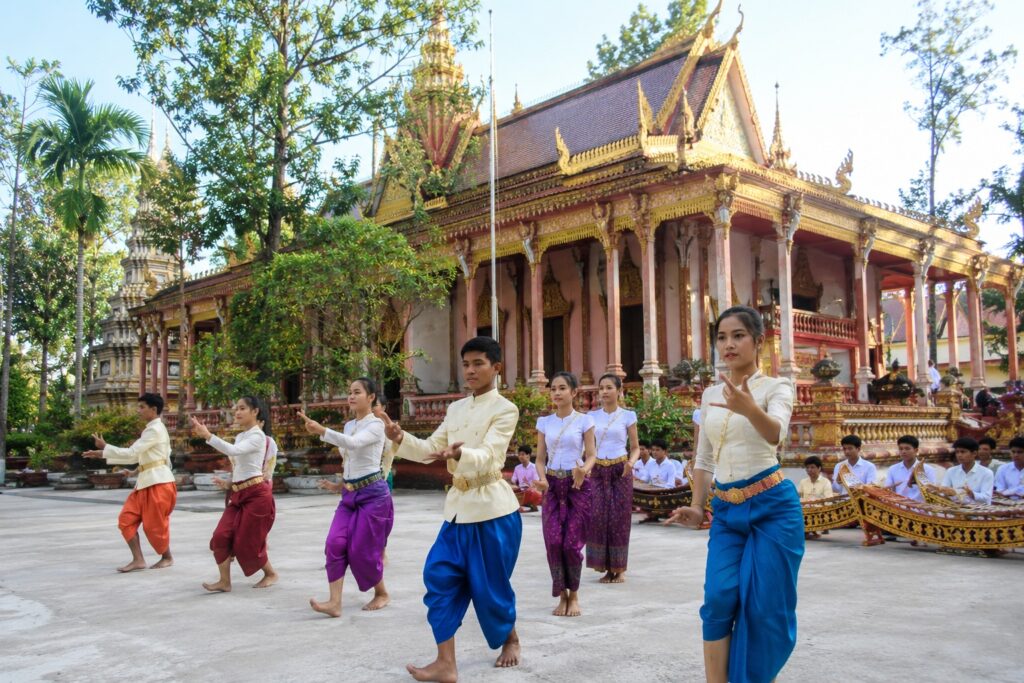
As dusk settles over the Mekong Delta, Khmer pagoda courtyards transform: monks’ chanting gives way to drums, traditional instruments and young dancers rehearsing steps passed down through generations. These performances embody a living tradition, evolving while rooted in the spiritual and social fabric of the Khmer Krom community.
For centuries, the Khmer Krom have maintained a distinct identity—Theravāda Buddhism, language, festivals, music, dance and arts. Despite modernisation and globalisation, they have preserved their heritage. Central to this has been the pagoda.
Khmer pagodas serve as education centres, repositories of collective memory, artistic venues and gathering places. Historically, boys received formal education within temple grounds; monks safeguarded manuscripts and literary works. The pagoda has long been where music, dance and theatre are taught and rehearsed.
Chùa Bốn Mặt in Sóc Trăng (Ấp Phước Thuận, Thuan Hoa, Can Tho) exemplifies ancient traditions flourishing through younger generations. Every afternoon, its courtyard hosts rehearsals of Rom Vong, Sa Dăm, Rô Băm and Dù Kê. For almost a decade, children, students and young adults have gathered there not merely to learn choreography but to participate in the transmission of cultural heritage.
This reflects that intangible traditions survive only through practice. A dance survives when performed; music remains alive when played; stories endure when retold. The true custodians are not only monks or scholars, but the young people who devote their afternoons to mastering ancestral movements.
This article explores the pagoda’s role as a living cultural institution through Chùa Bốn Mặt, examining how traditional dance expresses community identity, the characteristics of Rom Vong, Sa Dăm, Rô Băm and Dù Kê, and youth’s contribution to ensuring these art forms thrive.
The Khmer Community in Southern Vietnam
Long before modern borders, the Mekong Delta formed part of Khmer civilisation. For centuries, Khmer communities cultivated the land, built temples and developed a way of life intertwined with the river’s rhythms. Though political boundaries shifted, they preserved their identity.
Today, the Khmer people constitute one of Vietnam’s fifty-four officially recognised ethnic groups. Commonly referred to as Khmer Krom (“Lower Khmer”), they are concentrated in the former provinces of Sóc Trăng, Trà Vinh, Kiên Giang, An Giang, Bạc Liêu and parts of Cà Mau. Following administrative reorganisation, they are now primarily found within newly constituted provinces incorporating these historic territories. They share linguistic, religious and cultural traditions with the Khmer population of neighbouring Cambodia, while centuries of coexistence within Vietnam have given rise to distinctive regional characteristics.
Theravāda Buddhism shapes beliefs, education, moral values, arts and community organisation. Festivals, ceremonies, agricultural cycles and performances revolve around the pagoda’s calendar.
The pagoda serves as a religious sanctuary, school, cultural academy, library, meeting place and social centre. Historically, novice monks learned Buddhist teachings, reading, writing, ethics, history and literature. Before state education, the pagoda was the principal institution for knowledge transmission.
Its educational role extended to the arts: musicians trained apprentices, dancers instructed younger performers, troupes rehearsed stories from history, folklore and the Reamker. Learning relied on observation, repetition and patient correction.
This integration reflects culture as something lived, not merely preserved. Architecture provides the setting, but human activity gives it significance.
In recent decades, economic development has drawn young people to cities; global media competes with traditional arts. Yet Khmer communities tell a more optimistic story. Dance clubs, ensembles and theatrical groups attract young people who choose to learn from appreciation, not obligation. Tradition need not oppose modernity; it can provide identity and continuity.
Chùa Bốn Mặt has emerged as an inspiring example—more than a place of worship, a community space where sacred architecture frames the transmission of memory, identity and artistic knowledge.
Chùa Bốn Mặt: More than a Temple
Chùa Bốn Mặt appears a typical Khmer Theravāda temple with sweeping roofs, gilded ornamentation and richly decorated façades. Yet it is not merely a monument to admire, but a place to be lived.
Like many Khmer pagodas, it occupies a unique position in community life. Religious ceremonies remain central, but the temple also serves as an education, arts and social centre. The elderly visit to pray; families gather for festivals; monks teach Buddhist principles and Khmer language; children and young adults learn their cultural heritage.
Architecture reinforces continuity. Multi-tiered roofs evoke Mount Meru; Nāga serpents symbolise prosperity; Garudas, lotus motifs and carvings combine religious belief, mythology and craftsmanship.
Unlike museums, the pagoda is animated by everyday life. Morning brings contemplation—monks, incense, devotees. Afternoon brings activity: musicians arrive, children change into rehearsal clothes, older performers prepare costumes and stage. Parents and grandparents observe.
Rehearsals begin informally—one group practises steps, another tunes instruments. Mistakes are corrected patiently; experienced performers demonstrate repeatedly. Learning occurs through participation, observation and repetition, reflecting traditional training.
As evening approaches, music dominates. Drums establish tempo; percussion and strings accompany dancers in synchronised formations. Some afternoons feature Rom Vong; others focus on Rô Băm or Dù Kê. The purpose remains: knowledge passes from experienced practitioners to future inheritors.
Activities exist because the community values them. Young participants become part of an unbroken chain of transmission. Every rehearsal strengthens their connection to language, history and identity.
In an era when many traditional arts struggle for audiences, Chùa Bốn Mặt offers encouragement. Heritage survives not through policies alone, but because communities inhabit the spaces where culture flourishes. Beneath the golden roofs, sacred architecture frames a sacred endeavour: keeping Khmer music, dances and stories a living inheritance.
The Language of Movement: Khmer Dance Traditions
For the Khmer, dance is a cultural language expressing history, belief and collective memory. Some performances are communal; others demand years of training and convey mythology or classical literature.
Common features: live music, learning through observation and repetition, and performances within pagoda grounds. The courtyard becomes an essential space for transmitting artistic knowledge.
Rom Vong: The Dance of Community
Rom Vong is the best-known and most widely practised Khmer dance, extending beyond Vietnam to Cambodia, Laos and Thailand. Its spirit is togetherness.
Participants form circles, moving clockwise with graceful hand gestures and measured footwork. It welcomes all ages and backgrounds, temporarily dissolving social distinctions.
Choreography appears simple but is carefully controlled. Hand movements evoke nature—flowers, water, branches. Facial expressions remain serene, reflecting harmony, courtesy and mutual respect.
Rom Vong accompanies weddings, New Year (Chôl Chnăm Thmây), the Moon Festival (Ok Om Bok), temple fairs and village festivities. It serves as a social ritual as much as a performance.
Its popularity makes it the first dance many young Khmer learn, developing posture, balance and musical timing while strengthening cultural connection.
Sa Dăm: Echoes of Rural Life
Sa Dăm reflects countryside rhythms. Less familiar outside Khmer communities, it embodies the relationship between people and the agricultural landscape.
Choreography is more energetic, with coordinated formations and expressive arm movements evoking cultivation, harvesting or communal labour. It likely originated as a celebration of agricultural abundance.
Music combines drums, cymbals and melodic instruments. Dancers respond to tempo changes, reflecting the close dialogue between dance and music.
For younger participants, Sa Dăm offers engagement with rural life becoming distant through urbanisation. Through movement, they encounter landscapes and practices of earlier generations.
Rô Băm: Classical Elegance and Sacred Narratives
Rô Băm is the most refined Khmer dance theatre, combining elaborate choreography, symbolic gesture, dramatic storytelling and sumptuous costumes.
Historically associated with royal courts and religious ceremonies, it requires years of training. Every movement has codified meaning—finger position, head inclination, gaze direction. Grace comes through absolute control, transforming movement into visual language.
The repertoire draws on the Reamker (Khmer Ramayana). Heroes, princesses, demons and mythical beings populate stories of loyalty, courage and justice. Audiences recognise characters and symbolic costumes.
Costumes—embroidered garments, golden crowns, intricate jewellery—identify status, powers and moral character.
Learning Rô Băm demands commitment: hours perfecting posture, flexibility, balance and precision. Mastering a role represents years of study.
Dù Kê: Tradition Meets Popular Theatre
Dù Kê reflects popular culture’s vitality. Emerging in the early twentieth century in the Mekong Delta, it combines classical Khmer performance with folk theatre, music and contemporary storytelling.
Narratives are more accessible: romance, comedy, family conflict, moral dilemmas, local history and Buddhist teachings. Spoken dialogue alternates with sung passages, dance and instrumental interludes.
Music responds to mood—intensifying during tension, lightening during humour or romance. This integration gives Dù Kê distinctive theatrical identity.
Dù Kê demonstrates tradition’s capacity to evolve. New productions address contemporary themes while preserving inherited musical vocabulary and techniques. It remains both traditional and relevant.
At Chùa Bốn Mặt, veteran performers pass techniques to younger actors, ensuring Dù Kê remains vibrant community theatre.
Youth as Guardians of a Living Heritage
Tangible heritage—monuments, sites, buildings—represents only part of a community’s inheritance. Songs, dances, theatre, oral traditions and rituals cannot be preserved behind glass. Their survival depends on one generation teaching and another learning.
This is UNESCO’s intangible cultural heritage. It exists only when practised. Every performance is both an artistic event and cultural transmission. Each rehearsal passes accumulated knowledge from experienced practitioners to younger members.
Khmer pagodas function as living classrooms where artistic traditions remain embedded in community life. Transmission continues through personal relationships: masters teach apprentices, older dancers guide beginners, musicians rehearse with children, families encourage participation.
At Chùa Bốn Mặt, many attendees have grown up in a digital world—smartphones, social media, global culture—yet still devote afternoons to centuries-old dances.
This is not rejecting modernity. Young dancers move between worlds: digital communication while rehearsing ancient choreography; modern education while preserving traditional knowledge; full participation in Vietnamese society while maintaining Khmer identity.
Their commitment challenges the assumption that tradition inevitably declines with modernisation. Across the Mekong Delta, community leaders, monks, artists and families have created opportunities for young people to engage actively with heritage.
The pagoda balances continuity and change. Elderly performers share memories; younger participants contribute energy, organisational skills and digital tools. Heritage evolves without abandoning defining values.
This intergenerational dialogue is Khmer tradition’s greatest strength. Older teachers transmit not only skills but stories, ethics, religious symbolism and community understanding. Younger generations ensure traditions remain relevant.
Participation cultivates discipline, patience, cooperation, respect and confidence. Preparing for festivals encourages teamwork; learning complex choreography develops concentration. The arts continue their centuries-old educational role.
Cultural heritage cannot be sustained through legislation alone. Governments may recognise traditions, scholars document them, organisations promote them—but survival depends on communities. Every young person learning Rom Vong, Rô Băm, Dù Kê or accompanying musicians becomes an active participant in preserving an inheritance belonging to Khmer people and to Vietnam’s wider cultural diversity.
In an age of rapid change, Khmer pagoda courtyards offer a hopeful vision. As music fills the temple grounds, dancers forming circles are not simply recreating the past. With every step, gesture and performance, they ensure their heritage continues to live, evolve and inspire generations to come.
Conclusion
As daylight fades over the Mekong Delta, Chùa Bốn Mặt’s courtyard fills with movement. Drums mark another rehearsal; musicians take their places; young dancers form circles beneath ornate roofs. This is not mere practice but a community renewing its cultural memory through shared experience.
Khmer performing arts demonstrate that heritage cannot be measured by monument age or artefact rarity. Temples and manuscripts preserve physical traces; Rom Vong, Sa Dăm, Rô Băm and Dù Kê preserve knowledge, values and expressions giving meaning to community life. Their survival depends on participation, not permanence.
Chùa Bốn Mặt shows how sacred space becomes cultural sanctuary. Religion, education, creativity and social life remain inseparable. The pagoda is not a reminder of Khmer history but an active participant in shaping its future.
Most encouraging is the youth’s role. Globalisation need not erode local cultures. Modern education, digital technology and international influences have not prevented young Khmer from embracing traditions. Cultural identity is not a barrier to the modern world but a source of confidence.
The lessons extend beyond Vietnam. Communities worldwide face preserving intangible heritage in rapidly changing societies. The future of traditional culture depends less on nostalgia than on opportunity. When younger generations can learn, perform and take pride in their heritage, tradition becomes dynamic, resilient and relevant.
As the evening’s final notes drift across the courtyard, the performance ends, but the tradition does not. It lives in teachers’ memories, learners’ dedication, and the certainty that tomorrow, as the sun sets over the Mekong Delta once again, the music will begin again.