
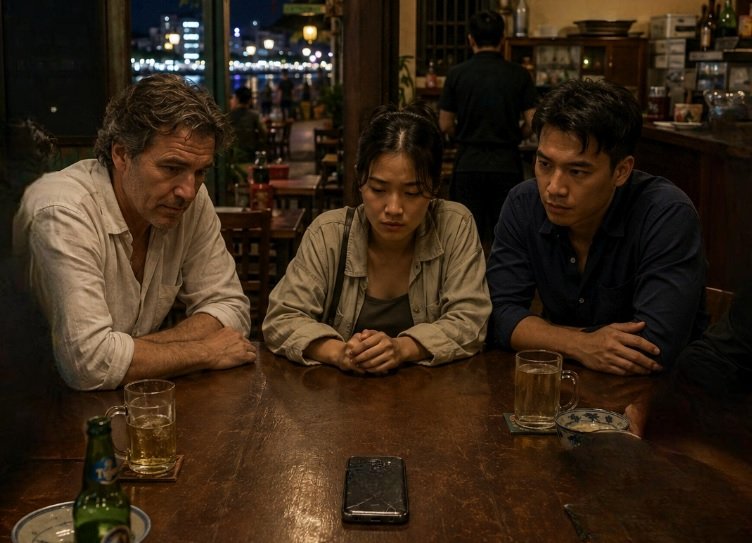
No one had touched it—not because they were afraid to, but because, somehow, it no longer seemed to belong to any one of them. It belonged to Phong.
For several moments, the only sounds came from the restaurant itself: cutlery against porcelain, the hiss of a wok from the kitchen, the occasional clink of a glass, and the steady murmur of conversations rising and falling like the river outside. Life continued. It always did.
The familiar sound of a motorbike stopping broke the silence. Juan looked towards the entrance.
“That’ll be Aaron.”
A moment later, Aaron H. stepped inside, a canvas shoulder bag hanging loosely from one shoulder. He nodded politely to Mr Hoàng behind the counter before looking around the dining room. His eyes stopped on Juan. Then Laurent. Neither of them looked up. That, more than anything else, caught his attention. There was something different in the room tonight. Not obvious. Nothing anyone else would have noticed. But Aaron had known the Mekong Restaurant for too long to miss a change in its atmosphere.
He walked over to their table. “Good evening.”
Juan looked up and smiled. “Evening.”
Aaron pulled out a chair. Then his eyes settled on the old Samsung lying on the table. He frowned. “Where did that come from?”
Laurent looked at him. “It used to be mine.”
Aaron stared at the phone for a moment. “I thought you gave it to Phong.”
“I did.”
“And now…?”
Juan looked towards Liên. “She brought it.”
Aaron turned towards her. “You knew Phong?”
Liên nodded. “Yes.”
“How?”
“I travelled with him.”
Aaron’s expression changed. Not dramatically. Just enough for the others to see that the answer had registered.
“When?”
“The day they disappeared.”
For several seconds, Aaron said nothing. The noise of the restaurant seemed suddenly louder around them. Then he looked back at the Samsung. “Phong had it?”
Laurent nodded. “He did.”
Liên spoke quietly. “He gave it to me.”
Laurent looked at her. “What exactly did he say?”
She hesitated, as though trying to separate the words themselves from everything that had happened around them. “He told me that if one of us got home, I had to bring it here.”
“To the Mekong?”
“Yes.”
“Nothing else?”
“He said it was important.” She looked down at the phone. “He didn’t explain why.”
Laurent smiled. “He always liked leaving people with half a story.”
Liên smiled for the first time. “He did.”
The smile disappeared almost immediately, but for that brief moment the woman sitting opposite them seemed less like someone who had arrived carrying a year of fear and more like someone remembering an ordinary man she had once met.
Aaron looked at her. “Did you know it was Laurent’s?”
“He told me.”
“What did he say?”
“That Laurent had given it to him.”
Laurent looked at the scratched casing. “I haven’t seen it in years.” He reached out, then stopped before touching it. “It still has the crack.”
Aaron looked at him. “You remember that?”
“I dropped it outside my apartment.”
“You blamed the phone.”
“I blamed the pavement.”
Laurent gave him a look. “The pavement was badly designed.”
Aaron shook his head.
For a moment, the tension around the table eased. It was only a small thing—a familiar joke about an old phone—but it was enough to remind them that Phong had once belonged to ordinary life.
Liên looked from one man to another. “He talked about this place.”
Juan glanced around the restaurant. “What did he say?”
“He said it was where people came when they needed somewhere to belong.”
Juan looked around again—the familiar tables, the open frontage, the lights beyond the restaurant, the river. “He wasn’t wrong.”
Liên nodded. For a few seconds she watched the customers around them. A couple were sharing a plate of food near the promenade. At another table, two Vietnamese men were talking quietly over their drinks. Lý moved between them with his usual unhurried efficiency, carrying dishes without ever seeming to hurry.
Then Liên’s expression changed. The warmth disappeared from her face.
“When the van stopped, I didn’t know what was happening.”
Nobody interrupted her. She looked down at her hands.
“There were several men. They were arguing.”
“About us?”
“No.” She shook her head. “About money.”
Aaron’s face tightened.
Liên drew a slow breath. “I remember one sentence.” She looked at them.
The other side pays double.”
The words seemed to settle over the table. No one repeated them. There was no need.
Liên continued. “They took me out first. I tried to resist. I reached for Phong.”
Her fingers tightened slightly against the edge of the table. “He caught my hand.”
For a moment, she closed her eyes. “He told me not to speak.” Her voice became quieter. “Then he gave me the phone.”
“Just like that?” Aaron asked.
She nodded. “He pushed it into my hands. I wanted to give it back. He wouldn’t let me.”
“What did he say?”
Liên looked towards the river. For a moment, she seemed to be listening to a voice that none of them could hear. “He told me to get home.” She paused.
“And if I did…” Her voice faltered. “…he said to bring the phone here.”
Nobody spoke.
Laurent finally looked at the phone again. “He knew.”
Juan looked at him. “What?”
“That he might not make it.”
Liên nodded slowly. “I think he did.” She looked down at her hands. “He wasn’t panicking. He was thinking.”
The sentence remained with them. Because it was perhaps the most disturbing thing she had said. Phong had not simply reacted. Even in those final seconds, with men arguing nearby and the situation collapsing around him, he had been making decisions. He had thought about what might happen next. And he had acted.
Aaron looked at Liên. “How long did you have to decide?”
She shook her head. “There wasn’t really time.”
“And he still managed to do that?”
“Yes.” She swallowed. “He was very calm.”
Laurent nodded slowly. “Yes.”
For several moments, no one said anything more. Then Mr Hoàng approached the table. He had been watching from behind the counter, though none of them had noticed him listening.
His eyes moved first to the Samsung. Then to Liên. “Phong asked you to bring it here?”
“Yes.”
Mr Hoàng nodded once. “Then it stays here.”
Laurent looked at him. “I could charge it.”
Mr Hoàng considered the suggestion. “Later.”
He reached down and picked up the phone. For a moment, everyone expected him to hand it to Laurent. Instead, he turned and walked behind the counter. He opened a drawer and placed the Samsung carefully inside, beneath a folder containing the restaurant’s important documents. Then he closed the drawer and locked it.
He returned to the table. “Tonight,” he said, “we eat.”
Juan smiled. “That sounds like an order.”
Mr Hoàng ignored him. He looked at Liên. “You’ve hardly eaten.”
She shook her head. “I’m not hungry.”
“You will be.”
He turned towards the kitchen. “Lý.”
From somewhere beyond the swinging door came a reluctant reply. Mr Hoàng said something quietly in Vietnamese.
A few minutes later, Lý appeared carrying a bowl of cháo gà. He placed it carefully in front of Liên without a word.
She looked up. “I didn’t order this.”
Mr Hoàng was already walking away. “No.”
Liên looked down at the steaming bowl. For a moment, she said nothing. The smell of the warm broth filled the small space between them. She picked up the spoon. Then, very slowly, she began to eat.
Juan lowered his eyes. Aaron said nothing. Laurent looked towards the river.
None of them wanted to turn the moment into something larger than it was. It was simply a bowl of chicken porridge. A small act of kindness in a restaurant that had seen more than its share of difficult evenings. But for Liên, after everything she had been through, it meant more than any of them could know.
The evening continued along Đường Hai Bà Trưng. Motorbikes passed. Tourists wandered along Bến Ninh Kiều. The lights of the riverfront shimmered on the dark water.
At the Mekong Restaurant, the old Samsung had disappeared into Mr Hoàng’s locked drawer. No one touched it again that night. There was no need. For the moment, it was enough to know that it had made the journey home. And for the first time in a year, someone was listening to Phong’s story.