
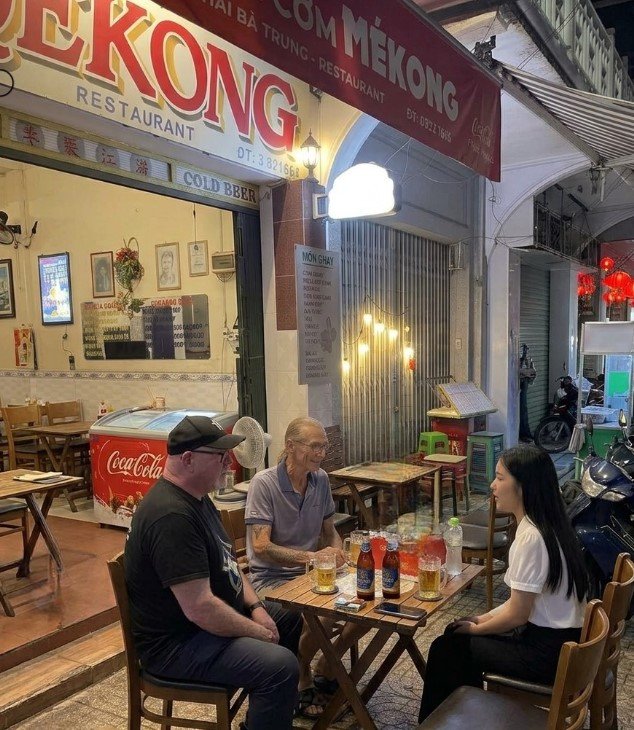
By the end of the week, the Mekong Restaurant had returned to its normal rhythm.
That was perhaps the strangest thing of all.
Customers who knew nothing of Phong’s disappearance continued to arrive as always. Tourists photographed their food before eating, their phones capturing plates of spring rolls and bowls of phở as though the images might somehow preserve the experience. Local families gathered around the larger tables and argued over what to order, children fidgeting impatiently while their parents debated the merits of various dishes. The regulars occupied their usual places, settling into conversations that seemed to have been continuing for years, their voices rising and falling with the easy familiarity of people who had known one another for a long time.
Lý complained silently about everything, his expression suggesting that the world had conspired to make his life unnecessarily difficult. Mr Hoàng continued with his accounts, his pen moving steadily across the pages of his ledger.
For Liên, the rhythm had gradually become familiar.
At first, she had sat quietly at the edge of conversations, listening more than speaking. She had watched the people around her and tried to understand the connections between them, the relationships that Phong had known so well. She had observed the way they moved through the restaurant, the way they greeted one another, the way they slipped into conversations as though they had never been interrupted.
Now she was beginning to settle into that rhythm. She was no longer simply sitting quietly and listening. She was beginning to participate.
That evening, Vincent arrived first. He sat down.
“Beer?”
Lý placed one in front of him.
Vincent smiled. “Thank you.”
Lý walked away without another word.
Liên watched him go. “He really does know.”
Vincent looked at her. “Know what?”
“What everyone wants.”
Vincent laughed. “He’s been doing it for a year.”
A few minutes later, Juan arrived.
Juan kept arriving as though the restaurant were an extension of his own home, taking his usual seat without being asked.
He looked at Liên. “How are you?”
“Better.”
“Good.”
She smiled. “I think I’m beginning to understand Phong.”
Juan sat down. “That could take a while.”
“I know.” She looked around the restaurant. The tables, the people, the familiar sounds had gradually become part of her own experience. “But I understand why he wanted me to come here.”
Juan nodded. “He knew this place. He knew the people. He knew someone would listen.”
Liên was quiet for a moment. Then she asked, “Was he happy?”
The question caught Juan off guard. He looked towards the river before answering. “I think so.”
“You think?”
“Yes.”
“Why?”
Juan smiled. “Because he never needed very much.” He paused. “He liked his work. He liked this restaurant. He liked people. He liked Cần Thơ.”
Vincent nodded. “He liked buying lottery tickets.”
She laughed. “Why did he like them so much?”
Vincent shrugged. “Habit. Hope. Entertainment.”
Juan added: “He liked the ritual.”
“What ritual?”
“Choosing the numbers. Checking them. Keeping the tickets. Sometimes he forgot to check them.”
Liên laughed. “That doesn’t sound very useful.”
Vincent leaned back in his chair. “He once bought the same numbers for six weeks.”
“Why?”
“Because he said changing them would mean admitting he didn’t believe in them.”
Liên smiled. “Did he ever win?”
“Never anything important.”
“Did he care?”
“Not really.” Juan shook his head. “He said the point wasn’t winning.”
“Then what was the point?”
“Having something to look forward to.”
The conversation moved on. They talked about the river, about the changes in Cần Thơ, about the new buildings that had appeared along the waterfront and the old ones that had disappeared. They talked about tourists who ordered dishes they could not pronounce and then insisted they were not spicy, and about the regulars who had been coming to the restaurant for so long that they no longer needed to order. They laughed.
For an hour, nobody mentioned the disappearance. Nobody mentioned Cambodia. Nobody mentioned the men who had taken Phong. For that hour, everything was almost normal.
Then Liên said quietly: “I think I know what I miss most.”
Juan looked at her. “What?”
“He made ordinary things feel important.”
Vincent nodded. “He did that.”
“Perhaps that’s why everyone remembers him.”
Juan looked around the restaurant. “No.” Liên waited. “People remember him because he remembered them.”
She smiled. “That too.”
The evening continued. Later, when the restaurant began to empty and the noise gradually subsided, Russell joined them.
“Phong used to write things down.”
Juan looked at him. “What things?”
“Nothing important.”
“Then why write them?”
Russell smiled. “Because they were important to him.”
He wrote names, dates, small reminders, a note about a birthday, a reminder to call someone. Nothing extraordinary. Nothing that, taken individually, seemed particularly meaningful. Yet together they formed a portrait of a man who had spent his life paying attention, who had understood that the smallest details often mattered most.
“People think they leave behind important things.” Russell looked around the restaurant. “Usually they don’t.” He paused. “They leave habits. Stories. People who remember them.” He looked at Liên. “And sometimes…” He let the words hang for a moment. “…someone who comes back.”
Nobody spoke. Outside, the last tourist boat of the evening moved slowly along the Hậu River. Its lights reflected across the dark water, stretching and breaking with the movement of the river, creating patterns that shifted and reformed with each passing moment.
Liên looked towards the water. A year ago, Phong had disappeared. Now she was sitting in the place he had chosen as the destination for the one thing he had managed to send home.
But she was beginning to understand something. The real thing he had left behind was not an object. It was a network of people—friends, family, colleagues, strangers who remembered him, people who had carried pieces of his life without even realising their importance.
And somewhere among those fragments, there might still be an answer. Not tonight. Perhaps not tomorrow. But it was there. Waiting. Just as Phong had always seemed to be.