
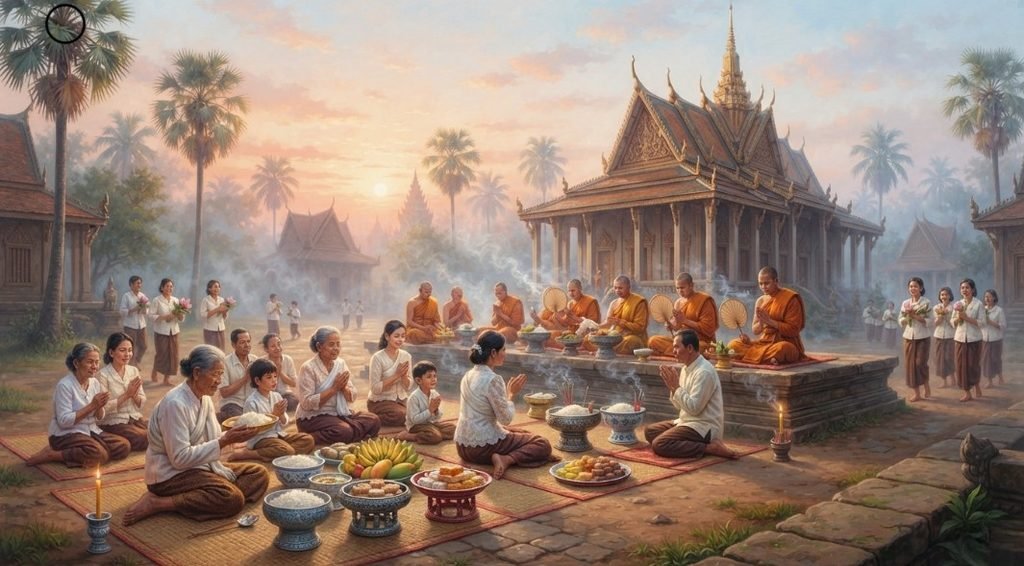
Once a year, as the rainy season draws towards its close, Cambodia turns its thoughts to those who came before. Pagodas fill with families bearing offerings, journeys home become a priority, and ancient beliefs about the afterlife find expression in rituals that remain deeply woven into the fabric of Cambodian life.
11 October 2026
In Cambodia, the dead are not necessarily regarded as beyond the reach of the living. There are times, according to traditional belief, when the distance between the two worlds narrows, allowing departed souls to return and seek the attention of their descendants. Pchum Ben, commonly known as Ancestors’ Day or the Festival of the Dead, is the occasion when Cambodians honour those who have gone before them, making offerings, performing religious rites and renewing bonds that death itself has not entirely severed.
In 2026, the principal public holidays fall on 10, 11 and 12 October, although the religious observance extends over fifteen days. Alongside Khmer New Year, Pchum Ben is one of the most important dates in Cambodia’s cultural and religious calendar. Its significance, however, lies in more than the scale of the celebrations. It offers a glimpse into a worldview in which family obligations do not end with death and remembrance is something to be practised, rather than merely felt.
Fifteen days of remembrance
The festival begins with a fourteen-day period known as Kan Ben, during which families visit pagodas, make offerings and participate in ceremonies. The observance culminates in Pchum Ben, when communities gather for the principal rites.
The name is associated with the coming together of people and the offerings they bring. At its heart lies a familiar but powerful idea: those who are still alive have a responsibility towards those who are no longer here.
Cambodian Buddhists traditionally make offerings and dedicate the merit gained through good deeds to deceased relatives, sometimes extending their remembrance across seven generations. Through generosity, prayer and religious observance, they seek to ease the suffering of departed souls and secure blessings for the living.
The beliefs surrounding the festival reflect the interaction of Theravada Buddhism with older Khmer traditions. Interpretations differ from one family and community to another, but the emphasis on compassion, gratitude and obligations between generations remains central.
Pchum Ben is therefore not simply a time for mourning. It is an affirmation of continuity, a reminder that personal identity is shaped by family histories extending far beyond the span of an individual life.
When the spirits return
Traditional Cambodian beliefs hold that, during Pchum Ben, the gates of the underworld open and certain spirits are permitted to return to the world of the living. Among them are the preta, commonly described as hungry ghosts, whose existence is associated with suffering and the consequences of past deeds.
Such spirits are believed to be unable to receive nourishment in the same way as ordinary beings. The offerings made during Pchum Ben are intended, among other purposes, to help these unfortunate souls.
It would be misleading, however, to treat these ideas as a single, universally accepted account of the afterlife. Buddhist teaching, local folklore and family traditions overlap, and individual Cambodians may understand the rituals in different ways. For some, their significance is primarily religious; for others, the ancestral dimension carries the greatest emotional weight.
What unites these interpretations is the conviction that compassion should extend beyond the visible world. Even the dead, in this understanding, should not be abandoned to their suffering.
Rice for the hungry ghosts
One of the festival’s most distinctive rituals involves bay ben, small balls of sticky rice, sometimes mixed with sesame seeds. In certain communities, devotees gather at pagodas before dawn to scatter or offer them as part of ceremonies intended to provide for hungry spirits.
The timing is significant. According to traditional belief, some spirits cannot benefit from ordinary offerings made during daylight hours, making the early-morning ritual particularly important.
There is something quietly affecting about the scene: families arriving in the darkness, the smell of freshly prepared food, the sound of monks chanting and the gradual emergence of daylight over the pagoda grounds. Religious observance and everyday life meet in an atmosphere that is both communal and intimate.
To an outsider, throwing rice onto the ground might seem an unusual way of addressing the needs of the dead. Within the tradition, however, the act expresses a straightforward form of compassion: the wish to offer sustenance to those who cannot provide for themselves.
It is a small gesture, but one that captures much of the festival’s spirit.
The pagoda at the centre of things
Throughout Pchum Ben, Cambodia’s pagodas become focal points of family and community life. Devotees bring cooked food, rice, fruit, candles and other necessities for the monks. These offerings take on particular significance as the rainy-season retreat, known as Vassa, approaches its conclusion.
Monks conduct ceremonies, recite sacred texts in Pali and lead prayers for the departed. In some traditions, chanting continues overnight as part of the observances associated with the festival.
The food itself is only part of the story. By giving to the monastic community, devotees perform acts of generosity through which they accumulate merit and dedicate its spiritual benefits to their ancestors.
This practice reflects a central feature of Cambodian Buddhist life: religious devotion is expressed not only through belief, but through what people give, what they do and the responsibilities they accept towards others.
The pagoda consequently serves several purposes at once. It is a place of worship, a gathering point for relatives and a setting in which the relationship between the living and the dead is renewed through collective action.
A country travelling home
Pchum Ben is also one of Cambodia’s great annual homecomings.
In the days surrounding the festival, people leave Phnom Penh and other urban centres to return to their home provinces. Roads become busier, transport services face increased demand, and families make arrangements to gather at ancestral pagodas.
For many, the journey is about more than attending a religious ceremony. It is an opportunity to see parents and grandparents, reconnect with relatives and return, however briefly, to the places with which their family history is bound up.
In a country where employment and economic opportunity have drawn many people away from their home communities, this annual return carries particular weight. The festival reasserts the importance of belonging in a society increasingly shaped by mobility and urbanisation.
The practical demands are considerable. Travel costs can be a burden, especially for lower-income households, and public authorities sometimes arrange additional services, including free buses, to help people make the journey.
Yet the underlying impulse is not difficult to understand. Whatever changes in work, income or lifestyle, there are occasions when being present matters more than anything else.
More than a festival of the dead
To describe Pchum Ben simply as a Cambodian festival of ghosts is to overlook its deeper significance. Its subject is not death alone, but the relationship between memory, responsibility and the passage of generations.
Ancestors are remembered because they were parents, grandparents and members of families whose lives helped shape the present. Their sacrifices, their influence and their place in family history are acknowledged through acts that turn remembrance into something tangible.
There is a practical dimension to this, too. People travel, prepare food, give donations, attend ceremonies and spend time with relatives. The past is not commemorated at a distance; it is brought into the present through shared effort.
Nor does the festival stand apart from contemporary Cambodian life. Migration, urban growth and changing economic circumstances have transformed how many families live, yet the observance continues to draw people together. Its endurance suggests that modernisation need not erase older traditions, particularly when those traditions address enduring human concerns.
In this respect, Pchum Ben offers an insight into Cambodian society that statistics and descriptions of economic development cannot easily convey. It reveals the continuing importance of family, spiritual obligation and collective memory in a country negotiating the demands of a changing world.
What we owe to those who came before
At its deepest level, Pchum Ben raises a question that is not confined to Cambodia: what do we owe to those whose lives made our own possible?
Different cultures answer in different ways. In Cambodia, the response is expressed through offerings at pagodas, prayers for the departed, acts of generosity and the return to the family home. The religious framework may be distinctively Khmer Buddhist, but the emotions it gives form to are widely recognisable.
There is grief, certainly, but also gratitude. There is the hope that suffering may be relieved, alongside the conviction that the living can still do something meaningful for the dead. Above all, there is the understanding that remembrance carries responsibilities of its own.
As Cambodian families gather at pagodas this October, Pchum Ben will once again bring the generations together in a ritual that looks backwards without losing sight of the present. The offerings may be intended for the departed, but the festival also speaks to those who make them: to their place within a family, to the obligations they inherit and to the values they will pass on.
Death may separate generations, but traditions such as Pchum Ben keep their stories within reach. In doing so, they remind us that a society’s relationship with its past is not measured only by what it remembers, but by what it continues to do in the name of those who are gone.
Pchum Ben at a glance
| Attribute | Details |
|---|---|
| Alternative names | Ancestors’ Day; Festival of the Dead |
| Duration | Fifteen days |
| 2026 public holidays | 10–12 October |
| Religious calendar | The festival culminates on the fifteenth day of the tenth month of the Khmer lunar calendar |
| Principal purpose | Honouring ancestors, making merit and helping deceased relatives |
| Traditional observance | Remembrance may extend across seven generations |
| Main rituals | Pagoda visits, food offerings, bay ben and Buddhist chanting |
| Wider significance | Family reunions, filial responsibility and cultural continuity |
Pchum Ben is not merely a remembrance of the dead. It is a living expression of the bonds between generations, and of the responsibilities that survive them.
Sources and Further Reading
- Agence Kampuchea Presse (AKP), Pchum Ben: Cambodia’s Sacred Festival of Remembrance, Filial Piety and Family Reunion, 10 October 2026.
- Tourism Cambodia, Pchum Ben Day.
- Agence Kampuchea Presse (AKP), Cambodians to Celebrate Pchum Ben Festival This Weekend, 6 October 2026.
- Royal Embassy of Cambodia in London, Public Holidays: 2026.