
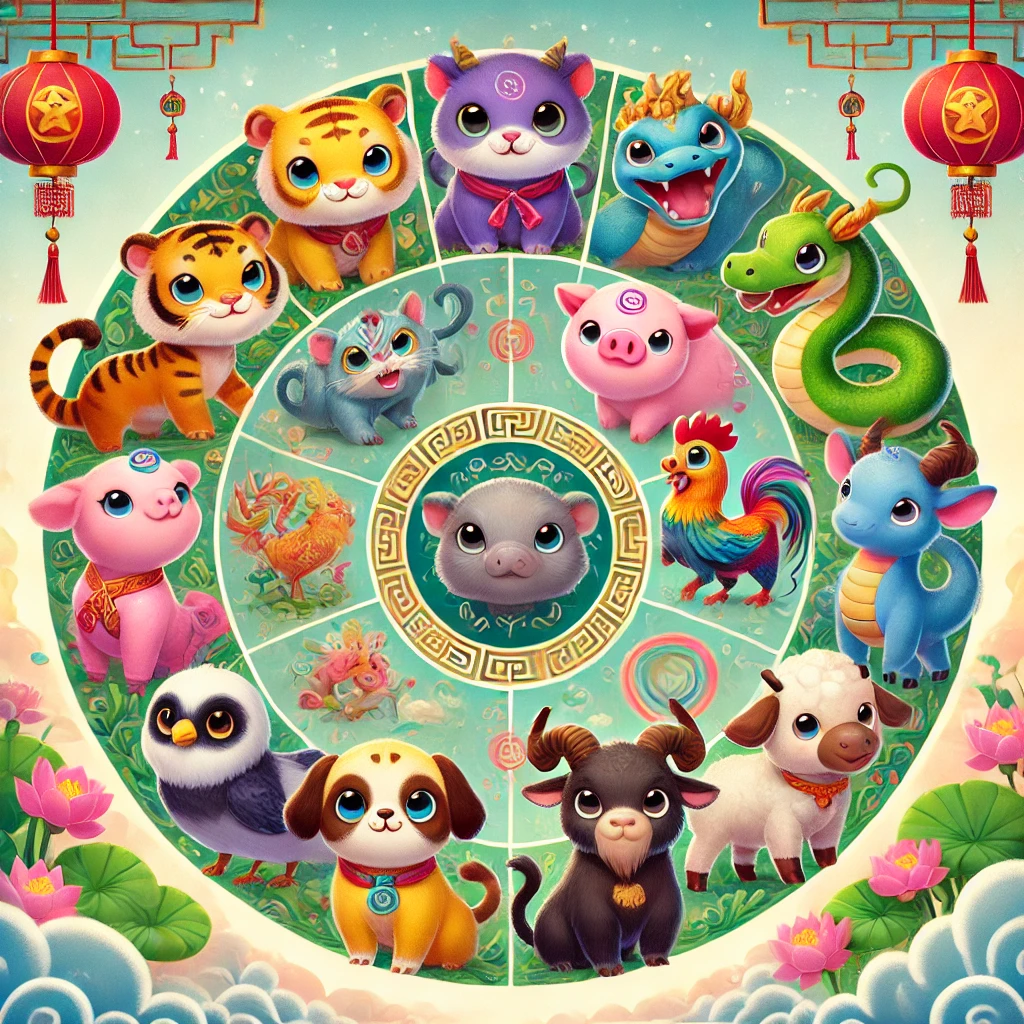
In a few days, we´ll step into a brand-new lunar year, Bính Ngọ – The Year of the Fire Horse! But did you know that Vietnam has its own unique take on the zodiac?
The zodiac plays a fundamental role in the cultural and spiritual beliefs of both Vietnam and China. While the Vietnamese and Chinese zodiacs share a similar 12-year cycle of animal signs and follow the principles of the Five Elements (Ngũ Hành – 五行), there are notable differences in the animals represented and in how these elements influence a person’s character. This article explores these differences, the meaning of each zodiac sign, and the deeper significance of the Five Elements in shaping one’s destiny.
The 12 Animal Signs in the Vietnamese and Chinese Zodiacs
Both systems follow a 12-year cycle, with each year associated with an animal that is believed to shape the characteristics of those born under it. However, there are four key differences between the Vietnamese and Chinese zodiacs:
| Vietnamese Zodiac | Chinese Zodiac | Reason for the Difference |
| Rat (Tý) | Rat (子 – Zǐ) | No difference, though the Vietnamese often perceive it as a field rat rather than a house rat. |
| Buffalo (Sửu) | Ox (丑 – Chǒu) | The buffalo is more culturally significant in Vietnam, symbolising hard work and agriculture. |
| Tiger (Dần) | Tiger (寅 – Yín) | No difference. |
| Cat (Mẹo) | Rabbit (卯 – Mão) | A linguistic confusion may have caused this switch, as the Chinese word for Rabbit (卯 – Mão) sounds similar to the Vietnamese word for Cat (Mẹo). |
| Dragon (Thìn) | Dragon (辰 – Chén) | No difference, as the dragon is a powerful and mythical creature in both cultures. |
| Snake (Tỵ) | Snake (巳 – Sì) | No difference in meaning, but the Vietnamese use “Tỵ” instead of the common word “Rắn” for snakes. |
| Horse (Ngọ) | Horse (午 – Wǔ) | No difference. |
| Goat (Mùi) | Goat (未 – Wèi) | Sometimes translated as “sheep” in English, but in Vietnam, it is understood primarily as a goat. |
| Monkey (Thân) | Monkey (申 – Shēn) | No difference. |
| Rooster (Dậu) | Rooster (酉 – Yǒu) | No difference. |
| Dog (Tuất) | Dog (戌 – Xū) | No difference. |
| Pig (Hợi) | Pig (亥 – Hài) | No difference. |
The biggest distinction is the Cat replacing the Rabbit in the Vietnamese zodiac. This change is unique to Vietnam, as most other cultures that use the zodiac (such as Korea and Japan) retain the rabbit.
Why Do the Vietnamese Use Zodiacal Terms Like “Ngọ” Instead of Everyday Words?
In the Vietnamese zodiac, the word “Ngọ” is used instead of “Ngựa” (the common Vietnamese word for horse). This follows the Earthly Branches (Địa Chi) system, which assigns specific, traditional names to the zodiac animals rather than their everyday Vietnamese counterparts.
Why Use Terms Like “Ngọ”?
- Traditional Influence: The Vietnamese zodiac is based on the ancient Chinese system, which uses specific, formal names for each animal (e.g., “Ngọ” for Horse, “Tý” for Rat). These names are deeply tied to astrology, timekeeping, and calendrical calculations.
- Formal and Symbolic Usage: Terms like “Ngọ” are considered more formal, symbolic, and traditional, used in literature, astrology, and formal announcements, whereas everyday words are used in casual speech.
- Consistency in the Zodiac System: All zodiac animals in this system have their own Earthly Branch name:
- Rat → Tý (instead of Chuột)
- Buffalo → Sửu (instead of Trâu)
- Tiger → Dần (instead of Hổ)
- Horse → Ngọ (instead of Ngựa)
For this reason, “Bính Ngọ” (2026) follows tradition, meaning “Year of the Fire Horse”, with “Ngọ” being the zodiacal term for Horse.
The Five Elements and Their Meaning
Both the Vietnamese and Chinese zodiacs operate within a 60-year cycle, combining the 12 animals with the Five Elements (Ngũ Hành – 五行). These elements play a crucial role in shaping a person’s personality, relationships, and even destiny.
The Five Elements Explained
- Wood (Mộc – 木)
- Symbolism: Growth, flexibility, expansion, vitality.
- Season: Spring.
- Personality: Creative, ambitious, kind, but sometimes stubborn.
- Direction: East.
- Colour: Green.
- Fire (Hỏa – 火)
- Symbolism: Passion, energy, transformation, action.
- Season: Summer.
- Personality: Charismatic, bold, adventurous, but can be impulsive.
- Direction: South.
- Colour: Red.
- Earth (Thổ – 土)
- Symbolism: Stability, nourishment, patience, reliability.
- Season: Late summer / transition periods.
- Personality: Practical, responsible, nurturing, but sometimes stubborn.
- Direction: Centre.
- Colour: Yellow, brown.
- Metal (Kim – 金)
- Symbolism: Strength, discipline, precision, determination.
- Season: Autumn.
- Personality: Resilient, disciplined, ambitious, but can be rigid.
- Direction: West.
- Colour: White, gold, silver.
- Water (Thủy – 水)
- Symbolism: Wisdom, adaptability, intuition, fluidity.
- Season: Winter.
- Personality: Intelligent, diplomatic, resourceful, but can be secretive.
- Direction: North.
- Colour: Blue, black.
Each zodiac year is a combination of an animal and an element. For example, 2026 will be the Year of the Fire Horse (Bính Ngọ), while 1966 was the Year of the Fire Horse (Bính Ngọ) in the previous cycle.
The Interactions Between Elements
The elements interact in two primary ways:
- Generating Cycle (Creative/Constructive):
- Wood fuels Fire.
- Fire creates Earth (ash).
- Earth produces Metal.
- Metal collects Water (condensation).
- Water nourishes Wood.
- Destructive Cycle (Control/Weakening):
- Wood breaks Earth (roots penetrate soil).
- Earth absorbs Water.
- Water extinguishes Fire.
- Fire melts Metal.
- Metal chops Wood.
Conclusion
The Vietnamese and Chinese zodiacs are deeply intertwined with cultural beliefs, astrology, and the philosophy of the Five Elements. While both systems share many similarities, Vietnam has distinct modifications, such as replacing the Rabbit with the Cat and emphasising the Buffalo over the Ox.
The Five Elements further personalise each zodiac sign, creating a 60-year cycle that influences personality traits, career paths, and relationships. Understanding these elements can provide insight into one’s strengths, weaknesses, and destiny, whether following the Vietnamese or Chinese tradition.
Footnote: Ngũ Hành (五行)
Ngũ Hành (五行) is the Vietnamese term for the Five Elements theory, which originates from ancient Chinese philosophy and cosmology. The term “Ngũ” (五) means “five,” and “Hành” (行) translates to “movements” or “phases,” emphasising the dynamic and interdependent nature of these elements.
The Five Elements—Wood (Mộc), Fire (Hỏa), Earth (Thổ), Metal (Kim), and Water (Thủy)—are believed to govern not only the zodiac but also the natural world, human life, medicine, and even social relationships. They interact through two fundamental cycles:
- The Generating Cycle (Sinh – 生), where each element supports the next (e.g., Wood fuels Fire).
- The Destructive Cycle (Khắc – 克), where elements control or weaken each other (e.g., Water extinguishes Fire).
In Vietnamese culture, Ngũ Hành is a guiding principle in astrology, feng shui, traditional medicine, and even naming practices. It helps individuals harmonise with the natural order of the universe.