
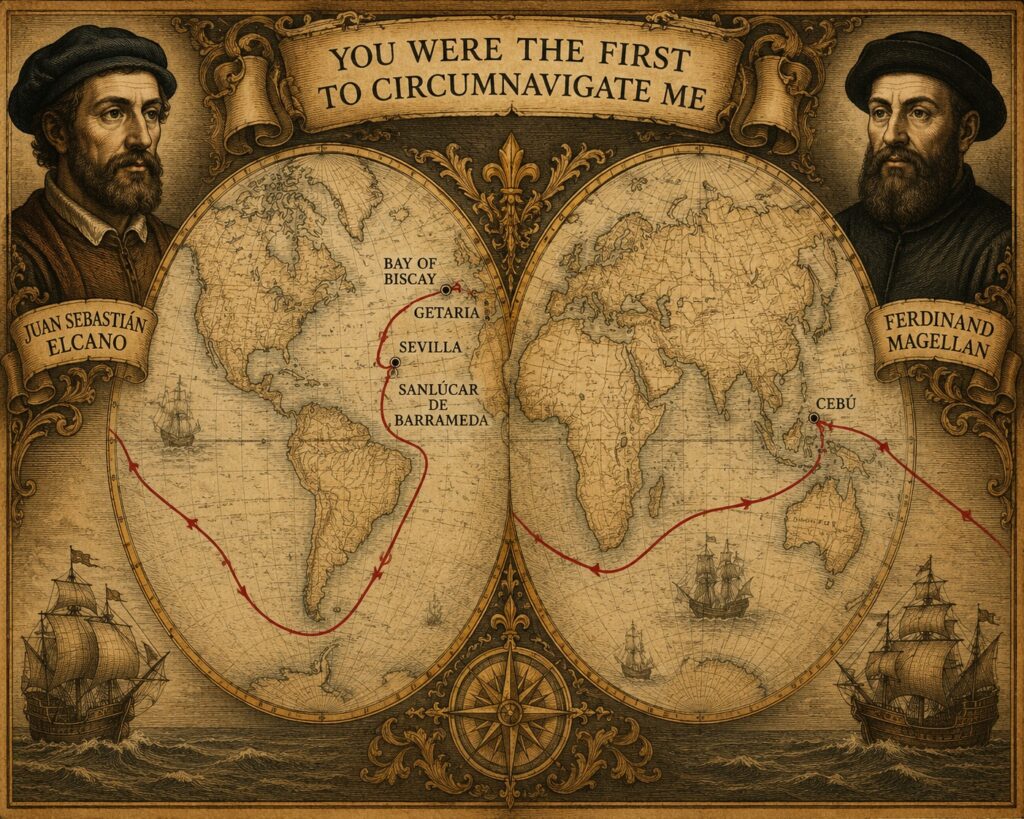
History often remembers Ferdinand Magellan as the first man to circumnavigate the globe. In reality, he never completed the voyage. Magellan was killed on 27 April 1521 during the Battle of Mactan, on the island of Cebu in the Philippines, after intervening in a local conflict against the warriors of Lapu-Lapu. He had not even reached the halfway point of the expedition.
The man who ultimately achieved one of humanity’s greatest maritime feats was Juan Sebastián Elcano.
Born around 1486 in the Basque fishing town of Getaria, on Spain’s northern Atlantic coast, Elcano grew up in a community whose life revolved around the sea. The Bay of Biscay was renowned for producing skilled sailors, fishermen and shipbuilders, and from an early age Elcano developed the seamanship that would later define his place in history.
Before joining the famous expedition, he had already gained considerable maritime experience, serving both as a merchant seaman and in military campaigns. Financial difficulties eventually led him to seek a place aboard Magellan’s ambitious expedition, which departed from Seville on 20 September 1519 with five ships and approximately 270 men. Its objective was not to sail around the world, but to reach the Spice Islands by sailing west, opening a new route that would avoid Portuguese-controlled waters.
The voyage soon became a struggle for survival. Mutinies, storms, disease, starvation and shipwrecks reduced the fleet dramatically. When Magellan was killed in the Philippines, the expedition seemed destined to fail. Leadership passed through several hands before Juan Sebastián Elcano assumed command of the Victoria, the expedition’s last surviving ship.
Faced with overwhelming odds, Elcano made a bold decision. Rather than attempting to return across the Pacific, he continued westwards across the Indian Ocean, rounded the Cape of Good Hope and sailed north through the Atlantic, constantly pursued by Portuguese forces determined to capture the precious cargo of spices.
On 6 September 1522, nearly three years after leaving Spain, the Victoria finally returned to Sanlúcar de Barrameda. Of the approximately 270 men who had begun the expedition, only 18 exhausted survivors completed the voyage.
Those eighteen men became the first people in recorded history to circumnavigate the Earth. Among them, Juan Sebastián Elcano was not merely a survivor but the captain who had successfully brought the expedition home.
Emperor Charles V recognised the extraordinary achievement by granting Elcano a coat of arms bearing the Latin inscription:
“Primus circumdedisti me.”
“You were the first to circumnavigate me.”
For the Basque Country, Juan Sebastián Elcano is far more than a historical figure; he embodies a centuries-old maritime tradition that produced some of Europe’s finest sailors, shipbuilders and navigators. His birthplace, Getaria, still looks out over the Bay of Biscay, whose often unforgiving waters shaped his character and honed the seamanship that would eventually enable him to accomplish one of history’s greatest voyages. Yet, beyond Spain, his name remains surprisingly unfamiliar.
History has often favoured visionaries over those who ultimately brought their visions to fruition.
Magellan conceived the expedition and gave it its initial direction, while Elcano inherited what appeared to be a doomed enterprise and transformed it into one of the greatest achievements in human history.
Perhaps the romance of the man who dared to dream has eclipsed the quieter greatness of the man who succeeded. It is a reminder that history is not always written solely by those who complete the greatest deeds, but often by those whose stories are told most compellingly.
Juan Sebastián Elcano deserves to stand not in the shadow of Magellan, but alongside the greatest explorers the world has ever known.