
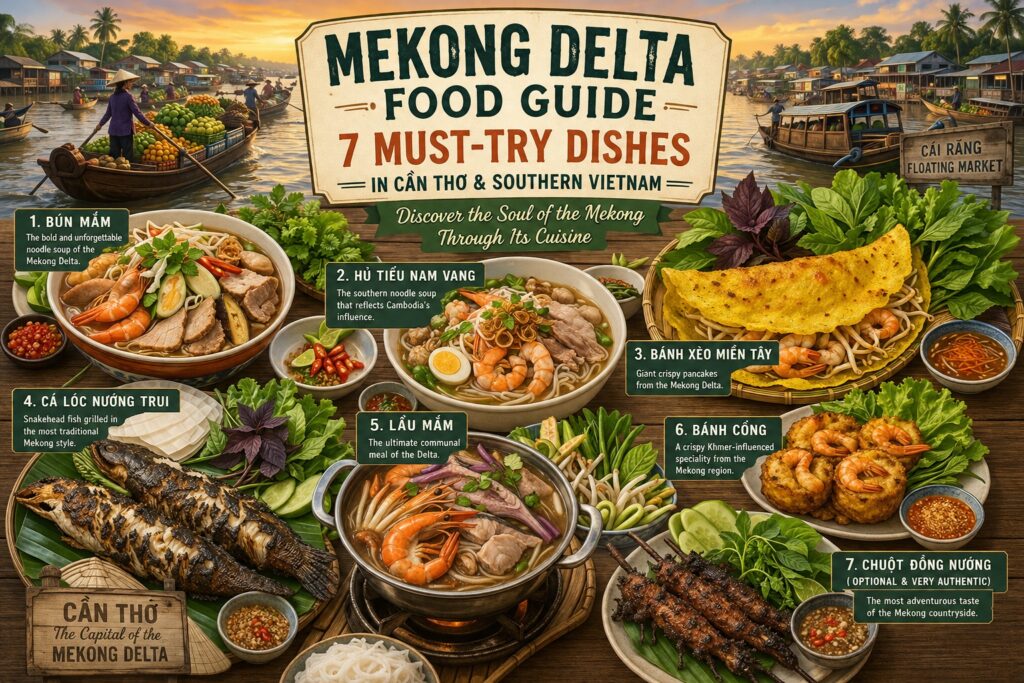
Discover the Soul of the Mekong Through Its Cuisine
When people think of Vietnamese cuisine, they often picture a steaming bowl of phở, a crispy bánh mì, or the lively street food of Hanoi and Ho Chi Minh City. Yet beyond these internationally celebrated dishes lies another culinary world—one shaped not by mountains or ancient imperial cities, but by water.
Welcome to the Mekong Delta, the fertile southern region where the mighty Mekong River finally reaches the sea after a journey of more than 4,000 kilometres through six countries. Here, life follows the rhythm of countless rivers, canals and floating markets. It is a landscape of rice paddies stretching to the horizon, lush orchards heavy with tropical fruit, fishing boats gliding through narrow waterways, and villages where recipes have been lovingly passed down through generations.
At the heart of this extraordinary region lies Cần Thơ, widely regarded as the capital of the Mekong Delta. While many visitors know the city for the famous Cái Răng Floating Market or the picturesque Ninh Kiều Wharf, food lovers quickly discover that Cần Thơ is equally remarkable for its cuisine. Every morning, market stalls begin serving breakfast before sunrise. Riverside restaurants welcome families gathering for long lunches, while evening street vendors fill the air with the irresistible aromas of charcoal grills, fresh herbs and simmering broths.
The cuisine of southern Vietnam differs noticeably from that of the country’s northern and central regions. The Delta’s abundance of freshwater fish, prawns, crabs and seasonal vegetables gives its dishes exceptional freshness. Coconut milk appears more frequently than in northern recipes, while palm sugar lends a gentle sweetness that reflects both the region’s tropical climate and its agricultural wealth.
The Mekong Delta has also been shaped by centuries of cultural exchange. Vietnamese traditions blend naturally with Khmer heritage, Chinese influences and, to a lesser extent, echoes of French colonial cuisine. This unique combination has produced a gastronomic identity unlike anywhere else in Vietnam. Here, fermented fish sauces sit comfortably alongside delicate herbs, rustic countryside recipes coexist with sophisticated urban dishes, and meals are almost always designed to be shared with family and friends.
Perhaps the greatest pleasure of eating in the Delta is its authenticity. Many of the region’s finest dishes remain largely unknown outside Vietnam. Rather than being created for tourists, they continue to be prepared for local people using recipes that have changed little over the decades. Visiting Cần Thơ therefore offers not only an opportunity to taste exceptional food, but also to experience everyday southern Vietnamese life.
Whether enjoying breakfast beside the Hậu River, sampling fresh produce at a floating market or sharing a hotpot with friends as the sun sets over the Mekong, visitors soon discover that food is central to the culture of southern Vietnam.
This guide introduces seven essential dishes that capture the spirit of Cần Thơ and the Mekong Delta. Together, they tell the story of one of Southeast Asia’s richest and most fascinating culinary regions.
1. Bún Mắm
The Bold and Unforgettable Flavour of the Mekong Delta
Few dishes represent southern Vietnam more authentically than Bún Mắm. Rich, aromatic and wonderfully complex, this iconic noodle soup perfectly reflects the multicultural heritage of the Mekong Delta.
Its distinctive broth is prepared using mắm—a traditional fermented fish paste that has been an essential ingredient in both Vietnamese and Khmer cooking for centuries. While the idea of fermented fish may sound intimidating to first-time visitors, skilled cooks transform it into an elegant broth with remarkable depth rather than overwhelming intensity.
The soup is generously filled with rice vermicelli, prawns, squid, slices of pork belly, roasted pork and fresh fish, depending on the region and the cook’s own recipe. Every bowl is crowned with an abundance of herbs and vegetables including banana blossom, water spinach, bean sprouts, Vietnamese mint and water lilies, all of which provide freshness and texture.
The result is a dish that perfectly balances savoury richness with herbal freshness. Each spoonful reveals new layers of flavour, making Bún Mắm one of the most rewarding culinary experiences in southern Vietnam.
Although variations exist throughout the Delta, Cần Thơ is widely regarded as one of the best places to enjoy this remarkable soup, where generations of family-run restaurants continue to preserve traditional recipes.
2. Hủ Tiếu Nam Vang
A Delicious Legacy of the Mekong’s Multicultural Heritage
If one dish perfectly illustrates the cultural diversity of southern Vietnam, it is Hủ Tiếu Nam Vang. Although many visitors simply think of it as another noodle soup, its history tells a far more fascinating story.
The name Nam Vang is the Vietnamese pronunciation of Phnom Penh, the capital of Cambodia. The dish originated within the Chinese communities living in Cambodia before gradually spreading into the Mekong Delta through trade, migration and centuries of cultural exchange. As it travelled across the border, Vietnamese cooks adapted the recipe using local ingredients and culinary traditions, creating the version that is now beloved throughout southern Vietnam.
Today, Hủ Tiếu Nam Vang is one of the most popular breakfasts in Cần Thơ, although many people happily enjoy it throughout the day. Long before sunrise, restaurants begin preparing enormous pots of crystal-clear broth, allowing the flavours to develop slowly over several hours.
Unlike the richer soups of central Vietnam, the broth is remarkably delicate. Pork bones, dried squid, preserved radish and carefully selected seasonings produce a clean yet deeply satisfying flavour that allows each ingredient to shine.
The bowl itself is wonderfully generous. Thin rice noodles are accompanied by slices of pork, minced pork, prawns, quail eggs, liver, fresh herbs, spring onions and crispy fried garlic. Some versions include wontons or squid, while others reflect individual family recipes that have remained unchanged for decades.
One of the pleasures of ordering Hủ Tiếu Nam Vang is choosing between the dry and soup versions. The dry version is tossed with a savoury sauce while the broth is served separately, allowing diners to alternate between the silky noodles and spoonfuls of fragrant soup. Many local residents actually prefer this version, believing it offers a greater appreciation of both textures and flavours.
Fresh herbs, lime wedges and chillies are served alongside every bowl, allowing each person to adjust the final balance according to personal taste. This interactive element is characteristic of Vietnamese cuisine, where the diner becomes part of the final preparation.
Walking through Cần Thơ in the early morning, it is impossible not to notice the aroma drifting from Hủ Tiếu restaurants. Office workers, students, families and elderly neighbours gather around steaming bowls before beginning their day, making the dish as much a social ritual as a meal.
For travellers, Hủ Tiếu Nam Vang offers something particularly special. It is more than delicious comfort food—it is edible evidence of the historical connections linking Vietnam, Cambodia and the Chinese communities that have enriched both cultures for centuries.
3. Bánh Xèo Miền Tây
The Giant Crispy Pancake of the Mekong Delta
The unmistakable sound of sizzling batter hitting a hot pan announces one of southern Vietnam’s most joyful culinary experiences: Bánh Xèo.
Its name literally means “sizzling pancake”, a reference to the distinctive noise made as the thin rice batter begins cooking. Although Bánh Xèo can be found throughout Vietnam, the version prepared in the Mekong Delta is larger, crispier and considerably more generous than those served elsewhere in the country.
The batter combines rice flour, coconut milk and turmeric, giving the pancake its beautiful golden colour and delicate fragrance. Coconut milk, abundant throughout southern Vietnam, adds a subtle richness that distinguishes the Delta’s version from those prepared in central Vietnam.
Once the pancake begins to crisp, cooks fill it with prawns, thinly sliced pork, bean sprouts, spring onions and occasionally mushrooms or seafood freshly caught from nearby rivers and canals. It is then folded in half while remaining delightfully crisp around the edges.
Yet Bánh Xèo is only half the story.
The real experience begins when it reaches the table. Diners tear off pieces of the pancake and wrap them inside large lettuce leaves together with aromatic herbs such as mint, Vietnamese coriander, basil and perilla. The resulting parcel is dipped into nước chấm, the famous Vietnamese fish sauce blended with lime juice, garlic, sugar and chilli.
Every mouthful offers an extraordinary contrast of textures: the crisp pancake, succulent prawns, tender pork, crunchy vegetables and fragrant herbs come together in perfect harmony. The dipping sauce provides brightness that balances the richness of the coconut-infused batter.
Preparing Bánh Xèo is often a family activity. At home, several generations gather around the table while one person cooks pancake after pancake over a charcoal stove. The meal unfolds slowly, with conversation flowing as naturally as the food itself.
The dish also reflects the extraordinary agricultural abundance of the Mekong Delta. Rice, coconuts, prawns, vegetables and herbs all come directly from the surrounding countryside, creating a recipe that is deeply connected to the landscape.
Visitors should resist the temptation to eat Bánh Xèo with knife and fork. The proper way is the local way—using your hands to assemble each fresh roll, just as Vietnamese families have done for generations.
Whether enjoyed at a riverside restaurant in Cần Thơ or at a small countryside eatery surrounded by rice fields, Bánh Xèo Miền Tây remains one of the Delta’s most memorable culinary experiences.
4. Cá Lóc Nướng Trui
The Rustic Taste of the Mekong Countryside
Some dishes are born in royal kitchens, others in bustling cities. Cá Lóc Nướng Trui, however, was born in the rice fields of the Mekong Delta.
This remarkably simple yet deeply satisfying dish dates back to the earliest Vietnamese settlers who transformed the Delta into one of Asia’s most productive agricultural regions. After long days working in flooded rice fields, farmers would catch snakehead fish directly from nearby canals and cook them using little more than dry straw gathered from the harvest.
Unlike modern grilling techniques, the fish is traditionally cooked whole without scaling or marinating. It is skewered on a bamboo stick, covered with straw and set alight. As the flames die down, the skin becomes blackened while the flesh inside remains incredibly moist, delicate and naturally sweet.
Once cooked, the burnt skin is peeled away, revealing perfectly white flesh that flakes effortlessly from the bone.
As with so many dishes in southern Vietnam, the fish is only one component of a larger culinary experience. It is served with rice paper, fresh herbs, cucumber, green banana, star fruit and pickled vegetables. Diners create their own rolls before dipping them into nước mắm or tamarind sauce.
Every bite celebrates freshness. The smoky fish contrasts beautifully with crisp vegetables, aromatic herbs and the gentle acidity of the dipping sauce.
Beyond its flavour, Cá Lóc Nướng Trui tells the story of the Mekong Delta itself. It reflects a way of life shaped by rivers, agriculture and an intimate understanding of nature. Nothing is complicated; nothing is wasted. The quality of the ingredients speaks for itself.
Today the dish is served in restaurants throughout Cần Thơ, where chefs faithfully preserve the traditional cooking method despite the conveniences of modern kitchens. Watching the fish arrive at the table still smoking gently remains one of the highlights of dining in the Delta.
For travellers wishing to experience authentic countryside cooking rather than elaborate restaurant cuisine, Cá Lóc Nướng Trui offers an unforgettable taste of southern Vietnam’s rural heritage.
5. Lẩu Mắm
The Ultimate Communal Feast of the Mekong Delta
If there is one dish that captures the spirit of sharing so deeply rooted in southern Vietnamese culture, it is Lẩu Mắm. More than simply a meal, it is an experience that brings family and friends together around a simmering pot placed at the centre of the table.
Like Bún Mắm, its soul lies in mắm—the traditional fermented fish that has long been a cornerstone of Mekong Delta cuisine. Yet while the noodle soup introduces this distinctive flavour with elegance and restraint, Lẩu Mắm embraces it with confidence, creating one of the richest and most complex broths in Vietnam.
Preparing an authentic Lẩu Mắm requires patience and expertise. The fermented fish is carefully cooked and strained, producing a velvety stock that forms the foundation of the hotpot. Coconut water, lemongrass, garlic and aromatic spices are then added to soften the intensity and create remarkable depth.
The ingredients surrounding the pot are as spectacular as the broth itself. Fresh prawns, squid, catfish, snakehead fish, pork belly and Vietnamese fish cakes are arranged alongside an astonishing variety of vegetables harvested from the fertile Delta.
Morning glory, water lily stems, banana blossom, lotus stems, okra, aubergine, mustard greens, water mimosa and dozens of seasonal herbs transform the meal into a colourful celebration of the region’s biodiversity.
Each diner cooks ingredients gradually in the bubbling broth before enjoying them with rice vermicelli and individual dipping sauces. Every bowl becomes slightly different, allowing everyone to create their own perfect balance of flavours.
Lẩu Mắm beautifully illustrates how geography shapes cuisine. The extraordinary diversity of fish, vegetables and herbs found throughout the Mekong Delta makes such a dish possible. In many parts of the world, assembling so many fresh local ingredients in a single meal would be impossible.
Restaurants specialising in Lẩu Mắm are particularly popular during evenings, when extended families gather after work to spend several leisurely hours eating, talking and laughing together. Visitors quickly discover that the meal unfolds slowly; there is no rush. Conversation is every bit as important as the food itself.
For many travellers, Lẩu Mắm becomes one of the defining culinary memories of southern Vietnam—not only because of its unforgettable flavours, but because it perfectly reflects the generosity and hospitality of the people who call the Delta home.
6. Bánh Cống
A Crispy Golden Delight with Khmer Roots
Few dishes reveal the historical connections between southern Vietnam and neighbouring Cambodia as clearly as Bánh Cống.
Believed to have originated among the Khmer communities of the Mekong Delta, this irresistible savoury fritter has become one of the signature specialities of the region, particularly around Sóc Trăng and Cần Thơ.
Its name comes from the small cylindrical mould, or cống, traditionally used during cooking. Rice flour is mixed into a light batter before being filled with minced pork, mung beans and whole prawns. The mould is then lowered into hot oil, producing a beautifully crisp exterior while keeping the filling wonderfully moist.
Fresh prawns remain visible on the surface, giving each fritter its distinctive appearance. Once golden brown, the Bánh Cống is served immediately while still hot and wonderfully crunchy.
As with many southern Vietnamese dishes, eating Bánh Cống involves much more than simply picking it up. Pieces of the fritter are wrapped in fresh lettuce together with mint, basil, Vietnamese coriander and other aromatic herbs before being dipped into the ever-present nước chấm.
The combination is extraordinary. The crisp shell gives way to soft mung beans and savoury pork, while herbs provide freshness that balances the richness of the fried batter.
Street vendors often prepare Bánh Cống to order, allowing customers to enjoy them at their absolute best. The sight of bubbling oil, the aroma of freshly fried batter and the constant movement of experienced cooks make watching the preparation almost as enjoyable as eating the finished dish.
Although less well known internationally than spring rolls or Bánh Xèo, Bánh Cống remains a treasured part of the Delta’s culinary identity. It also serves as a delicious reminder that the Mekong Delta has always been a meeting place of cultures, where Vietnamese and Khmer traditions continue to enrich one another.
7. Chuột Đồng Nướng
The Mekong Delta’s Most Authentic Countryside Delicacy
For many international visitors, Chuột Đồng Nướng, or grilled field rat, is undoubtedly the most surprising dish in the Mekong Delta. It often raises eyebrows at first, yet for local people it is neither unusual nor exotic. Instead, it is a respected rural speciality that has been enjoyed for generations.
The key lies in understanding exactly what kind of animal is being served. These are not city rats, but field rats that live among the rice paddies and feed almost exclusively on rice grains, young shoots and wild plants. After each harvest, farmers have traditionally caught them in large numbers, both to protect future crops and to provide an additional source of high-quality protein.
This close relationship between agriculture and cuisine reflects the practical wisdom of the Delta’s farming communities, where very little from nature is wasted.
The preparation is remarkably simple. After careful cleaning, the meat is marinated with garlic, shallots, salt, pepper, fish sauce and sometimes a touch of honey or palm sugar before being slowly grilled over glowing charcoal. The skin becomes beautifully crisp while the meat remains tender, juicy and surprisingly delicate.
Those who overcome their initial hesitation are often astonished by the flavour. It is frequently compared to a cross between free-range chicken and rabbit, with a firm texture and a clean, mildly sweet taste that absorbs the smoky aromas of the charcoal perfectly.
Like many dishes in southern Vietnam, Chuột Đồng Nướng is rarely eaten on its own. It is usually accompanied by fresh herbs, cucumber, green banana, star fruit, rice paper and a dipping sauce made with fish sauce, chilli, garlic and lime. Each bite combines smoky meat with the refreshing crunch of herbs and vegetables, creating the balance that characterises so much of Vietnamese cuisine.
Although it is most commonly found in rural districts throughout the Mekong Delta, several traditional restaurants in and around Cần Thơ proudly include it on their menus, particularly during the rice harvest season when field rats are considered to be at their finest.
More than simply an unusual food, Chuột Đồng Nướng offers visitors an opportunity to appreciate the ingenuity and sustainability of rural Vietnamese life. It demonstrates how local communities have long adapted their cuisine to the natural environment, transforming what outsiders may see as unexpected into a genuine culinary tradition.
For adventurous travellers seeking an experience beyond the familiar bowls of phở and bánh mì, tasting Chuột Đồng Nướng is not merely trying a new dish—it is discovering an authentic piece of the Mekong Delta’s cultural identity.
Whether you decide to sample it or simply learn about its place in local life, this remarkable speciality reminds us that the world’s most memorable culinary experiences are often those that challenge our expectations and invite us to see another culture through different eyes.
Why Food Lovers Should Visit Cần Thơ & the Mekong Delta
For anyone passionate about food, the Mekong Delta is one of Southeast Asia’s most rewarding yet underrated culinary destinations. While millions of visitors head towards Vietnam’s famous beaches or historic cities, comparatively few venture into this remarkable river landscape, where authentic flavours remain at the heart of everyday life.
A Living Culinary Tradition
In the Delta, recipes are not preserved in museums or recreated for tourists—they are simply part of daily life. Families continue to prepare dishes exactly as their parents and grandparents did, preserving traditions that have evolved over centuries.
Extraordinary Freshness
Few places in Asia enjoy access to such an abundance of fresh ingredients. Fish and prawns arrive directly from rivers and canals. Tropical fruit is harvested from nearby orchards. Herbs and vegetables are picked daily from fertile fields nourished by the Mekong’s annual floods.
This freshness is immediately noticeable in every meal.
A Fascinating Cultural Crossroads
The cuisine of southern Vietnam tells the story of the region itself. Vietnamese, Khmer and Chinese communities have lived alongside one another for generations, sharing techniques, ingredients and recipes that continue to shape local cooking today.
Every bowl of noodles and every shared hotpot reflects this remarkable cultural exchange.
Floating Markets and Riverside Dining
Few culinary experiences equal eating breakfast after visiting one of the Delta’s famous floating markets. At places such as Cái Răng, vendors prepare steaming bowls of noodles and strong Vietnamese coffee directly from their boats, creating one of the most distinctive food cultures anywhere in the world.
Later in the day, riverside restaurants overlooking the Hậu River offer equally memorable settings for leisurely lunches and evening meals as boats drift peacefully along the water.
Warm Southern Hospitality
Perhaps the Delta’s greatest attraction is its people. Visitors are welcomed with genuine warmth, curiosity and generosity. Restaurant owners happily explain unfamiliar dishes, recommend local specialities and often treat guests less like customers than old friends.
Final Thoughts
The Mekong Delta is far more than Vietnam’s agricultural heartland—it is one of Asia’s great culinary treasures.
Its cuisine reflects the rivers that sustain it: generous, diverse and constantly flowing. Every dish tells a story of fertile landscapes, cultural encounters and families whose traditions continue to thrive in kitchens, markets and riverside homes.
Whether you begin your day with a steaming bowl of Hủ Tiếu Nam Vang, share a fragrant Lẩu Mắm with friends as the evening settles over the Hậu River, or enjoy a perfectly grilled plate of Cơm Tấm before strolling along Ninh Kiều Wharf, you are experiencing far more than exceptional food. You are becoming part of a way of life that has been shaped by the Mekong for countless generations.
For travellers seeking the authentic soul of southern Vietnam, the answer is wonderfully simple: come to Cần Thơ with an open mind, an empty stomach and plenty of time.
The rivers will guide your journey, the people will welcome you with genuine smiles, and the cuisine will leave memories that linger long after your journey has come to an end.
In the Mekong Delta, every meal is more than food—it is a celebration of culture, community and the timeless rhythm of life on the river.