
An Analysis of Cambodian Legends in Cultural and Historical Context
Abstract
Cambodian legends constitute a significant component of the nation’s cultural heritage, encapsulating historical memory, religious syncretism, and socio-political identity. Rooted in centuries of oral tradition and shaped by both Hindu and Buddhist cosmologies, these narratives extend beyond entertainment, functioning as vehicles of moral instruction, cosmological explanation, and national cohesion. This article examines key Cambodian legends, including the foundational myth of Preah Thong and Neang Neak, narratives associated with Angkorian temples, and adapted Buddhist Jataka tales. Through thematic and symbolic analysis, the study explores recurring motifs such as Nāga symbolism, divine kingship, and the spiritualisation of nature. Furthermore, it assesses the role of these legends in contemporary Cambodian identity, particularly in the context of cultural preservation and post-conflict reconstruction. By situating these narratives within their historical and cultural frameworks, the article demonstrates that Cambodian legends remain vital to understanding both the past and present of Khmer civilisation.
1. Introduction
Legends occupy a unique position within the broader spectrum of traditional narratives, often situated between myth and folklore. While myths typically address cosmological origins and divine actions, and folklore tends to reflect everyday life and popular culture, legends frequently combine elements of both, grounding extraordinary events within a quasi-historical framework. In the Cambodian context, legends serve as repositories of collective memory, reflecting the interplay between religion, politics, and cultural identity.
Cambodia’s narrative traditions have been shaped by a confluence of influences, most notably indigenous animist beliefs, Indian Hindu cosmology, and Theravāda Buddhist philosophy. These influences have produced a rich tapestry of stories that articulate a worldview in which the sacred and the mundane coexist. Central to these narratives is the Khmer understanding of the relationship between humans, nature, and the divine.
This article aims to examine Cambodian legends through a multidisciplinary lens, analysing their thematic structures, symbolic meanings, and socio-cultural functions. It focuses on key narratives that have endured across generations, exploring how they contribute to the construction of national identity and moral frameworks. In doing so, the study highlights the enduring relevance of these legends in both historical and contemporary contexts.
2. Historical and Cultural Context
2.1 The Khmer Civilisation and the Angkorian Era
The development of Cambodian legends cannot be understood without reference to the Khmer civilisation, particularly during the Angkorian period (ninth to fifteenth centuries). This era witnessed the construction of monumental temple complexes and the consolidation of a sophisticated socio-political system centred on divine kingship. The rulers of Angkor were often regarded as devarāja, or god-kings, embodying both political authority and spiritual legitimacy.
The temples themselves, such as Angkor Wat and Angkor Thom, were not merely architectural achievements but also cosmological representations. They symbolised Mount Meru, the centre of the universe in Hindu and Buddhist cosmology. Legends associated with these structures often reflect this cosmological symbolism, portraying the temples as products of divine or supernatural intervention.
2.2 Religious Syncretism
Cambodian legends are deeply influenced by religious syncretism. Early Khmer society incorporated elements of Hinduism, particularly the worship of Shiva and Vishnu, alongside indigenous animist beliefs. Over time, Theravāda Buddhism became the dominant religious framework, shaping moral and philosophical interpretations of traditional narratives.
This blending of religious traditions is evident in many legends, where Hindu deities coexist with Buddhist ethical teachings and animist spirits. Such syncretism allows for a flexible narrative structure in which different belief systems reinforce rather than contradict one another.
2.3 Oral Tradition and Transmission
Historically, Cambodian legends were transmitted orally, often through storytelling, performance, and ritual. This mode of transmission allowed for adaptation and reinterpretation across generations. Storytellers played a crucial role in preserving these narratives, ensuring their relevance within changing social contexts.
The oral nature of these traditions also means that multiple versions of the same legend may exist, each reflecting local variations and cultural nuances. Despite these differences, core themes and symbols remain remarkably consistent, underscoring their importance within the Khmer cultural imagination.
3. Key Cambodian Legends
3.1 The Legend of Preah Thong and Neang Neak
One of the most significant Cambodian legends is the story of Preah Thong and Neang Neak, widely regarded as the foundational myth of the Khmer people. According to the narrative, Preah Thong, an exiled Indian prince, arrives in a foreign land where he encounters Neang Neak, a Nāga princess. Following a series of trials, the two marry, and Neang Neak’s father, the Nāga king, drinks the surrounding waters to reveal the land upon which their kingdom is established.
This legend is rich in symbolic meaning. The union between Preah Thong and Neang Neak is commonly interpreted as representing the fusion of foreign (Indian) and indigenous (Khmer) cultures. The Nāga, a serpent-like being associated with water, fertility, and protection, symbolises the land’s original inhabitants and its natural resources. Moreover, the marriage narrative legitimises Khmer kingship by grounding it in both divine (Nāga) and civilisational (Indian) origins.
The legend continues to influence contemporary Cambodian culture, particularly in wedding ceremonies, where elements of the story—such as the symbolic crossing of the Nāga bridge—are re-enacted as part of traditional rituals. This enduring presence underscores the legend’s role in shaping Khmer identity across centuries.
3.2 Legends of Angkor Wat
Angkor Wat, one of the most iconic monuments in Southeast Asia, is surrounded by numerous legends concerning its construction. Some narratives attribute its creation to divine beings or celestial architects, suggesting that the temple could not have been built by human hands alone. Others credit the god Indra with its construction, claiming that the temple was originally erected for a celestial prince before being gifted to humanity.
These legends emphasise the sacred nature of the structure, reinforcing its role as a cosmological centre. The temple’s design, with its concentric galleries and towering spires, is frequently interpreted as a representation of Mount Meru, the mythical home of the gods in Hindu and Buddhist cosmology. This architectural alignment with cosmic order further links Angkor Wat to broader religious and political ideologies of the Khmer Empire.
Such narratives also serve to elevate the status of the Khmer Empire, portraying it as a civilisation capable of achieving divine harmony between architecture, religion, and governance. By framing Angkor Wat as divinely inspired, these legends legitimate the power of Khmer rulers as intermediaries between heaven and earth.
3.3 The Crocodile and the Princess
Another widely known legend involves a princess who is sacrificed to a crocodile, often portrayed as a powerful and malevolent creature inhabiting rivers or lakes. In some versions, the crocodile demands human offerings to ensure the safety of the community, while in others, the sacrifice is motivated by prophecy or divine instruction. The princess is typically depicted as both victim and heroine, whose willing sacrifice brings about communal salvation.
This narrative reflects the Khmer relationship with nature, particularly the dangers posed by waterways such as the Tonlé Sap and the Mekong River. It also conveys moral lessons concerning duty, sacrifice, and the delicate balance between human needs and natural forces. In some retellings, the crocodile is eventually defeated or transformed, symbolising the possibility of overcoming chaos through courage and virtue.
The legend persists in oral traditions and has been adapted into folk theatre and children’s storytelling, illustrating its ongoing relevance in Cambodian moral education.
3.4 Sacred Trees and Ta Prohm
The temple of Ta Prohm, famously intertwined with massive tree roots, has inspired numerous legends about the spiritual power of nature. These stories often depict trees as inhabited by spirits (known as neak ta) or as manifestations of divine presence. According to local belief, the trees that have grown over the temple ruins are not accidental but are guardians of the sacred site, punishing those who attempt to remove them.
Such narratives highlight the persistence of animist beliefs within Cambodian culture, even in the context of organised religion (namely Theravada Buddhism and, historically, Hinduism). They underscore the idea that nature is not merely a physical environment but a living entity with spiritual significance. The symbiotic relationship between stone and root at Ta Prohm thus becomes a metaphor for the coexistence of human religious ambition and the uncontrollable power of the natural world.
These legends also serve to reinforce the importance of forest spirits in daily life, particularly in rural Cambodia, where offerings to neak ta remain common practice.
3.5 Buddhist Jataka Tales in Cambodia
The Buddhist Jataka tales, which recount the previous lives of the Buddha, have been extensively adapted into Cambodian storytelling traditions. These narratives emphasise moral virtues such as compassion (metta), generosity (dana), and perseverance (khanti). Among the most popular are the Vessantara Jataka, which celebrates the virtue of perfect generosity, and the Temiya Jataka, which teaches the value of renunciation.
In the Cambodian context, Jataka tales are often localised, incorporating familiar settings, names, and cultural references. This adaptation enhances their accessibility and reinforces their role as tools for moral education, particularly within monastic and village communities. They are frequently recited during religious festivals, depicted in temple murals, and performed as shadow puppetry (sbek thom).
By embedding Buddhist ethics within recognisable cultural frameworks, these tales bridge formal religious teachings and everyday moral practice, shaping Khmer social values across generations.
3.6 The Legend of Princess Chanreaksmey: Heroic Resistance at Angkor
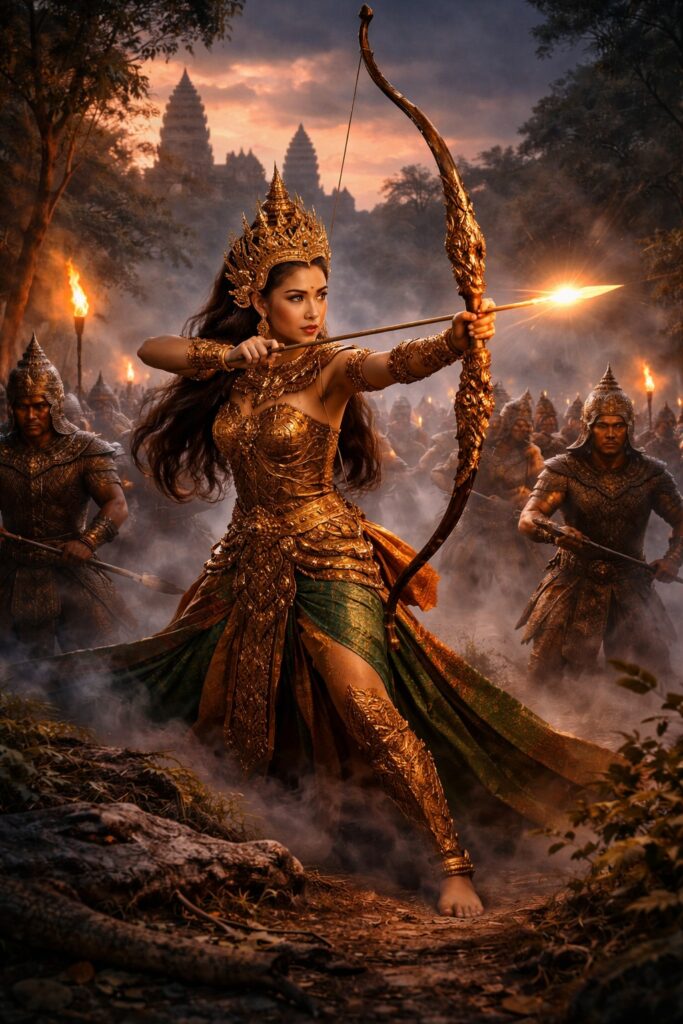
Among the corpus of Cambodian legends, the tale of Princess Chanreaksmey, known in Khmer as ចាន់រះស្មី (translated as ‘The Moonlight Flame of Angkor’), exemplifies the fusion of historical memory and mythic imagination. According to the narrative, in the year 1353, as Siamese armies advanced towards Angkor, Chanreaksmey—daughter of King Jayajittha and trained in the sacred martial arts of baksei chamkrong—led a small contingent of loyal warriors in defence of the kingdom. The legend recounts that with only seventeen guardians, the princess repelled the invaders using arrows blessed by monks, supernatural intervention from the jungle, and unparalleled martial skill. Her ultimate fate remains mysterious, with some accounts describing her transformation into a protective spirit (neak ta) of Angkor’s forests, while others assert she returned to the heavens after fulfilling her mission.
This legend exemplifies several recurring motifs in Cambodian storytelling:
- Heroic Individuality and National Duty – Chanreaksmey embodies the ideal of selfless courage, defending not merely territory but the cultural and spiritual essence of the Khmer kingdom. Her story challenges conventional gender roles by presenting a female warrior as the saviour of the nation.
- Sacred Geography and Spiritual Power – The narrative situates the heroine within sacred spaces, including Angkor Thom and Preah Vihear, linking natural and architectural sites to divine protection. This geographical anchoring reinforces the spiritual authority of Cambodia’s ancient capitals.
- Interaction with the Supernatural – The jungle itself acts as an ally, and the princess’s skills are enhanced by sacred blessings, demonstrating the enduring belief in the intertwining of human and supernatural agency. Such elements reflect the syncretic nature of Khmer spirituality, where Buddhism, Hinduism, and animism coexist.
- Oral and Symbolic Legacy – While likely composed post facto as a mythologised memory of historical conflicts with Siam, the tale continues to inspire a sense of cultural resilience, echoing through temple legends and local oral traditions. It serves as a reminder of Cambodian resistance against external threats, particularly relevant in the context of post-colonial and post-conflict identity formation.
Incorporating Chanreaksmey into the broader discussion of Cambodian legends illustrates the capacity of myth to memorialise both heroic deeds and cultural identity, bridging history, spirituality, and collective memory. Her story complements foundational legends such as Preah Thong and Neang Neak, demonstrating that Cambodian legends encompass not only creation myths but also historicised heroic narratives that reinforce Khmer identity in times of crisis.
4. Themes and Symbolism
4.1 Nāga Symbolism
The Nāga is one of the most pervasive and enduring symbols in Cambodian legends. Associated with water, fertility, protection, and cosmic order, the Nāga plays a central role in both mythological narratives and architectural design. Representations of Nāgas can be found throughout Cambodia: in temple carvings (most notably at Angkor Wat and the Bayon), as balustrades forming bridges to sacred sites, and on ceremonial artefacts such as royal barges and ritual offerings.
The prominence of the Nāga reflects the fundamental importance of water in Cambodian society, particularly in relation to the annual flooding of the Tonlé Sap and the rice cultivation cycle. As a creature that dwells at the boundary between land and water, the Nāga symbolises the precarious yet life-giving relationship between humans and their environment. Moreover, the Nāga serves as a bridge between the human and supernatural realms, often acting as a guardian of sacred spaces and a mediator between earthly kings and celestial beings.
In the legend of Preah Thong and Neang Neak, the Nāga king does not merely yield territory; he bestows divine legitimacy upon the new kingdom. This act establishes the Nāga as a foundational figure in Khmer cosmology, one whose presence continues to be honoured in rituals such as the annual Chol Chnam Thmey (Khmer New Year) and Buddhist consecration ceremonies. The seven-headed Nāga, in particular, has become a national emblem, appearing on the modern Cambodian flag as a stylised representation of Angkorian architecture and its serpentine guardians.
Beyond symbolism, the Nāga also embodies the concept of karma and cyclical time. As a creature capable of shedding its skin and being reborn, it represents renewal, transformation, and the enduring continuity of Khmer civilisation despite historical ruptures.
4.2 Kingship and Divine Authority
Many Cambodian legends emphasise the divine nature of kingship. Rulers are often depicted as chosen by the gods (devaraja), as possessing supernatural abilities, or as being direct descendants of divine beings—most notably the Nāga lineage established through the marriage of Preah Thong and Neang Neak. This portrayal reinforces the legitimacy of political authority and aligns it with cosmic order, positioning the king as the axis mundi who maintains balance between heaven, earth, and the underworld.
Such narratives were particularly significant during the Angkorian period (c. 9th–15th centuries), when the concept of the devaraja (god-king) served as a foundational ideology for governance. The king was understood not merely as a secular ruler but as a living deity whose actions directly influenced the prosperity and stability of the realm. Temple complexes such as Angkor Wat, the Bayon, and Preah Khan were constructed as cosmic representations of Mount Meru, with the king at their symbolic centre.
Legendary accounts of Khmer kings—such as Jayavarman II, who was said to have been visited by a Brahmin priest who consecrated him as a chakravartin (universal monarch)—further sacralise political authority. These stories served to distinguish Khmer rulers from neighbouring polities, asserting a unique spiritual mandate that transcended mere military or economic power.
Even in post-Angkorian and modern contexts, echoes of this divine kingship persist. While the contemporary Cambodian monarchy is constitutionally limited, the king remains a revered figure, and royal ceremonies (such as the Royal Ploughing Ceremony) continue to invoke legendary and cosmological themes. Legends of divine rulership thus contribute to a collective memory of sovereignty that resists complete secularisation.
4.3 Nature and the Supernatural
Cambodian legends frequently depict nature as imbued with spiritual significance. Forests, rivers, mountains, and even individual trees are often inhabited by spirits (neak ta), deities, or ancestral guardians. This reflects the enduring influence of animist beliefs that predate and coexist with both Hinduism and Buddhism. In many legends, the natural world is not a passive backdrop but an active participant—allying with heroes, punishing transgressors, or demanding ritual respect.
This perspective fosters a deep sense of respect for the natural environment, emphasising the need for harmony between humans and nature. Legends involving sacred groves, forbidden forests, or spirit-protected waterways often carry implicit warnings against environmental exploitation. The destruction of a sacred tree or the pollution of a river, in these narratives, invites supernatural retribution in the form of illness, crop failure, or misfortune.
The legend of Ta Prohm, in particular, illustrates this symbiosis. The temple’s absorption by jungle roots is not portrayed as decay but as a form of sacred cohabitation. The trees are not invaders but guardians, their roots acting as both anchors and protectors of the spirits dwelling within the stones. Similarly, legends of the Tonlé Sap’s formation—often attributed to a Nāga who created the lake by thrashing its tail—explain natural phenomena through supernatural causation, thereby sacralising the landscape itself.
In contemporary Cambodia, these beliefs remain active, particularly in rural areas where offerings to neak ta are routine before agricultural or construction activities. The supernatural inhabitation of nature thus continues to shape environmental ethics and land-use practices, demonstrating that myth is not merely historical but performative and ongoing.
4.4 Moral and Ethical Instruction
A key function of Cambodian legends is the transmission of moral values and ethical frameworks across generations. Stories often illustrate the consequences of human actions—both virtuous and wicked—reinforcing principles such as karma (the law of moral cause and effect), justice, compassion (metta), and social duty. Unlike formal legal codes, legends operate through emotional engagement and memorable narratives, making ethical lessons accessible to both literate and non-literate audiences.
These narratives serve as informal educational tools, shaping behaviour and social norms within the community. Parents, grandparents, and monks recount legends to children, embedding moral expectations within familiar storylines. For example, Jataka tales teach generosity and renunciation through the exemplary lives of the Bodhisatta, while legends of greedy kings or disobedient princesses warn against pride, selfishness, and transgression of social boundaries.
Several recurring ethical themes emerge across Cambodian legends:
- The Primacy of Gratitude – Many stories emphasise that ingratitude (katanyu) is among the gravest moral failings, often punished by supernatural forces or social ostracism.
- Sacrifice for the Collective – Legends such as the Crocodile and the Princess idealise individuals who willingly endure suffering or death for the sake of family, community, or kingdom.
- The Inevitability of Karmic Justice – Villains may prosper temporarily, but legends consistently depict their eventual downfall as a direct result of their misdeeds, reinforcing belief in moral causality.
- Respect for Hierarchy and Elders – Proper conduct toward monks, parents, teachers, and rulers is consistently rewarded, while disrespect brings ruin.
Beyond individual morality, these legends also encode collective values such as solidarity, hospitality, and resilience in the face of adversity. In a country that has endured colonialism, civil war, and genocide, the ethical continuity provided by legendary storytelling offers a form of cultural survival—a means of preserving moral order when political and social institutions have collapsed.
4.5 Gender and Female Agency in Cambodian Legends
Cambodian legends present a complex and often contradictory portrayal of female agency. While women are frequently cast as passive figures—victims of sacrifice, objects of desire, or rewards for heroic deeds—a significant countercurrent of narratives features women as active agents, warriors, protectors, and even supernatural guardians. This duality reflects broader tensions within Khmer social history, where women have traditionally held substantial economic and domestic authority while remaining subject to patriarchal norms.
Heroic and Defensive Female Figures
The legend of Princess Chanreaksmey, detailed above, stands as the most dramatic example of female martial agency in Cambodian storytelling. Trained in sacred combat arts, she leads a defence of Angkor against Siamese invasion, embodying the archetype of the warrior-queen. Similarly, the legend of Neang Kdam (Lady Kdam), referenced in Hannok et al. (2024), presents a female figure who uses cunning and resourcefulness to overcome threats to her community, often outsmarting male antagonists through intelligence rather than brute force.
In the Jataka tradition, female figures also demonstrate agency, though often within constrained roles. Queen Maddi in the Vessantara Jataka exemplifies wifely devotion and compassion, yet she also makes autonomous moral choices that drive the narrative. Other Jataka tales feature female bodhisattvas, though these are less commonly emphasised in Cambodian retellings.
Supernatural Female Agency
The Nāga princess Neang Neak, while initially appearing as a consort to Preah Thong, is far from passive. Her choice to marry the Indian prince and her mediation with her father, the Nāga king, are essential to the founding of the Khmer kingdom. Moreover, Neang Neak is not merely a bride but a source of indigenous legitimacy, spiritual power, and territorial sovereignty. Without her, Preah Thong remains a foreign exile; through her, he becomes a king.
Female spirits (neak ta srei) also populate Cambodian legend. These guardian spirits are often depicted as powerful, capricious, and demanding proper respect. Unlike male neak ta, who may be associated with territorial boundaries or agriculture, female spirits frequently guard water sources, forests, or domestic spaces. Their authority is absolute within their domains, and legends warn of dire consequences for those who disrespect them.
Contradictions and Cultural Tensions
Despite these examples of female agency, Cambodian legends also reinforce patriarchal expectations. The sacrifice of princesses to crocodiles or demons, while tragic, often serves to restore communal order rather than challenge it. Women who defy norms—such as disobedient daughters or unfaithful wives—are typically punished severely, reinforcing the value of female obedience and chastity.
This tension reflects historical realities. In pre-modern Cambodia, women managed household economies, negotiated marriages, and owned property under certain legal frameworks. However, political authority remained overwhelmingly male, and royal women, while sometimes influential, rarely ruled independently. Legends thus operate as both repositories of remembered female power and instruments of patriarchal socialisation.
Implications for Memory and Identity
The dual portrayal of women in Cambodian legends has contemporary relevance. In post-Khmer Rouge Cambodia, where women suffered disproportionately under forced marriage and labour policies, the recovery of heroic female figures from legend offers a resource for reimagining gender roles. Feminist scholars such as Jacobsen (2008) have argued that reclaiming narratives of female agency—from Neang Neak to Chanreaksmey—can contribute to a more equitable cultural memory, one that acknowledges women not only as victims of history but as active shapers of Khmer civilisation.
4.6 Memory, Trauma, and Legendary Resilience
Beyond their mythological and moral functions, Cambodian legends serve as vehicles for collective memory and cultural resilience, particularly in the aftermath of historical trauma. The 20th century brought devastating violence to Cambodia—first under French colonialism, then the US bombing campaign, followed by the Khmer Rouge genocide (1975–1979), and decades of civil war. During these ruptures, legends provided a continuous thread of cultural identity, a symbolic language through which trauma could be processed, and a framework for imagining survival and renewal.
Legends as Mnemonic Anchors
In oral societies, legends function as what cultural memory scholars term mnemonic anchors—narratives that fix collective identity to specific places, events, and values. The legend of Preah Thong and Neang Neak, for example, does more than explain origins; it maps Khmer identity onto the Cambodian landscape itself. The Nāga bridges, the sacred ponds, and the royal palaces referenced in legends become tangible links to a glorious past, even when that past is partially mythical.
During the Khmer Rouge period, the Democratic Kampuchea regime systematically attempted to destroy traditional culture, including legends, religious practices, and familial memory. Yet legends survived, transmitted secretly between family members or encoded in songs and rituals that the regime could not fully suppress. After the fall of the regime, the retelling of legends became an act of cultural reclamation, a way of reconstituting a destroyed social fabric.
Legendary Responses to Trauma
Some Cambodian legends explicitly address themes of destruction, loss, and renewal, making them particularly resonant for post-genocide audiences. The legend of Angkor Wat’s abandonment, for instance, explains the fall of the Khmer Empire as a consequence of moral decay or divine withdrawal—not as permanent obliteration but as a cycle from which renewal remains possible. Similarly, legends of hidden treasures, underground cities, or sleeping kings who will one day return to restore glory encode a hope for rebirth that echoes Cambodian experiences of rebuilding after catastrophe.
More recently, scholars such as Li (2026) have examined how local cosmologies—including legendary frameworks—inform transitional justice processes in Cambodia. Belief in spirits, karmic retribution, and legendary justice shapes how survivors understand accountability for genocide. In some communities, the Extraordinary Chambers in the Courts of Cambodia (the Khmer Rouge Tribunal) is interpreted through legendary lenses, with perpetrators viewed not merely as criminals but as figures whose violation of cosmic order invites supernatural as well as legal punishment.
Legends as Tools of Resilience
Contemporary research by Loeke, Tath, and Kuy (2025) demonstrates that community-based storytelling projects, rooted in local legends, have been used to support psychosocial recovery in Cambodian villages. Retelling legends in group settings provides a safe narrative framework for discussing loss, injustice, and hope. Unlike direct testimony of traumatic events, which may be too painful or dangerous to share, legends allow communities to process collective grief through metaphor and allegory.
5. Legends and National Identity
Cambodian legends continue to play a vital role in shaping national identity. They are reflected in various aspects of cultural expression, including traditional dance, visual arts, literature, and religious practices. The Apsara dance, for instance, draws heavily on mythological themes and imagery, with its graceful movements evoking celestial beings carved into the walls of Angkor Wat.
In the aftermath of the Khmer Rouge regime, efforts to preserve and revitalise cultural heritage have underscored the importance of these narratives. Legends provide a sense of continuity and resilience, linking contemporary society to its historical roots in an era of rapid social and economic change. They serve as a counterweight to the ruptures of the 20th century, affirming that Khmer civilisation endures beyond the violence inflicted upon it.
Educational institutions and cultural organisations have also contributed significantly to the preservation of these stories, ensuring their transmission to future generations. The Ministry of Culture and Fine Arts, along with non-governmental organisations such as Cambodian Living Arts, has supported initiatives to document oral traditions, train master storytellers, and integrate legends into school curricula. Museums and heritage sites increasingly use digital media to present legendary narratives to both domestic and international audiences.
Furthermore, legends have been mobilised in the service of national branding and tourism. The Nāga, Apsara, and the story of Preah Thong and Neang Neak feature prominently in promotional materials for Cambodian culture abroad. While such commodification carries risks of simplification, it also ensures that these narratives remain visible and valued in a globalised world.
6. Conclusion
Cambodian legends represent a dynamic and multifaceted tradition that continues to shape the nation’s cultural and historical identity. Through their rich symbolism and thematic depth, these narratives offer valuable insights into the beliefs, values, and experiences of the Khmer people across centuries of change.
By examining key legends and their underlying themes, this article has demonstrated that these stories function not only as cultural artefacts but also as active components of social, moral, and political life. From the foundational union of Preah Thong and Neang Neak to the heroic resistance of Princess Chanreaksmey, from the animist spirits of forest and river to the moral instruction of the Jataka tales, Cambodian legends encode a worldview in which the human, natural, and supernatural realms are deeply intertwined.
The continued relevance of these narratives in contemporary Cambodia—evident in wedding rituals, temple art, community storytelling projects, and even transitional justice processes—highlights the enduring power of storytelling as a means of understanding and interpreting the world. Legends help Cambodians navigate questions of identity, gender, authority, and morality that remain as urgent today as they were in the Angkorian era.
Future research may explore comparative analyses with other Southeast Asian legendary traditions, such as those of Thailand, Laos, or Myanmar, where similar Nāga and Jataka narratives appear with local variations. Additionally, the role of digital media—including virtual reality projects such as HimmapanVR (Chernbumroong et al., 2024), social media storytelling, and online archives—offers promising avenues for investigating how legends are being transformed for 21st-century audiences.
Far from being static relics of a pre-modern past, Cambodian legends are living narratives that continue to evolve in response to historical crises and contemporary opportunities. The same stories that once explained monsoon rains and dynastic succession now help survivors articulate experiences of genocide, loss, and rebuilding. In this sense, legends are not merely about memory—they are a form of memory, a practice of collective remembrance that sustains Khmer identity across generations of rupture.
References
Ang, C. (1986). Indigenous folklore of Cambodia. Buddhist Institute.
Bizot, F. (1992). Le figuier à cinq branches: Recherches sur le bouddhisme khmer. École française d’Extrême-Orient.
Chandler, D. P. (2008). A history of Cambodia (4th ed.). Westview Press.
Chandler, D. P. (2019). *Voices from S-21: Terror and history in Pol Pot’s secret prison* (Updated ed.). University of California Press.
Chernbumroong, S., Worragin, P., Wongwan, N., & Intawong, K. (2024). Digitisation of myth: The Himmapan VR project’s role in cultural preservation. Heliyon, 10(9), e30052. https://doi.org/10.1016/j.heliyon.2024.e30052
Coedès, G. (1968). The Indianized states of Southeast Asia (S. B. Cowing, Trans.). University of Hawai‘i Press.
Ebihara, M. M. (1968). Svay, a Khmer village in Cambodia. Columbia University Press.
Edwards, P. (2007). Cambodge: The cultivation of a nation, 1860–1945. University of Hawai‘i Press.
Eslit, E. R. (2023). Use of mythical creatures in Southeast Asian folk literature: A comparative analysis. International Journal of Religion, Education and Law, 2(2), 89–96.
Forest, A. (1980). Le culte des génies protecteurs au Cambodge. École française d’Extrême-Orient.
Hannok, S., Baeseiw, K., & Chatewutthiprapha, C. (2024). Motif and meaning from Khmer folktales: “Sdac trey” and “Neang Kdam.” KKU International Journal of Humanities and Social Sciences, 14(3).
Harris, I. (2005). Cambodian Buddhism: History and practice. University of Hawai‘i Press.
Higham, C. (2001). The civilisation of Angkor. University of California Press.
Higham, C. (2014). Early mainland Southeast Asia: From first humans to Angkor. River Books.
Jacobsen, T. (2008). Lost goddesses: The denial of female power in Cambodian history. NIAS Press.
Keyes, C. F. (1995). The golden peninsula: Culture and adaptation in mainland Southeast Asia. University of Hawai‘i Press.
Li, F. (2026). Reckoning with the spirits of the dead: Local cosmologies and transitional justice in Cambodia. The International Journal of Human Rights, 30(1), 66–83. https://doi.org/10.1080/13642987.2025.2519580
Loeke, S., Tath, N., & Kuy, T. (2025). The power in re-telling research: A Cambodian community-based approach. Development in Practice. https://doi.org/10.1080/09614524.2025.2463913
Mabbett, I., & Chandler, D. (1995). The Khmers. Blackwell.
Phim, T., & Thompson, A. (1999). Dance in Cambodia. Oxford University Press.
Reid, A. (1993). Southeast Asia in the age of commerce, 1450–1680 (Vol. 1). Yale University Press.
Swearer, D. K. (2010). The Buddhist world of Southeast Asia (2nd ed.). State University of New York Press.
Thompson, A. (2004). Calling the souls: A study of Cambodian ritual texts. Monash University Press.
Vickery, M. (1998). Society, economics, and politics in pre-Angkor Cambodia. Centre for East Asian Cultural Studies.