
Back in 1994, I began jotting down Vietnamese proverbs, idioms, traditions, legends, and even recipes. At the time, I didn’t have a clear purpose beyond wanting to capture the little cultural gems I came across in everyday life. Some were shared over a meal, others heard in casual conversations, and a few were discovered in old books or passed down by friends’ grandparents.
Now, more than three decades later, I find myself leafing through those old notes with a sense of nostalgia. It feels like opening a time capsule of thoughts and observations, fragments of wisdom I once felt compelled to preserve. What surprises me most is how many of those words still resonate with me today—sometimes even more than they did back then.
Two proverbs in particular caught my attention this week.
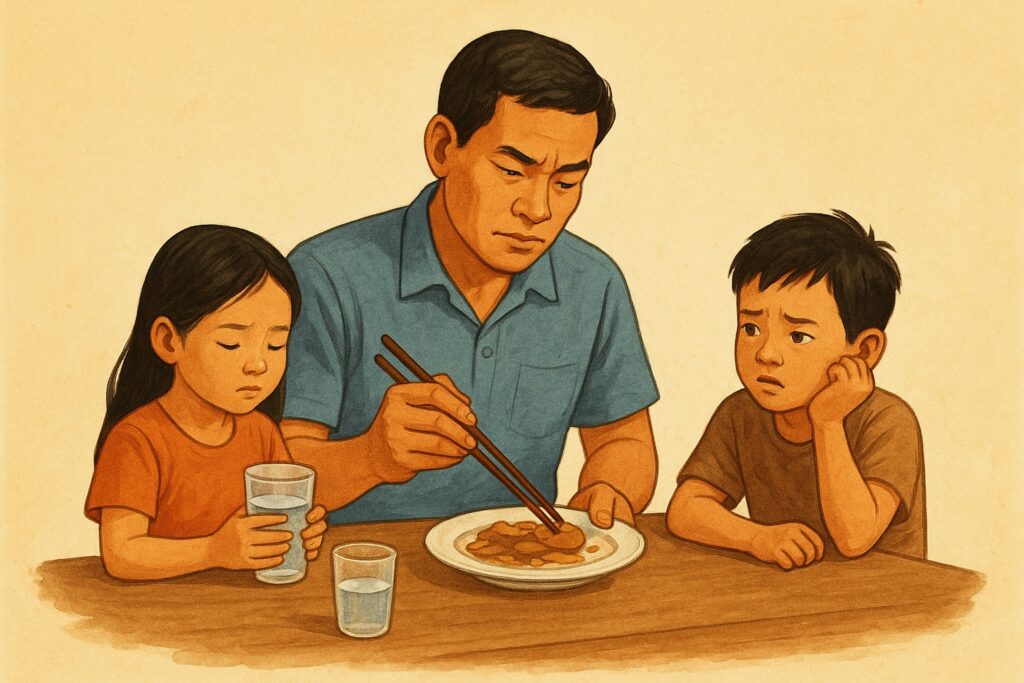
Cha ăn mặn, con khát nước
The literal translation is: “The father eats salty food, the children go thirsty.”
When I first came across this saying, I was struck by its clarity. Actions have consequences, and often those consequences do not fall on the person responsible but on those who come after. It’s not simply about morality; it’s about accountability across generations.
I remember writing it down in 1994 and thinking of my own family, of how the choices made by parents and grandparents—whether wise or reckless—can shape the lives of their children in unseen ways. Even now, I feel it serves as a powerful reminder: the things we do today, however small, ripple outward. We owe something not only to ourselves but also to the people who will come after us.

Cái nết đánh chết cái đẹp
This proverb translates as: “Goodness defeats beauty.”
The English equivalent might be: “Handsome is as handsome does.” I’ve always liked how it flips the natural temptation to value appearance above all else. Instead, it gently reminds us that true worth lies in character, in kindness, and in deeds.
I can still recall moments when I heard this being used casually, almost as advice. Sometimes it was directed at young people who placed too much importance on looks; other times, it was said with a knowing smile when someone admired something—or someone—that was superficially attractive but lacking in substance. For me, it has become a personal caution against being dazzled by the surface.
Why They Still Matter
Revisiting these proverbs after thirty-one years feels like catching up with old friends. They are short, simple lines, but behind them lies a deep well of human experience.
One proverb teaches responsibility: that our actions are rarely ours alone, but part of a much larger story that extends into the future. The other teaches perspective: that true beauty is not something fleeting or shallow, but something that endures in the way we treat others and live our lives.
They may have been spoken centuries ago, passed down from parent to child and repeated in markets, schools, and homes across Vietnam. And yet, here they are, speaking to me now—reminding me that wisdom, like culture itself, never really goes out of date.
As I look back on the notes I began in 1994, I realise they weren’t just scribbles in a notebook. They were small anchors of meaning, fragments of a culture that has taught me to pause, to listen, and to value the lessons hidden in everyday words.
Perhaps that is why I keep returning to them.