
A cultural-philosophical essay on time, change and the present
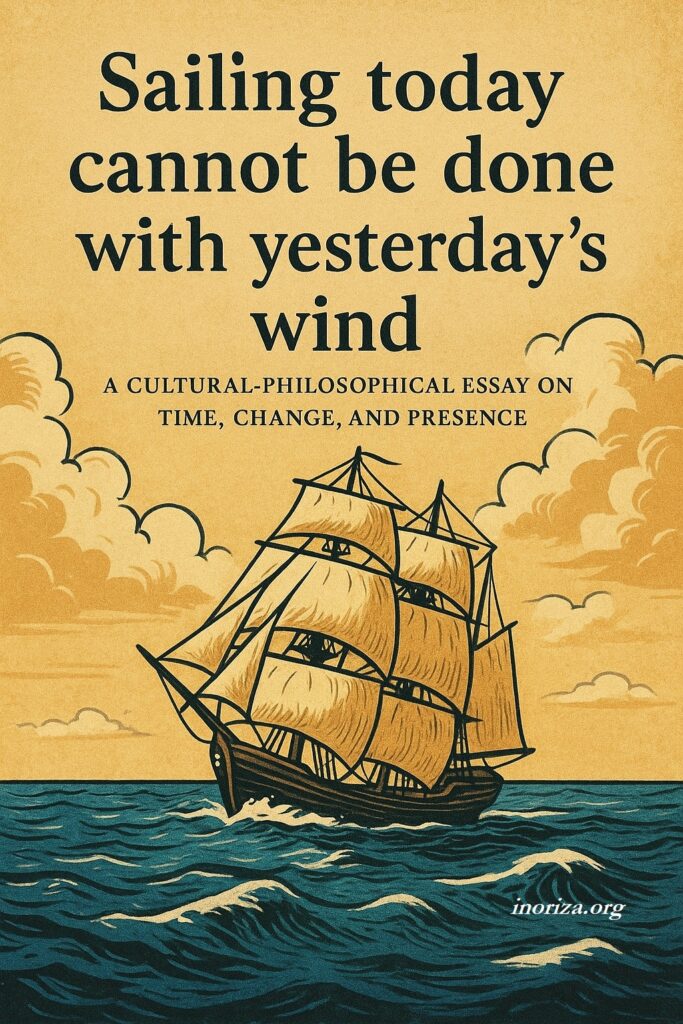
Proverbs are not merely folkloric ornaments of language; they embody a collective memory, condensed forms of life experience that endure across generations. Among them, the German proverb “Auf dem Wind von gestern kann man heute nicht segeln” (“You cannot sail today with yesterday’s wind”) carries remarkable depth. It links an image from the world of seafaring with a timeless insight: the past may have shaped us, but it no longer carries us forward. Each age brings its own wind, and those who rely solely on yesterday’s currents lose the ability to shape today.
Time as a River – Philosophical Perspectives
Heraclitus famously declared: “You cannot step into the same river twice.” With this, he laid the foundation for a philosophy that views change as the fundamental law of existence. The river symbolises time, and the person who steps into it is never the same. The proverb expresses a parallel idea: yesterday’s wind no longer blows, and the sail must be trimmed anew.
Nietzsche, in his Untimely Meditations, criticised enslavement to historicism: those who dwell too heavily on the past lose the strength to live in the present. Sailing with yesterday’s wind, one might say, paralyses the will to act. In this sense, the proverb calls on us not to forget the past, but to let it go once it hinders us in the now.
Heidegger, too, spoke of the Augenblick—the moment in which past, present and future converge. Here again we find the resonance of the proverb: life unfolds not in yesterday or tomorrow, but in the present.
Work: From Industry to the Digital Age
The history of labour offers ample evidence of this truth. The factory worker of the nineteenth century could not simply survive with the tools of his forefathers once the Industrial Revolution reshaped the world of work. Similarly, today’s craftsman or teacher must embrace digital tools to remain relevant.
“New times, new customs” has been a human refrain across history. Thomas Mann, in Buddenbrooks, charts the decline of a merchant dynasty that failed precisely because it could not adapt to changing times. To attempt to sail with yesterday’s wind is to risk shipwreck in the storms of modernisation.
Relationships: Love and Friendship in Motion
The same necessity is evident in human relationships. Goethe’s letters and poems reveal that love only flourishes when it is renewed. Memories of tenderness are precious, yet they cannot by themselves sustain a partnership.
“What is past, is gone.”
Nostalgia is seductive but dangerous; it can blind us to what must be done here and now—whether a conversation, an act of reconciliation, or simply the shared experience of the present. Rilke reminds us: “For staying is nowhere.” Feelings are currents; they demand constant tending, lest the spring run dry.
Learning: Education as Process
The history of education, too, shows that knowledge is never static. Medieval scholasticism could not sustain the rise of natural science, and the pedagogy of the nineteenth century is obsolete today.
“The clock only strikes forwards.”
This applies equally to individual learning: a language not spoken fades; a field of knowledge not cultivated becomes outdated. In Kant’s spirit, enlightenment is a process, not a state once attained. Knowledge is not a coin one can pocket—it is sailing, not anchoring.
Time as Healing and Hope
Yet the proverb carries not only warning but consolation. “Time heals all wounds” evokes the regenerative power of time. History bears witness: post-1945 Europe found a new wind by overcoming old enmities and building new communities.
Literature, too, offers this comfort. Rilke’s Duino Elegies remind us that pain and loss are integral to being human, yet transformed by time. “In time, all things pass”—not as naïve hope, but as the deep recognition that change is also healing.
The Essence: Presence as the Site of Life
All these perspectives converge on a central truth: life unfolds only in the now. The past offers guidance, the future offers hope—but action is possible only in the present.
“Whoever misses the moment, misses life.”
Thus the proverb “You cannot sail today with yesterday’s wind” is more than a practical maxim. It is a cultural-philosophical key, reminding us of our responsibility: to stand in the present, to set the sail anew, and to chart our course consciously.
Memory may hold us like an old harbour, and the future may beckon like a far horizon—but the voyage itself can only succeed with the wind that blows today.