
Between Tradition and Change
1. Introduction
Vietnamese society has long been shaped by a complex interplay of Confucian, Buddhist, and indigenous values, which have traditionally upheld a strict moral code concerning sexuality, family structure, and gender roles. In this framework, sexual conduct was not merely personal, but a matter of collective honour, deeply tied to the reputation of one’s family and lineage.
However, the past few decades—particularly since the economic reforms known as Đổi Mới in the late 1980s—have witnessed rapid social change, especially in urban areas.
The arrival of global media, the spread of social networks, increased mobility, and rising individualism have challenged older notions of sexual morality and marital fidelity. Yet these changes unfold unevenly, producing tensions between tradition and modernity, and between public values and private behaviours.
2. Traditional Sexual Morality in Vietnam
Historically, Vietnamese sexual ethics were deeply rooted in Confucianism, which emphasised hierarchical family structures, female obedience, and the centrality of filial piety. The ideal woman was expected to remain chaste before marriage, loyal within it, and submissive to both her husband and in-laws. The phrase phụ nữ đoan chính (a woman of upright conduct) captured the expectation of female virtue, encompassing modesty, silence, and restraint.
Marriages were often arranged by families, with an emphasis on social background compatibility rather than emotional connection. Sexuality was rarely discussed openly; instead, it was tightly controlled and confined within the framework of marriage.
Public displays of affection were frowned upon, and premarital sex—especially for women—was considered dishonourable.
Men, while subject to similar ideals of moral conduct, were often afforded greater leniency. A husband’s authority over his wife was not only accepted but institutionalised, and male infidelity, though not idealised, was sometimes tolerated, particularly among the upper classes.
3. Contemporary Shifts in Sexual Norms
In recent years, urbanisation, globalisation, and technological change have contributed to shifting sexual norms, especially among the younger generations in major cities like Hà Nội, Đà Nẵng, and Thành phố Hồ Chí Minh (Hồ Chí Minh City). The spread of social media platforms, dating apps, and access to foreign entertainment has made conversations around sex more visible, diverse, and open.
Among urban youth, premarital sex is increasingly normalised, and romantic relationships are formed more freely.
While virginity was once considered a crucial aspect of a woman’s honour, today it holds less significance, particularly in more liberal or educated circles.
Nevertheless, these changes are uneven. In rural areas or among older generations, traditional expectations still dominate. Young people often navigate contradictory pressures: on the one hand, the pull of individual freedom and romantic love; on the other, the persistent weight of familial expectations and moral judgement.
4. Marriage, Jealousy, and the Double Standard
In Vietnamese culture, marriage remains highly valued, both as a social institution and as a personal milestone. However, attitudes towards infidelity and jealousy reveal a long-standing gendered double standard.
Historically, male infidelity was often excused or ignored, encapsulated in proverbs such as “Trai năm thê bảy thiếp, gái chính chuyên một chồng” (A man may have five wives and seven concubines, but a woman must be loyal to one husband).
Female infidelity, by contrast, was viewed as a serious transgression, threatening family honour and moral order.
Jealousy (ghen tuông) has long been a theme in Vietnamese literature and popular culture. While male jealousy is sometimes seen as a sign of possessiveness or wounded pride, female jealousy is portrayed both sympathetically and as a source of conflict, particularly in family dramas.
Today, many women challenge this double standard. Urban, educated women increasingly expect mutual fidelity and emotional commitment.
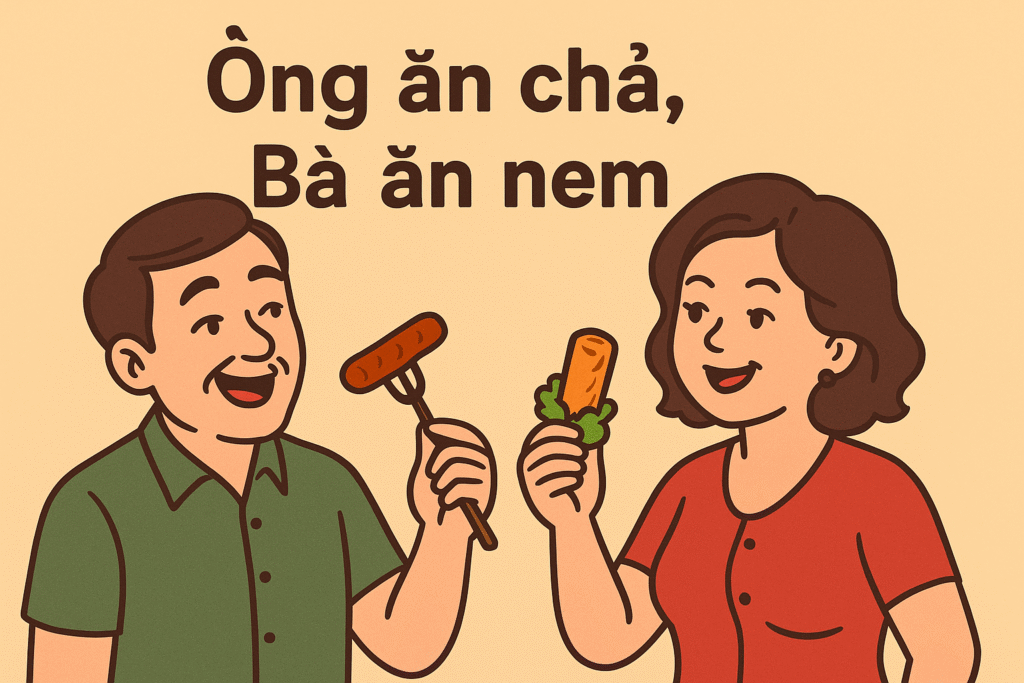
Yet old sayings like “Ông ăn chả, bà ăn nem” (The man eats chả [grilled pork], the woman eats nem [spring rolls])—implying mutual infidelity—reflect a growing rejection of unequal treatment, even if expressed with irony or humour.
Vietnamese folk culture is rich in culinary metaphors for sexual activity, framing intimacy as consumption. These idioms serve as euphemisms and social commentary. Proverbs like “Ghen quá hoá điên” (Too much jealousy drives one mad) portray jealousy as destabilising.
Others, like “Chồng chung không ai khóc” (No one cries over a shared husband), hint at resignation toward male promiscuity.
Similarly, “Chán cơm thèm phở” (Tired of rice, craving noodle soup) critiques a man’s boredom with his wife (“rice”) and desire for novelty (“phở”).
“Ăn bánh trả tiền” (You eat the cake, you pay the money) bluntly denotes transactional sex. These sayings, circulating more freely than open discussion, act as coded expressions of entrenched gendered attitudes toward sex and morality.
5. Infidelity and Divorce Today
The rise in divorce rates in Vietnam since the Đổi Mới period reflects both economic liberalisation and shifting social attitudes. While divorce was once rare and stigmatised, it is now increasingly common, particularly in urban centres.
Infidelity remains a leading cause of marital breakdowns. Although both genders may engage in extramarital affairs, men continue to be more socially “forgiven”, whereas women risk being labelled immoral or unfit mothers. In some cases, affairs are exposed via social media—where perpetrators
“Ăn vụng không biết chùi mép” (eat on the sly without wiping their mouths), carelessly leaving evidence—amplifying public shaming and gossip.
Legally, Vietnamese law permits divorce on the grounds of adultery, and courts may consider infidelity when deciding on custody or division of assets. However, in practice, women may still face social pressure to remain in unsatisfying or abusive marriages to “save face” or for the sake of their children.
Notably, a growing number of women—particularly in the middle and upper classes—are choosing divorce as an act of self-assertion, challenging patriarchal norms and claiming the right to personal happiness over social approval.
6. Tensions and Continuities
Vietnam’s evolving sexual morality reflects a broader tension between continuity and change. While modern influences promote personal freedom and gender equality, traditional values remain deeply embedded, particularly in rural areas, conservative families, and among the elderly.
Social class, education, and region play decisive roles. For instance, educated women in urban areas are more likely to question male dominance or accept divorce, while women in rural or poor settings may have fewer options.
Similarly, young men in cities may embrace Western-style dating, while their rural counterparts adhere more closely to traditional courtship.
There is also a gap between public morality and private behaviour. Many continue to endorse traditional norms while privately pursuing more liberal lifestyles. The result is a society marked by moral ambivalence, in which appearances and conformity often mask deeper currents of change.
7. The Resonant Proverb: “Ông ăn chả, bà ăn nem”
Translated: “The man eats chả (grilled pork), the woman eats nem (spring roll).” Figuratively, it means both partners engage in infidelity. This proverb exemplifies Vietnam’s tradition of using culinary metaphors as social critique.
It reflects a tit-for-tat morality increasingly voiced by younger generations, challenging double standards through characteristically Vietnamese humour.
Like “Chán cơm thèm phở” or “Ăn vụng…”, it transforms private acts into public commentary via edible imagery—a culturally nuanced way of processing uncomfortable truths about power and desire.
8. Modern Mechanisms of Exposure: From Gossip to Livestreams
In the age of smartphones and high-speed internet, infidelity no longer stays in the bedroom – it often ends up on Facebook. Viral livestreams of lovers caught in hotels, screenshots of steamy messages, and hidden camera footage from cafés or karaoke bars have become a staple of Vietnamese internet drama. While once discreet affairs might have stayed behind closed doors, today’s betrayals are increasingly spectacular and public, with live streamers sometimes acting as self-appointed moral judges.
Some see this as a modern form of public shaming – others see it as digital justice. Either way, the internet has become the new village square.
9. Pop Culture Reflections: From Dramas to TikTok
Vietnamese pop culture mirrors these tensions. Romantic dramas on TV (phim truyền hình) often feature complex plots around adultery, broken families, and jealous exes – with exaggerated slaps and heart-wrenching monologues. Online, TikTok videos parody cheating tropes with satirical sketches, while young creators remix proverbs like “Ông ăn chả…” into viral audio memes.
The moral codes in these media are not monolithic: some content criticises betrayal and glorifies forgiveness; others lean into feminist satire and depict women taking revenge or asserting autonomy.
10. Conclusion
Vietnam stands at a cultural crossroads where centuries-old traditions coexist with rapid modernisation. Sexual morality, once strictly codified by Confucian ideals, is now being negotiated in real time, especially by younger generations seeking a balance between respect for family and the pursuit of personal happiness.
The shifts in attitudes towards marriage, infidelity, and divorce reflect a broader transformation in how individuals define their roles within families and society. Yet the process is far from linear. Contradictions, resistances, and double standards persist, reminding us that moral change is rarely simple.
As Vietnam continues to develop economically and globally, the negotiation between loyalty and liberty, tradition and autonomy, will remain a defining tension in the country’s evolving cultural landscape.
What’s clear is this: from Confucian scripts to TikTok trends, Vietnam’s sexual morality has become a dynamic space – at once comedic, tragic, performative, and deeply human.