
A Comparative Analysis of Thai, Cambodian, and Vietnamese Martial Arts
Abstract
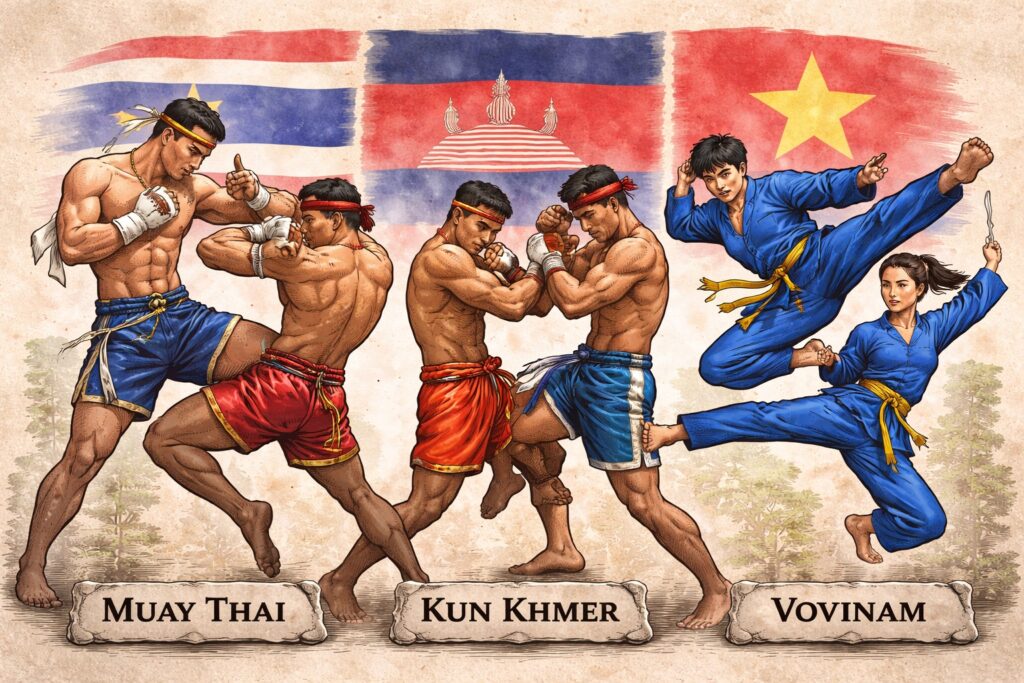
Martial arts in mainland Southeast Asia function not only as systems of combat but also as repositories of cultural memory, national identity, and historical continuity. This article presents a comparative analysis of Thai, Cambodian, and Vietnamese martial traditions, focusing on Muay Thai, Kun Khmer, and key Vietnamese systems such as Vovinam and traditional regional styles. Through a historical and cultural lens, the study examines shared origins, technical divergences, ritual practices, and processes of modernisation. The findings suggest that while Thai and Cambodian striking arts share a common pre-modern military heritage, Vietnamese martial traditions evolved within a more pluralistic and syncretic framework shaped by indigenous development and external influences, particularly Chinese martial culture.
Keywords: Southeast Asian martial arts, cultural heritage, Muay Thai, Kun Khmer, Vovinam, traditional combat systems, ritual performance
1. Introduction
Martial arts across Southeast Asia are deeply embedded within broader socio-cultural and historical contexts. In Thailand, Cambodia, and Vietnam, combat systems have historically served dual functions: practical methods of self-defence and symbolic expressions of national identity (Green & Svinth, 2010). Among these, Muay Thai and Kun Khmer are often perceived as closely related striking arts, while Vietnam presents a more heterogeneous martial landscape shaped by indigenous traditions and modern hybrid systems.
This article aims to provide a comparative overview of these martial traditions by analysing their origins, technical characteristics, ritual frameworks, and cultural significance. Rather than treating them solely as sports, the discussion situates them within the broader discourse of intangible cultural heritage and identity formation.
2. Historical Origins and Regional Interconnections
2.1 Pre-modern Military Foundations
Muay Thai and Kun Khmer both derive from ancient battlefield combat systems developed in the region historically associated with the Siamese and Khmer polities. These pre-modern systems emphasised close-range striking, limb conditioning, and practical techniques suitable for warfare. Over time, as warfare technologies evolved, these combat practices transitioned into ritualised and sportive forms.
Historical interactions between the Khmer Empire and successive Siamese kingdoms facilitated cross-cultural exchanges in martial training, contributing to the technical similarities observable today. Scholars have argued that the shared use of elbows, knees, and clinch work reflects a regional combat paradigm rather than a singular national invention.
2.2 Vietnamese Martial Development
In contrast, Vietnamese martial arts emerged from a more complex matrix of influences. Indigenous combat traditions coexisted with strong Chinese cultural and military influences, reflecting centuries of political interaction. This resulted in systems that integrated striking, grappling, weaponry, and philosophical elements rooted in Confucian and Daoist thought.
The twentieth century marked a period of codification and nationalisation, particularly with the foundation of Vovinam in 1938 by Nguyễn Lộc. This modern system sought to synthesise traditional Vietnamese techniques with structured pedagogical methods and elements borrowed from other Asian martial arts.
3. Technical Comparison: Kun Khmer and Muay Thai
3.1 Striking Philosophy and Tactical Orientation
Although visually similar, Muay Thai and Kun Khmer differ in their technical emphasis. Muay Thai is often characterised by a systematic and rhythm-based approach to striking, integrating kicks, knees, elbows, and punches within a strategic scoring framework. Conversely, Kun Khmer tends to prioritise aggressive close-range engagement, particularly through explosive elbow strikes.
3.2 Clinch Dynamics
The clinch represents a central component of both systems; however, its tactical application differs. Muay Thai employs prolonged clinch control to destabilise opponents and deliver repeated knee strikes, reflecting a tactical and endurance-oriented strategy. Kun Khmer, by contrast, frequently utilises shorter, more dynamic clinch exchanges, often as transitional moments leading to rapid elbow or knee attacks.
3.3 Kicking Mechanics and Body Movement
Biomechanical analysis suggests that Muay Thai commonly favours diagonal, penetrating kicks executed with full hip rotation and shin contact, maximising kinetic force transmission. Kun Khmer kicking techniques are often described as more horizontal and impact-focused, emphasising weight transfer and rotational momentum.
3.4 Sweeps, Throws, and Combat Flow
Historically, Kun Khmer has maintained a broader inclusion of sweeps and off-balancing techniques, whereas contemporary Muay Thai competition increasingly prioritises effective striking and ring control. These differences reflect both regulatory evolution and national stylistic preferences.
4. Ritual, Music, and Cultural Symbolism
Ritual performance remains integral to Southeast Asian martial traditions. Pre-fight ceremonies in both Thai and Cambodian contexts serve as acts of homage to teachers, ancestors, and spiritual protectors. The Thai Wai Kru ritual, for instance, symbolises lineage and discipline, while the Cambodian Kun Kru ritual incorporates a codified sequence of postures often linked to classical epic narratives.
Musical accompaniment further reinforces cultural identity. Traditional orchestral music accompanies bouts in both systems, creating a ceremonial atmosphere that distinguishes these arts from Western combat sports. Such practices illustrate the inseparability of martial performance and ritualised cultural expression.
5. The Pluralistic Martial Arts Landscape of Vietnam
5.1 Vovinam as a National Synthesis
Vovinam represents one of the most prominent modern Vietnamese martial arts and is frequently framed as a symbol of national pride. Its curriculum includes striking, grappling, joint locks, throws, and weapon training, reflecting a comprehensive pedagogical structure. Notably, its signature flying scissor takedowns exemplify both technical innovation and aesthetic distinctiveness.
5.2 Traditional Regional Systems
Beyond Vovinam, Vietnam preserves numerous regional martial traditions. The Bình Định martial arts, historically associated with the Tây Sơn period, emphasise animal-inspired movements, weapon mastery, and explosive striking techniques. Meanwhile, traditional wrestling practices such as Đấu Vật continue to be performed in festival contexts, highlighting communal values and ritual continuity.
6. Modernisation and Globalisation
The globalisation of combat sports has significantly influenced Southeast Asian martial arts. Muay Thai has achieved widespread international recognition, shaping training methodologies worldwide. Kun Khmer, while historically less globalised, has recently experienced a revival tied to national cultural heritage initiatives.
Vietnamese practitioners increasingly engage in cross-training with Muay Thai, Kickboxing, and Sanda to compete in international circuits, reflecting a pragmatic adaptation to contemporary combat sport standards. This hybridisation illustrates the dynamic evolution of martial traditions in response to global sporting frameworks.
7. Martial Arts as Intangible Cultural Heritage
From a cultural studies perspective, these martial arts function as forms of intangible cultural heritage. They encode historical narratives, ethical values, and national identity through embodied practice. Ritual dances, musical accompaniment, and teacher-student hierarchies reinforce social cohesion and continuity across generations.
In Thailand and Cambodia, state and cultural institutions actively promote their respective martial arts as heritage symbols, often linking them to historical legitimacy and cultural diplomacy. Vietnam similarly frames Vovinam as a modern embodiment of national resilience and cultural synthesis.
8. Conclusion
The comparative analysis of Thai, Cambodian, and Vietnamese martial arts reveals both shared regional foundations and distinct cultural trajectories. Muay Thai and Kun Khmer demonstrate a common historical lineage rooted in pre-modern combat systems, yet diverge in technical emphasis, ritual expression, and national framing. Vietnamese martial arts, in contrast, reflect a pluralistic evolution shaped by indigenous traditions, Chinese influence, and modern synthesis.
Ultimately, these martial systems should be understood not merely as competitive sports but as culturally embedded practices that articulate identity, history, and social values. Their continued evolution within globalised combat sports environments underscores the dynamic interplay between tradition and modernity in Southeast Asian martial culture.
References
- Green, T. A., & Svinth, J. R. (2010). Martial arts of the world: An encyclopedia of history and innovation. ABC-CLIO.
- Nguyen, L. (2016). Vovinam and the construction of Vietnamese martial identity: Tradition, modernity, and nationalism. Journal of Asian Martial Arts Studies, 8(2), 45–62.
- Pham, K. (2003). Vietnamese martial traditions and Sino-Vietnamese cultural exchange. Journal of Southeast Asian Cultural Studies, 12(1), 77–95.
- Poliakoff, M. (2012). Combat sports in the ancient world: Competition, violence, and culture. Yale University Press.
- Spencer, D. C. (2012). Ultimate fighting and embodiment: Violence, gender and mixed martial arts. Routledge.
- Taylor, P. (2004). Goddess on the rise: Pilgrimage and popular religion in Vietnam. University of Hawai‘i Press.
- Turner, J. (2009). Biomechanics of striking in combat sports: Efficiency, power, and performance. International Journal of Sports Science & Coaching, 4(3), 345–358.
- Vail, P. (2018). Muay Thai: Inventing tradition for a national symbol. Journal of Sport and Social Issues, 42(6), 509–531.