
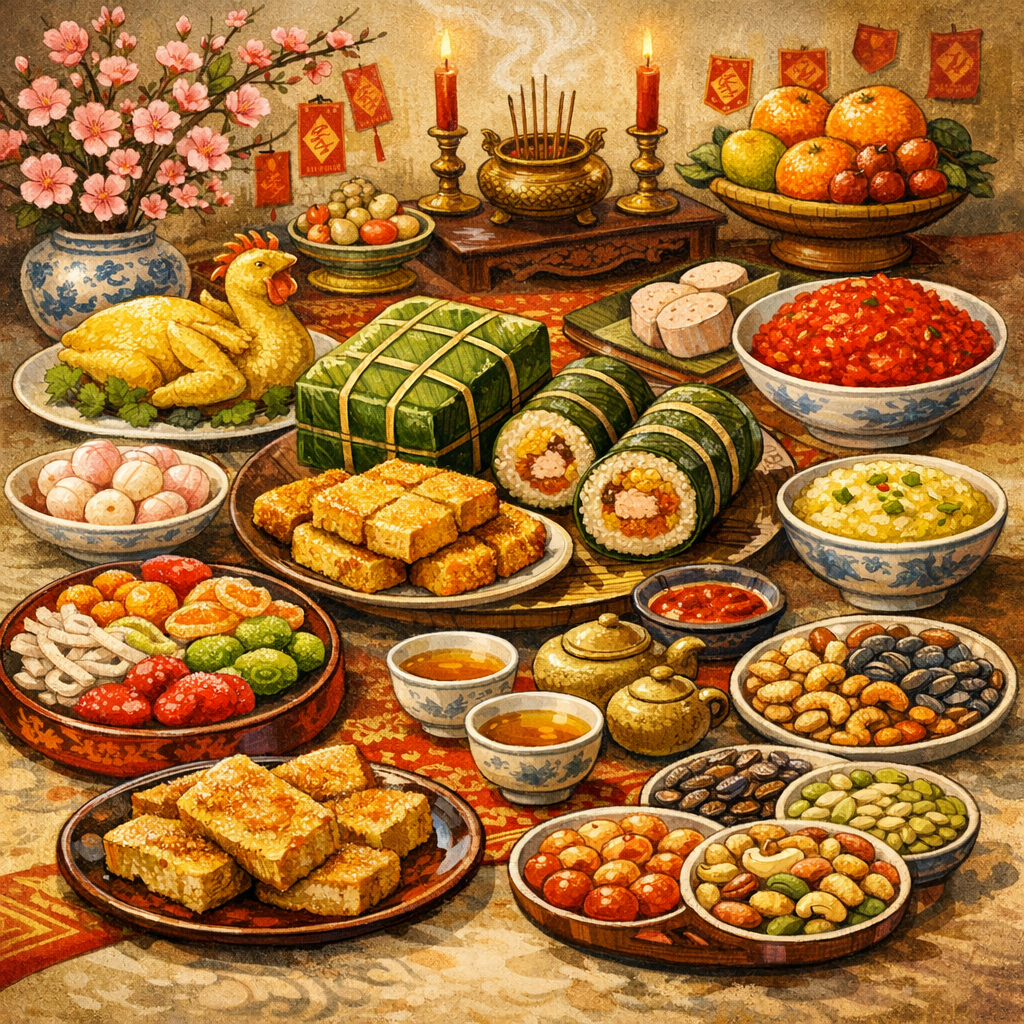
Tết, the Vietnamese Lunar New Year, is much more than a celebration—it is a time of remembrance, gratitude, and hope. Food plays a central role in the festivities, with each dish carefully prepared not only for its flavour, but also for the meaning it carries. From offerings to ancestors to shared family meals, traditional Tết foods symbolise harmony, prosperity, and wishes for a good year ahead.
Bánh Chưng and Bánh Tét
These iconic sticky rice cakes lie at the heart of Tết celebrations. Bánh Chưng, with its square shape, represents the Earth, while the cylindrical Bánh Tét is associated with the Sky. Together, they reflect gratitude towards nature and honour the ancestors who shaped Vietnamese life and traditions.
Fried Bánh Chưng
After the main celebrations, leftover Bánh Chưng is often sliced and pan-fried until crisp and golden. The contrast between the crunchy exterior and soft, savoury interior makes it a comforting favourite, embodying both creativity and respect for food.
Pickled Onions (Dưa hành)
Light, tangy, and refreshing, pickled onions are an essential accompaniment during Tết. Their sharpness balances the richness of many festive dishes and helps cleanse the palate after generous meals.
Boiled Chicken
Boiled chicken is a traditional offering placed on ancestral altars before being shared at family gatherings. Served whole, it symbolises purity, prosperity, and unity—values at the heart of the New Year.
Mung Bean Pudding (Chè đậu xanh)
This gently sweet dessert made from mung beans is both comforting and symbolic. It is believed to bring peace, good fortune, and a sense of calm for the year ahead.
Chả Lụa (Vietnamese Sausage)
Smooth and delicately seasoned, chả lụa is a staple on the Tết table. It is commonly sliced and served with sticky rice or tucked into bánh mì, making it both festive and everyday at once.
Xôi Gấc (Red Sticky Rice)
Coloured naturally by the gấc fruit, xôi gấc stands out with its vibrant red hue. Red is a powerful symbol of happiness, luck, and prosperity, making this dish especially popular during celebrations.
Candied Fruits (Mứt Tết)
Colourful and sweet, mứt Tết is enjoyed slowly with cups of hot tea as families welcome guests. These preserves symbolise sweetness, optimism, and a positive beginning to the New Year.
Roasted Nuts and Seeds
Watermelon seeds, pumpkin seeds, cashews, pistachios, and other roasted treats are classic Tết snacks. Often placed on tables for guests to share, they represent fertility, growth, and abundance.
Bánh Tét

Bánh Tét: A Southern Vietnamese Tết Classic
Bánh Tét is a signature dish of southern Vietnam and a familiar sight in almost every household during Tết. While it shares its origins with Bánh Chưng from the north, Bánh Tét has evolved into its own distinctive variation. The core ingredients—glutinous rice, mung beans, and seasoned pork—remain largely the same, but its long, cylindrical shape sets it apart from the square form of Bánh Chưng.
How Bánh Tét Is Made
Bánh Tét is usually prepared well in advance, often about a week before Tết begins. Choosing high-quality ingredients is essential. The glutinous rice must be fragrant and freshly harvested to ensure the best texture and aroma. Mung beans are rinsed several times before being cooked until smooth.
The pork, including both lean meat and pork fat, is seasoned with salt, sugar, and spices, then pre-cooked before being combined with the other ingredients. In some families, dried shrimp is added to the centre along with the pork to enhance flavour. All the components are carefully layered onto banana leaves, tightly wrapped, and secured with string or ribbons before being steamed for many hours in a large pot.
Ingredients
Like Bánh Chưng, Bánh Tét is made from soaked glutinous rice and mung beans, and wrapped in banana leaves. The simplicity of the ingredients highlights the care and patience required in its preparation.
Eating and Enjoying Bánh Tét
Once cooked, Bánh Tét is traditionally cut using a string rather than a knife, producing neat, round slices. The cross-section reveals layers of soft sticky rice surrounding a rich core of mung bean and pork, resembling a filled ring.
Bánh Tét is commonly eaten with pickled turnip (củ cải muối or củ cải ngâm nước mắm) and thịt kho nước cốt dừa—pork braised in coconut juice—a classic Tết pairing in the south. During the holiday, Bánh Tét can be stored in the refrigerator and reheated by steaming. Many people also enjoy slicing and pan-frying it until crisp, creating a delicious contrast in texture. Some even coat the slices lightly in flour before frying for extra crunch.
Serving Bánh Tét and Regional Variations
Hot tea is the traditional accompaniment to Bánh Tét. A cup of tea not only complements its rich flavour but also helps cleanse the palate, making each bite more enjoyable.
In addition to the savoury version, there is also Bánh Tét Chuối, a sweet variation made with ripe bananas. The bananas must be fully ripe to achieve the right sweetness—unripe fruit can result in a bitter or sour taste. This version is especially popular in the Mekong Delta, particularly in Tiền Giang Province, and offers a softer, dessert-like take on this beloved Tết cake.
If Banh Chung – Banh Day is considered a symbol for the North, Banh Tet is a unique dish for Southern people. Banh Tet, as well as its process from making to savouring, has been a significant activity that partially brings the warm Tet atmosphere of reunions among family members and neighbours when they sit together and share the taste of Banh Tet on the first day of the New Year.

Banh Chung
Banh Day (Chung cake or square rice cake)
History and Legend
The origins of Bánh Chưng date back to the Hồng Bàng Dynasty, during the reign of the sixth Hùng King. As the emperor grew old and began to consider stepping down, he sought a worthy successor among his twenty-one sons. To decide who would inherit the throne, he announced a cooking contest: the prince who prepared the most meaningful and satisfying dish would become the next ruler.
While most of the princes travelled far and wide in search of rare and exotic ingredients, Lang Liêu—the eighteenth son of the Hùng King—remained at home. Poor and lonely after losing his mother at a young age, he lacked the wealth to compete in the same way as his brothers. One night, however, a fairy appeared to him in a dream and revealed a simple but profound idea.
Guided by the dream, Lang Liêu created two cakes using humble ingredients: glutinous rice, mung beans, and meat. He shaped one cake into a round form and named it Bánh Dày, symbolising the sky above. The other was square, filled with mung bean paste and ground pork, and called Bánh Chưng, representing the earth below.
On the day of presentation, while other princes offered lavish and unfamiliar delicacies, Lang Liêu and his wife presented these two simple cakes. Though initially mocked, the emperor was deeply moved by both their flavour and their symbolism. Impressed by the respect shown to nature and humanity, the Hùng King declared Lang Liêu the winner and passed the throne to him. From that moment on, Bánh Chưng and Bánh Dày became central to Tết celebrations, passed down through generations.
Bánh Chưng Today
Today, Bánh Chưng remains one of the most important foods of the Vietnamese Lunar New Year. It can be eaten as it is or pan-fried to create Bánh Chưng Rán, a comforting dish especially popular during Vietnam’s cooler February weather.
In southern Vietnam, the same ingredients are wrapped into a cylindrical shape known as Bánh Tét, while in the north a longer version called Bánh Chưng Dài or Bánh Tày is made with mung beans and little or no pork, allowing it to be preserved for longer periods.
Across the country, Bánh Chưng has evolved into many regional and cultural variations. These include Bánh Chưng Gù (a humped version made by the Sán Dìu people), Bánh Chưng Chay for vegetarians and Buddhists, and Bánh Chưng Ngọt, a sweetened version. Each variation reflects local tastes, beliefs, and traditions, while preserving the deep cultural meaning of this iconic Tết dish.
Fried Chung Cake
(Fried Chung Cake is a popular variation of Vietnamese Square Cake)

Traditionally, the making of Bánh Chưng was as important as the cake itself. It was a time for family members to gather, often sitting together around a warm fire through the night. As the cakes slowly cooked, stories were shared, memories revisited, and good wishes exchanged in anticipation of the New Year. The process embodied togetherness, continuity, and the passing down of traditions from one generation to the next.
Today, fewer Vietnamese families prepare Bánh Chưng at home, as modern life leaves little time for such labour-intensive rituals. Even so, Bánh Chưng remains irreplaceable on ancestral altars during Tết. Its presence is a powerful symbol of filial piety, loyalty, and deep gratitude towards one’s ancestors—values that continue to shape Vietnamese culture.
The cultural importance of Bánh Chưng has long been celebrated in Vietnamese poetry. One well-known verse captures the essence of a traditional Tết scene:
“Thịt mỡ, dưa hành, câu đối đỏ
Cây nêu, tràng pháo, bánh chưng xanh”
Translation:
“Rich meats, pickled onions, red calligraphy couplets,
The New Year’s pole, strings of firecrackers, and green Bánh Chưng.”
Together, these images evoke the warmth, colour, and spirit of Tết, with Bánh Chưng standing at the heart of the celebration.
Dưa hành
Pickled onions

Pickled onions (dưa hành) are a beloved staple during Tết, the Vietnamese Lunar New Year, yet they are enjoyed by Hanoians throughout the year. Lightly tangy and refreshing, they are the perfect accompaniment to rich, fatty pork dishes, helping to balance flavours and cleanse the palate after festive meals.
Ingredients
- 450 g green onions (white parts only)
- 480 ml white rice vinegar
- 2 tablespoons salt
- 100 g brown sugar
- 5 shallots, peeled
Method
- Thoroughly wash the onions and allow them to dry completely. Removing excess moisture helps ensure a crisp texture.
- In a saucepan, combine the vinegar, brown sugar, and salt. Bring the mixture to a gentle boil, stirring until fully dissolved, then remove from the heat and leave to cool.
- Arrange the onions and shallots in a clean, sterilised glass jar.
- Pour the cooled pickling liquid over the vegetables, ensuring they are fully submerged.
- Seal the jar tightly and leave it at room temperature for at least three days to allow the flavours to develop.
- Once pickled, store the jar in the refrigerator. The onions will keep well for up to three weeks.
Crisp, lightly sweet, and pleasantly sharp, these pickled onions are a simple yet essential addition to any Tết table—and just as enjoyable alongside everyday meals.
Gà Luộc
Boiled Chicken

Chicken in Vietnamese Culture
Rooted in a long tradition of wet-rice agriculture, Vietnamese culture maintains a close relationship with nature. Alongside the buffalo, the chicken is one of the most familiar and significant animals in daily life, forming part of a group that also includes the pig, goat, and horse.
Domesticated thousands of years ago, chickens have played an essential role in Vietnamese society—not only as a source of nourishment, but also in farming rhythms, customs, and spiritual beliefs.
Fortune-Telling Through Chicken Feet
One of the most distinctive traditions linked to chickens is the custom of reading fortunes from a cock’s feet. On New Year’s Eve, a carefully chosen cock is offered to the gods, and its feet are believed to reveal signs about the family’s fortunes in the year ahead.
Interpreting these signs requires experience and wisdom, usually entrusted to an elder. In general, bright yellow feet with neatly clustered claws are considered auspicious. According to ancient belief, a chicken uses three claws to dig the earth for food and four to fight enemies; when the claws naturally cluster together, they symbolise voluntary dedication and harmony.
If the signs are favourable, the chicken feet are hung from the kitchen roof until the next New Year’s Eve, in the hope of preserving good luck and prosperity for the household.
The Vietnamese Perception of the Chicken
Beyond its practical value as nutritious food and a natural alarm clock—farmers traditionally rise with the cock’s dawn crow—the chicken also holds deep symbolic meaning. In Vietnamese spiritual thought, the cock represents a sacred connection through five core virtues:
- Knowledge (Văn): the cock’s comb resembles the hat worn by ancient civil mandarins.
- Martial strength (Vũ): its spurs and beak serve as powerful natural weapons.
- Bravery (Dũng): cocks instinctively protect hens and chicks.
- Benevolence (Nhân): a cock gathers and cares for the flock.
- Trustworthiness (Tín): the cock crows unfailingly at dawn, regardless of weather.
Together, these qualities explain why the chicken holds an indispensable place in Vietnamese daily and spiritual life.
Chicken at Tết
During Tết, a boiled castrated cock is considered essential. It symbolises purity and is regarded as the most respectful offering to ancestors. Cocks chosen for this purpose must meet strict standards: a bright red comb, smooth feathers, and slender legs—signs of strength and vitality.
Once boiled, the chicken is traditionally displayed on the family altar holding a rose in its beak. In some households, a flower carved from carrot replaces the rose. Whether natural or carved, the flower represents the yin (female) element, reflecting the Vietnamese belief in balance between yin and yang.
How to Make Traditional Boiled Chicken
Ingredients
- 1 whole chicken
- Dried lime peel
- 1 teaspoon salt
- 2 teaspoons ginger
Method
- Clean the chicken thoroughly with salt and water, then allow it to dry.
- Place the chicken in a large pot with approximately three litres of water, along with the ginger, salt, and dried lime peel.
- Bring to the boil and simmer gently for around 30 minutes, until the chicken is fully cooked.
- Remove from the pot and garnish with finely chopped lime or lemon leaves before serving.
Simple in preparation yet rich in meaning, boiled chicken remains one of the most powerful symbols of respect, balance, and continuity during the Vietnamese New Year.
Chè đậu xanh
Mung Bean Pudding

Mung Bean Pudding (Chè Đậu Xanh): A Quiet Tết Tradition
For generations, mung bean pudding has been a familiar and cherished presence in Vietnamese households, traditionally placed on ancestral altars on New Year’s Eve. Modest rather than luxurious, this dessert carries deep cultural meaning, elevated by a distinctive ingredient: cardamom. Valued not only for its warm aroma but also for its digestive benefits, cardamom gives the pudding both comfort and balance.
The Role of Cardamom in Vietnamese Cuisine
Cardamom is an aromatic spice grown mainly in Vietnam’s mountainous regions. With its gently sweet, warming flavour, it is widely used in Vietnamese cooking, enhancing both savoury dishes—such as poultry and vegetables—and sweet preparations. In mung bean pudding, the warmth of cardamom beautifully complements the smooth, cooling quality of the mung beans.
A Fading Tradition
Once considered an essential part of the Tết table, mung bean pudding has gradually fallen out of everyday celebration. Today, it is more commonly found in local markets or served at pagodas during fasting periods, quietly preserving its link to tradition and spirituality.
Cultural Significance
Historically, mung bean pudding was regarded as a test of culinary skill and patience. Mothers often used it to assess the diligence and care of prospective daughters-in-law, as the recipe demands precision, attentiveness, and a gentle hand. In this way, the dish came to symbolise craftsmanship, devotion, and domestic harmony.
Recipe: Mung Bean Pudding
Ingredients
- 500 g dried mung beans (with skins)
- 500 g granulated sugar
- 2 tablespoons sesame seeds
- ½ tablespoon grapefruit essence or vanilla
- A pinch of ground cardamom
Method
- Prepare the mung beans
Soak the mung beans overnight. Remove any damaged beans, then carefully peel off the skins. Allow the beans to dry. - Toast the sesame seeds
Dry-toast the sesame seeds in a shallow pan over medium heat until fragrant. Set aside to cool. - Cook the mung beans
Boil the mung beans in a pot of water for 50 minutes to 1 hour, until soft and tender. - Combine with sugar
In a separate pot, bring water to the boil and dissolve the sugar. Add the cooked mung beans and simmer over low heat, stirring constantly until the mixture thickens into a smooth paste. - Add flavourings
Stir in the ground cardamom, grapefruit essence (or vanilla), and toasted sesame seeds, mixing thoroughly. - Serve
Serve warm for a comforting dessert, or allow to cool before serving.
Simple, fragrant, and deeply rooted in tradition, mung bean pudding remains a gentle reminder of the care, patience, and respect at the heart of Vietnamese New Year customs.
Chả Lụa
Vietnamese sausage

Chả lụa is a traditional Vietnamese steamed pork sausage, made from finely ground pork blended with tapioca starch and a delicate balance of seasonings. The mixture is traditionally wrapped in banana leaves before being steamed or boiled, imparting a subtle, earthy aroma and a silky texture.
Serving Suggestions: Sliced chả lụa is incredibly versatile. Enjoy it tucked inside a crisp bánh mì (Vietnamese baguette), rolled into bánh cuốn (steamed rice rolls), or as a component in beloved dishes such as bún thang (vermicelli noodle soup) or cơm tấm (broken rice). Its mild, savoury flavour makes it a perfect complement to both simple snacks and more elaborate meals.
Variations:
- Chả bò – a beef version with a richer taste.
- Chả Huế – a spicier interpretation featuring chilli and the distinctive spices of central Vietnam.
Ingredients
- 500g pork shoulder (or preferred cut of pork)
- 1 tbsp fish sauce
- 1 tsp salt
- 1 tsp sugar
- ½ tbsp garlic powder
- 2 tsp black pepper
- 1 tsp baking soda
- 2 tbsp oil
Instructions
Serve Warm or Cool
Chả lụa can be enjoyed either warm or at room temperature. It pairs beautifully with Bánh Chưng, Bánh Cuốn, Xôi Vò, or simply steamed rice.
Prepare the Meat
Slice the pork thinly and freeze for around 2 hours. This firms it up, making it easier to grind finely.
Mix the Ingredients
Grind the pork thoroughly, then combine with fish sauce, salt, sugar, garlic powder, black pepper, baking soda, and oil. Using an electric mixer, beat the mixture for approximately 10 minutes until smooth and uniform. Allow it to rest for 20 minutes to let the flavours meld.
Shape the Mixture
Pack the mixture tightly into a round mould, pressing firmly to achieve a compact, even shape.
Wrap and Steam
Remove from the mould and wrap in banana leaves or cling film. Steam gently until fully cooked, taking care not to overcook so the sausage remains tender.
Serve and Enjoy
Once cooked, slice and serve as part of your chosen dish, or enjoy it on its own for a true taste of Vietnamese tradition.
Xôi Gấc
Red Sticky Rice

One dish that immediately catches the eye is a vibrant red sticky rice, strikingly unusual in appearance. This delicacy is called xôi gấc, a distinctive type of red sticky rice found exclusively in Vietnam.
But what exactly is gấc, and how is xôi gấc made?
Gấc is a tropical fruit native to Asia, known in English as “baby jackfruit,” “sweet gourd,” or by its scientific name, Momordica cochinchinensis. When fully ripe, the fruit takes on a deep orange hue, with a spiky outer skin and vivid red flesh and seeds within. In Vietnamese culture, gấc is valued not only for its culinary uses but also for its medicinal properties, making it a staple in both festive dishes and traditional remedies.

Gac Fruit
Gấc fruit is truly a nutritional powerhouse. A glance at its nutrient profile is enough to impress anyone—it contains more beta-carotene than any other fruit or vegetable. Beyond this, it is packed with antioxidants, phytonutrients, and vitamins, making it a natural ally for eye and skin health.
The fruit’s signature bright red colour and fragrant aroma come from its seeds, each encased in a vivid red aril. These seeds are the heart of xôi gấc—Vietnam’s iconic red sticky rice.
Making Xôi Gấc
Watching the preparation of xôi gấc is both fascinating and a little surprising, thanks to the vibrant red pulp of the gac fruit. First, the seeds are scooped out, then mashed and blended with glutinous rice that has absorbed water. A pinch of salt is added, and the mixture is steamed to perfection. Finally, a touch of coconut milk and sugar transforms the rice into a sweet, fragrant, and beautifully red sticky rice. Sometimes, it is shaped using moulds and finished with a sprinkle of sesame seeds or shredded coconut, making it as visually appealing as it is delicious.
Xôi Gấc and Vietnamese Tradition
You might wonder why xôi gấc holds such an esteemed place in Vietnamese culture. Traditionally, it is a key feature at weddings, Lunar New Year celebrations, and other important rituals. Its roots go back to Vietnam’s agrarian society and ancient matriarchal traditions, when offerings to Mother Nature and protective deities were made to ensure a peaceful life and bountiful harvests.
The colour red, especially, is laden with symbolism in Vietnam, representing luck, prosperity, and happiness. Rice, the nation’s staple food, has always been central to offerings and celebrations, making red sticky rice the perfect fusion of sustenance and symbolism.
Today, xôi gấc is no longer reserved solely for festive occasions. It is also enjoyed as a breakfast dish or snack. Despite its natural sweetness, it pairs wonderfully with savoury accompaniments such as ruốc (salty dried pork), giò lụa (Vietnamese pork rolls), or chicken, making it a versatile and beloved part of Vietnamese cuisine.
Mứt Tết
Candied Fruits

Vietnamese Snacks for Tet
Mứt Tết is not a dish served as part of a formal meal during the Tet holiday. Instead, it is a delightful snack designed to welcome guests into the home. Traditionally, mứt is arranged in beautiful boxes on the living room table, offering the main treat for hosts and visitors alike to enjoy while chatting over a cup of tea.
Unlike Western-style jam, which is typically a spreadable fruit preserve served with bread, Vietnamese mứt is usually dry. It is made from dried fruits or seeds, such as pumpkin, sunflower, or watermelon seeds, and comes in a dazzling array of flavours, including ginger, carrot, coconut, pineapple, pumpkin, lotus seed, star fruit, and sweet potato. While cakes and other sweets are gradually becoming more common during Tet, many families continue to cherish this unique, traditional snack.
Roasted Nuts and Seeds for Tet
No Tet snack tray would be complete without roasted nuts. Every Vietnamese household prepares a colourful selection of treats for guests, including candies, biscuits, fruits, jams, and, of course, roasted nuts. These nuts are more than just a snack—they help create a warm, convivial atmosphere as hosts and visitors share them together.
Unlike pre-shelled nuts often bought in stores, Vietnamese roasted seeds are frequently served in their shells, making the simple act of peeling them a slow, enjoyable ritual. During Tet, there’s no need to rush—savouring tea while peeling nuts is part of the experience. Each type of nut brings its own flavour and nutritional benefits, adding both variety and healthfulness to the snack tray.
Here are the top five most popular roasted nuts and seeds enjoyed during Tet in Vietnam.
- Hạt dưa (Watermelon seeds)

If you’ve ever eaten watermelon, you’ve probably noticed the black seeds inside. In Vietnam, these seeds are known as hạt dưa. The largest seeds are carefully selected, dried with gentle heat, and then roasted in large pans to create the final snack. There are two main types—red and black—depending on the natural colouring used.
Hạt dưa is not only delicious but also a nutritious and wholesome snack. It is rich in protein, carbohydrates, healthy fats, and essential vitamins such as B1, B2, and E, as well as minerals like calcium, iron, and zinc. The protein in hạt dưa is particularly beneficial for the nervous system, and it supports muscle growth, blood health, and bone development. Regularly enjoying a handful of hạt dưa can boost memory and even help protect against heart disease, making it a snack that’s both satisfying and good for you.
- Hạt bí (Pumpkin seeds)

Hạt bí, or pumpkin seeds, are a favourite Tet snack, partly because they are easier to shell than sunflower seeds (hạt dưa). They are prepared in much the same way as sunflower seeds—roasted to perfection—but without any added colouring, allowing their natural hue to shine through.
Both traditional and modern medicine recognise hạt bí as a nutritional powerhouse. They are rich in protein, healthy fats, carbohydrates, calcium, magnesium, fibre, and L-tryptophan. Beyond being a tasty snack, pumpkin seeds have long been valued for their health benefits, supporting kidney function, aiding digestion, and promoting heart health.
- Hạt hướng dương (Sunflower seeds)

The name of this nut—hạt hướng dương, or sunflower seed—clearly reflects its origin, as it is harvested once the sunflower has fully matured. After drying and roasting at just the right temperature, and occasionally seasoned with salt or a hint of liquorice, these seeds are ready to enjoy.
Hạt hướng dương is a beloved snack among children and young people in Vietnam, eaten throughout the year, not only during Tet. They are often savoured alongside a glass of iced tea or lemon tea, making them perfect for casual snacking. In addition to offering similar nutritional benefits as other nuts, sunflower seeds are also celebrated for their health properties—they may help slow the ageing process, promote cell regeneration, and boost memory.
- Hạt điều (Cashew nuts)

Cashew nuts, or hạt điều, originate from Northern China and Mongolia and are considered one of the most luxurious types of roasted nuts. This prestige comes from the fact that cashew trees only produce fruit once every four to five years. In Vietnam, cashews are often roasted with a touch of salt to enhance their flavour and preserve them, and they are regarded as a symbol of good luck.
Cashews are rich in healthy nutrients, including vitamins B1, B2, and B3, calcium, protein, and phosphorus, and they are naturally free of cholesterol. Their monounsaturated fats may help reduce the risk of cancer, while their high fibre content makes them a smart choice for those mindful of their diet.
- Hạt dẻ cười (Pistachio)

Pistachios, originally from Persia (modern-day Iran), are regarded as one of the most luxurious and expensive roasted nuts in Vietnam. Their shape and the way they are eaten are reminiscent of chestnuts, which is why they are called hạt dẻ cười in Vietnamese (“hạt dẻ” meaning chestnut). Pistachios are a popular snack during Tet, especially when paired with tea, or enjoyed alongside beer and wine, which are often part of festive celebrations.
Nutritionally, pistachios are packed with goodness. They are believed to reduce oxidation and stress, and their high fibre content supports healthy digestion—more than any other type of nut. Regularly enjoying pistachios is also thought to help prevent heart disease, making them both a delicious and beneficial snack.
Together, these snacks are more than just food—they are an expression of Vietnamese hospitality, family bonding, and cultural tradition. Each bite of mứt, each shell cracked from a nut, is a small celebration of the New Year, inviting joy, good fortune, and connection into the home.