
Chapter 1: Origins, Legends and the First Kingdoms
From myth to early statehood
“Before Vietnam was a country, it was a story…”
And not just any story, but one that begins, as the best ones often do, somewhere between the sea and the mountains, between a dragon and a fairy, between history and something far more elusive: memory dressed up as myth.
If you are looking for a precise starting date, you will be disappointed. Vietnam does not begin with a neatly inscribed year or a coronation witnessed by scribes. It begins instead with an egg. Or rather, one hundred of them.
A dragon, a fairy, and one hundred children
The foundational tale of Vietnam centres on two figures who would not feel out of place in a dream: Lạc Long Quân, a lord of the seas with the strength and mystery of the deep, and Âu Cơ, a mountain spirit of grace, beauty, and quiet authority.
Their union is less a romance in the conventional sense and more a symbolic convergence of worlds. He belongs to the waters; she to the highlands. He is fluid, restless, tidal; she is rooted, elevated, enduring. Together, they produce a single sac containing one hundred eggs, from which hatch one hundred sons.
Already, the story resists ordinary logic—and that is precisely the point.
In time, the couple parts ways. Lạc Long Quân returns to the sea, taking fifty of the children with him. Âu Cơ retreats to the mountains with the other fifty. It is, at first glance, an oddly practical arrangement for a myth. Yet within it lies one of the most enduring ideas in Vietnamese identity: that the people are born of dual origins—coastal and highland, water and earth, movement and stability.
It is not merely a charming legend told to children. It is a cultural equation. A way of explaining diversity without division.
And among those one hundred sons, tradition tells us, the eldest becomes the first of the Hùng Kings.
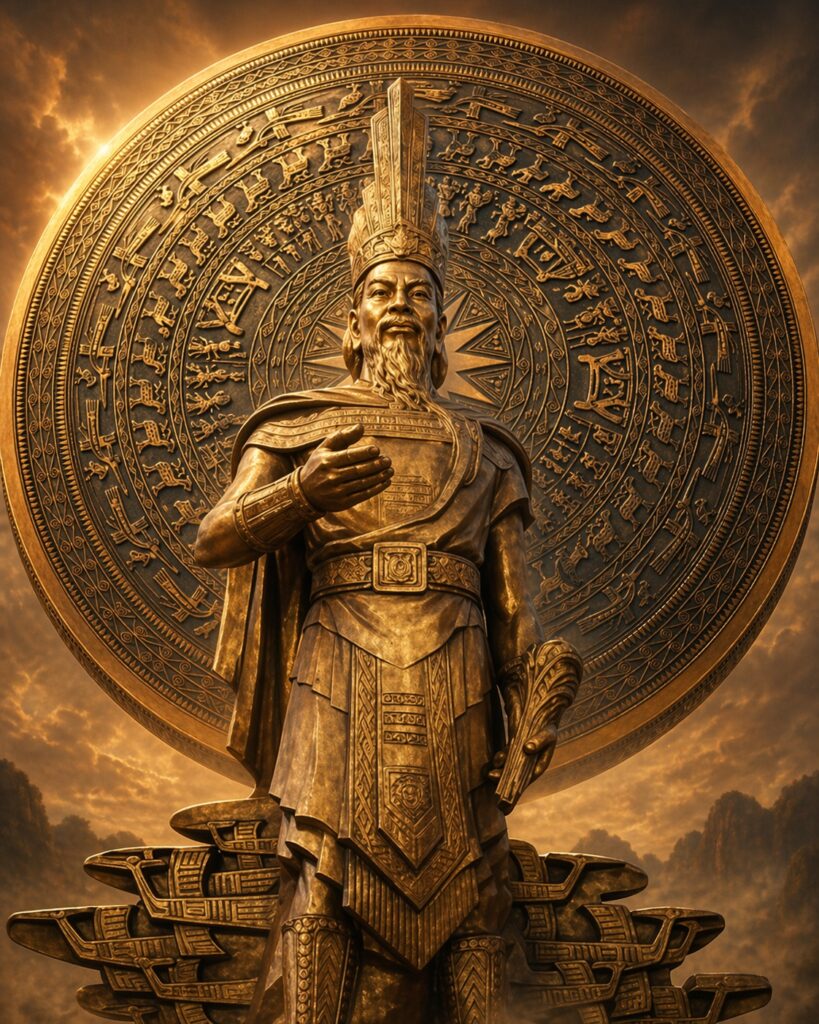
The Hùng Kings: where myth meets the shape of a nation
Here is where the narrative begins to shift. Not abruptly, but perceptibly. The figures become less otherworldly, the setting more recognisable, the actions more grounded. The mist does not disappear—but it thins.
The Hùng Kings are said to have ruled the first Vietnamese state, known as Văn Lang, beginning sometime around the third millennium BCE. The dates are, to put it gently, flexible. The number of kings—traditionally eighteen—is similarly symbolic rather than strictly historical.
And yet, to dismiss them entirely as fiction would be to misunderstand their role.
“No one can quite prove the Hùng Kings existed… but that hardly matters. Nations are built as much on stories as on stones.”
What matters is that, through them, Vietnam tells its own beginning—not as a footnote to another civilisation, but as a story with its own centre of gravity.
Văn Lang: a kingdom before kingdoms
The kingdom of Văn Lang, attributed to the Hùng Kings, is often described as the first organised Vietnamese polity. To imagine it as a kingdom in the later, medieval sense—with palaces, bureaucracies, and rigid hierarchies—would be misleading. It was, instead, something more fluid: a network of communities bound together by shared customs, leadership, and, crucially, geography.
The Red River Delta, where Văn Lang is thought to have been located, is both a gift and a challenge. Rich in alluvial soil, it is ideal for agriculture. But it is also prone to flooding, seasonal shifts, and the constant negotiation between land and water.
To live here is to adapt.
And adaptation, over time, becomes organisation.
The Hùng Kings, in this context, are remembered less as autocrats and more as unifying figures—leaders who coordinated rather than commanded, who presided over a loose yet meaningful social structure.
Rice, rivers, and the rhythm of life
If there is one element that defines early Vietnamese civilisation, it is not a monument or a military conquest, but a crop: rice.
Wet rice cultivation is not simply agriculture; it is choreography. It requires timing, cooperation, and an intimate understanding of water. Fields must be flooded, drained, and tended with precision. Irrigation systems—however rudimentary—must be maintained. The success of one family’s harvest often depends on the actions of many others.
In this sense, the “culture of water” becomes more than a poetic phrase. It is a social structure.
Communities are organised around rivers and paddies. Labour is shared. Knowledge is transmitted not through written manuals but through practice, observation, and repetition. The landscape itself becomes a teacher.
It is easy, from a modern perspective, to overlook how sophisticated this is. But managing water—too much, too little, too soon, too late—requires a level of coordination that nudges society towards something resembling governance.
Not yet a state, perhaps. But no longer merely a collection of villages.
Proto-state, or something like it
So what, exactly, did the Hùng Kings rule?
Not a state in the bureaucratic sense, certainly. There were no ministries, no tax codes etched in stone, no standing armies marching in uniform. But there were layers of authority, roles that suggest early forms of administration.
Local leaders—often referred to in later accounts as Lạc lords—oversaw specific regions. Beneath them, smaller community heads managed day-to-day affairs. At the centre, the Hùng King functioned as a symbolic and coordinating figure, linking disparate groups into a broader whole.
It is tempting to call this a “proto-state”, and the term is useful, so long as we remember its limits. What existed in Văn Lang was less a machine of governance and more an ecosystem of relationships: between people, land, water, and belief.
Because belief, too, played a crucial role.
Ancestor worship, animist practices, and a deep respect for natural forces helped bind communities together. Authority was not only political; it was spiritual. To lead was, in part, to mediate between the visible and the invisible.
The festival that refuses to fade
Fast forward several thousand years, and the Hùng Kings are still very much present—not in palaces or official decrees, but in memory, ritual, and celebration.
Each year, Vietnam honours them during the Hung Kings’ Festival, held on the tenth day of the third lunar month. Pilgrims travel to temples, most notably on Nghĩa Lĩnh Mountain, to offer incense, food, and respect.
It is, on the surface, a commemoration of ancient rulers. But in practice, it is something more intimate: a reaffirmation of origin.
People do not gather because they have verified archaeological evidence of the Hùng dynasty. They gather because the story continues to resonate. Because it provides a shared beginning in a world that often feels fragmented.
There is a quiet confidence in this. A willingness to say: this is where we come from, whether or not it fits neatly into the categories of modern historiography.
From legend to earth: the Đông Sơn horizon
At some point, the mist thickens again—only this time, it is not myth that obscures the view, but time.
Yet archaeology offers a different kind of clarity.
Enter the Đông Sơn culture, a Bronze Age civilisation that flourished in northern Vietnam roughly between 1000 BCE and the early centuries CE. Unlike the Hùng Kings, the people of Đông Sơn leave behind tangible traces: tools, weapons, ornaments, and most strikingly, drums.
Large, intricately decorated bronze drums, often referred to as Đông Sơn drums, have been unearthed across the region. They are not modest objects. They are statements.
Their surfaces are adorned with scenes of daily life: people in feathered headdresses, boats gliding across water, birds in flight, rituals unfolding in rhythmic patterns. At the centre, often, a starburst motif radiates outward, as if anchoring the entire composition.
What were these drums for?
The honest answer is: we are not entirely sure. They may have been used in ceremonies, in communication, in displays of power or prestige. Perhaps all of the above.
But what matters is what they reveal: a society capable of advanced metalworking, rich symbolism, and a coherent visual language.
In other words, a society with identity.
Echoes between myth and metal
It is tempting to draw a straight line between the Hùng Kings and the Đông Sơn culture—to say that one flows neatly into the other. Reality is, as ever, more complicated.
The timelines do not align perfectly. The sources are fragmentary. The connections are suggestive rather than definitive.
And yet, the parallels are difficult to ignore.
A culture centred on rivers and water appears in both the legends and the archaeological record. The importance of community, ritual, and symbolic expression echoes across both domains. Even the imagery on the drums—boats, birds, gatherings—feels like a visual counterpart to the narrative of a people shaped by movement and environment.
Perhaps it is not a direct inheritance. Perhaps it is a convergence.
Or perhaps, more simply, the stories remembered what the earth would later confirm: that long before written history, something distinctive was already taking shape in this region.
The usefulness of uncertainty
Modern readers often approach early history with a certain impatience. We want dates, names, and clear sequences of cause and effect. We want to separate fact from fiction, as if the two were mutually exclusive.
But Vietnam’s origins resist this tidy division.
The story of Lạc Long Quân and Âu Cơ is not “true” in a literal sense. The Hùng Kings cannot be verified with the precision of later dynasties. And yet, to discard these narratives would be to lose something essential.
They tell us how a people understands itself.
They encode values: unity in diversity, resilience, and connection to land and water. They provide continuity, linking the present to a past that may be partly imagined but is no less meaningful for it.
In a way, the uncertainty is not a flaw. It is a feature.
It allows the story to breathe.
A beginning that never quite ends
So, where does Vietnam begin?
With a dragon and a fairy? With a line of semi-legendary kings? With the first rice fields carved into a floodplain? With the casting of bronze drums that still echo across millennia?
The answer, inconveniently, is all of the above.
Vietnam does not emerge from a single moment, but from a layering of stories, practices, and adaptations. Myth shades into memory; memory into early organisation; organisation into culture.
By the time written history begins to take a firmer hold, the foundations are already there—quietly, persistently, shaped by generations who may never have thought of themselves as “founders” at all.
And perhaps that is the most fitting beginning of all.
Not a grand declaration, but a gradual becoming.
In the next chapter, the story will encounter a formidable neighbour to the north—and a millennium-long test of endurance that will define Vietnam in both visible and subtle ways. But before that, it is worth pausing here, at the threshold between legend and history, and acknowledging something simple:
Long before Vietnam had borders, it had a voice.
And it has been telling its story ever since.