
Cultural Meaning, Social Function, and Linguistic Practice
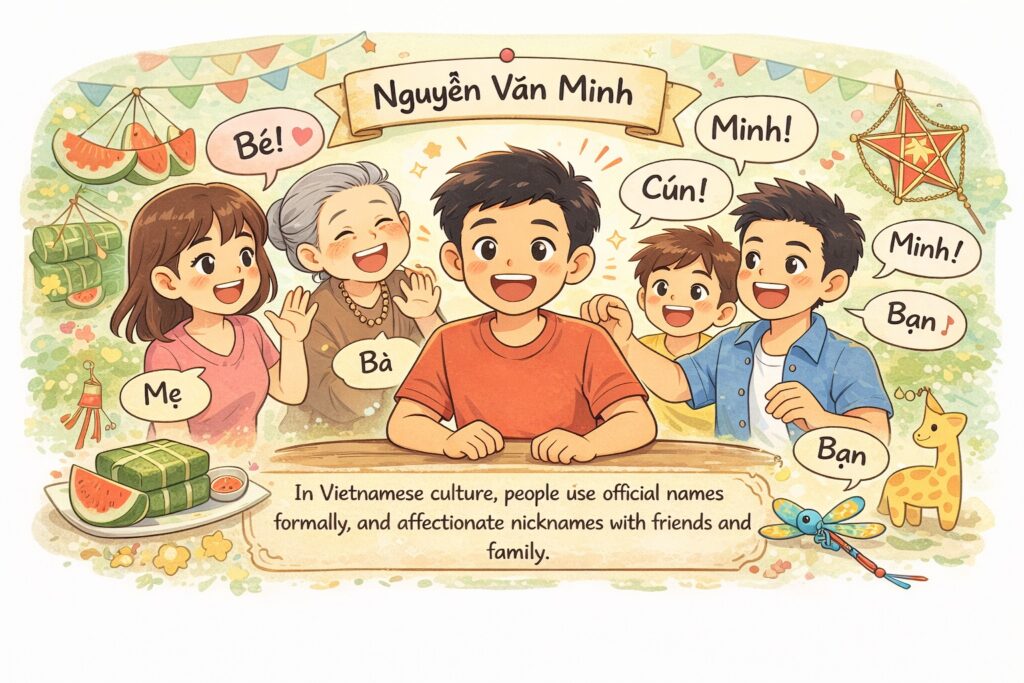
Vietnamese society possesses one of the most distinctive naming traditions in East and Southeast Asia. Personal names in Vietnam are not merely identifiers; they serve as markers of family lineage, social hierarchy, cultural values, and interpersonal relationships. Alongside official or legal names, Vietnamese people frequently employ nicknames—informal alternative names used within families, friendships, and increasingly in digital environments. The coexistence of formal names and nicknames reflects deep cultural practices rooted in history, social organisation, linguistic patterns, and changing modern lifestyles.
This article explores the structure of Vietnamese personal names, the cultural logic behind the widespread use of nicknames, and the social roles these informal names play in everyday life. By examining historical traditions, linguistic features, and contemporary digital culture, we can better understand why nicknames remain such an integral element of Vietnamese identity.
The Structure of Vietnamese Personal Names
Vietnamese personal names traditionally follow a three-part structure consisting of a family name, a middle name, and a given name. The order differs from most Western naming systems, as the family name appears first. This structure reflects the strong influence of Confucian social organisation and ancestral lineage in Vietnamese culture.
For example:
Nguyễn Văn Minh
In this name:
- Nguyễn is the family name (surname).
- Văn is the middle name.
- Minh is the given or personal name.
In everyday conversation, Vietnamese people address one another using the given name rather than the family name. Thus, a person called Nguyễn Văn Minh would typically be referred to simply as Minh in informal or semi-formal contexts.
The dominance of a few family names contributes to the importance of the given name in everyday communication. The surname Nguyễn, for example, is borne by a very large proportion of the Vietnamese population, making it impractical for identification in daily social interaction. Other common surnames include Trần, Lê, Phạm, and Hoàng.
Middle names also play a significant cultural role. Historically, certain middle names were associated with gender or generation. The middle name Văn was commonly used for men, while Thị was frequently used for women, though these conventions are evolving in modern Vietnam. Middle names can also express parental aspirations, family traditions, or aesthetic preferences.
Thus, Vietnamese personal names serve multiple functions: they identify individuals, reflect family heritage, and express cultural ideals.
The Cultural Logic of Nicknames
Despite the importance of formal names, nicknames are widely used in Vietnamese society. These informal names often emerge in childhood and may remain in use throughout adulthood among close family members and friends.
Several cultural and social factors explain this practice.
Affection and Emotional Intimacy
One of the primary functions of nicknames in Vietnam is to express affection. Family members frequently use diminutives or playful names to signal closeness and warmth. Parents often address children with affectionate nicknames that convey tenderness rather than formality.
Common examples include names referring to animals, foods, or endearing qualities. For instance, children might be called “Cún” (puppy), “Mèo” (cat), or “Bé” (little one). These names carry positive emotional associations and emphasise the intimate bond within the family.
Such nicknames are rarely used in official contexts but may persist throughout a person’s life in family circles.
Childhood Naming Traditions
Many Vietnamese children receive nicknames shortly after birth that bear no direct relation to their official names. These names may arise spontaneously within the family and often reflect physical traits, personality characteristics, or playful observations.
Examples may include references to size, temperament, or appearance. A small child might be called “Tí”, meaning tiny or little, while another might be nicknamed after a favourite food or fruit.
These childhood names serve a practical social function within extended families where multiple relatives may share similar official names. Nicknames help differentiate individuals familiarly and affectionately.
Historical Beliefs and Protective Naming
Another important factor in the tradition of nicknames is historical superstition. In earlier periods of Vietnamese history, infant mortality rates were high, and families sometimes believed that malevolent spirits might harm attractive or fortunate children.
To protect the child, parents might deliberately give ordinary or even humorous nicknames intended to make the child appear unremarkable to supernatural forces. By avoiding grand or prestigious names in everyday use, the family symbolically shielded the child from spiritual attention.
Although such beliefs are less prominent today, the cultural memory of these practices still influences naming habits in some communities.
Differentiation in a Society of Common Names
Vietnamese society contains a relatively limited pool of surnames and a frequently repeated set of given names. As a result, it is common for several individuals within a school class, workplace, or neighbourhood to share identical full names.
Nicknames provide a convenient way to distinguish between people with the same official name. These differentiating nicknames often refer to physical characteristics, personality traits, or contextual associations.
For example, two individuals named Minh might be distinguished informally by descriptive nicknames referring to height, hairstyle, or occupation.
While such descriptive names may appear blunt from a Western perspective, within Vietnamese social groups they are often used playfully rather than insultingly, particularly among friends.
Linguistic Characteristics of Vietnamese Nicknames
From a linguistic perspective, Vietnamese nicknames frequently display several distinctive features.
Reduplication and Phonetic Play
Vietnamese, as a tonal language, lends itself to rhythmic and playful sound patterns. Many nicknames involve reduplication or simplified syllables that create a childlike or affectionate tone.
Examples include short, easy-to-pronounce syllables that may repeat sounds or emphasise particular vowels. This phonetic simplicity makes the nickname memorable and suitable for everyday use in family settings.
Semantic Categories
Nicknames often fall into several semantic categories:
Animals:
Names derived from animals are particularly common and usually carry affectionate meanings. Examples may include references to cats, puppies, bears, or rabbits.
Foods and Fruits:
Food-related nicknames are also widespread. These may refer to fruits, sweets, or staple foods and typically evoke warmth and familiarity.
Physical Traits:
Nicknames based on physical appearance, such as height, body shape, or complexion, are also used. Among close friends, these descriptors are often interpreted humorously rather than offensively.
Personality Characteristics:
Some nicknames reflect behavioural traits such as playfulness, stubbornness, or energy.
These categories illustrate how Vietnamese nicknames often emerge organically from everyday observation and social interaction.
Social Contexts of Name Usage
The choice between a formal name and a nickname in Vietnam depends heavily on context and social relationships.
In official or administrative settings, such as legal documents, government forms, and academic records, individuals must use their full legal names.
In professional environments, colleagues may address each other by given names combined with appropriate titles that reflect age or status.
Within families and close friendships, however, nicknames frequently replace formal names. In some cases, a person may be known almost exclusively by a nickname within their immediate social circle.
The Vietnamese language also relies heavily on kinship terms to indicate social relationships. Words equivalent to “older brother,” “younger sister,” “aunt,” or “uncle” often function as pronouns in conversation. As a result, the actual personal name may be less important than the relational term used to address someone.
Nicknames, therefore, coexist with a broader linguistic system that emphasises relational identity rather than strictly individual identification.
Nicknames in Contemporary Vietnamese Digital Culture
The rise of digital communication has transformed the role of nicknames in Vietnamese society. Social media platforms such as Facebook and messaging applications like Zalo have encouraged the creation of new forms of informal naming.
Many users adopt playful online names combining Vietnamese words with English adjectives or popular culture references. These hybrid names often emphasise personality, humour, or aesthetic style.
The digital environment also allows individuals greater freedom to experiment with identity. Young people may maintain separate online nicknames distinct from their offline identities. In some cases, these digital names become widely recognised within social networks and gaming communities.
At the same time, online nicknames continue the long-standing Vietnamese tradition of informal naming as a marker of social closeness and group belonging.
Cultural Significance of Nicknames
The persistence of nicknames in Vietnamese society reveals several deeper cultural patterns.
First, nicknames emphasise community and relational identity. Rather than presenting individuals as isolated actors, Vietnamese social life often defines people through their relationships with family and friends.
Second, nicknames demonstrate the value placed on emotional warmth and familiarity in everyday communication. The use of affectionate names strengthens social bonds and reinforces group cohesion.
Third, nicknames illustrate the flexibility of Vietnamese linguistic practices. Formal naming conventions coexist comfortably with informal alternatives that evolve organically within social groups.
Finally, the continued use of nicknames in the digital era highlights the adaptability of Vietnamese cultural traditions. Even as communication technologies change, the social impulse to create meaningful informal names remains strong.
Conclusion
Vietnamese naming practices represent a rich intersection of language, culture, and social organisation. While official personal names reflect ancestral lineage and historical traditions, nicknames reveal the intimate and relational aspects of Vietnamese life.
These informal names arise from affection, childhood experiences, historical beliefs, and the practical need to distinguish individuals within a society characterised by a limited set of common surnames. They also demonstrate the creativity of Vietnamese linguistic expression and the importance of emotional bonds in everyday communication.
In contemporary Vietnam, the tradition of nicknames continues to evolve through social media and digital interaction. Yet its fundamental purpose remains unchanged: to express closeness, identity, and belonging within a network of personal relationships.
Understanding the interplay between formal names and nicknames, therefore, provides valuable insight into Vietnamese culture itself, where identity is not defined solely by official records but by the dynamic social ties that shape everyday life.
References
Emeneau, M. B. (1951). Studies in Vietnamese (Annamese) grammar. Berkeley: University of California Press.
Hanks, P., Coates, R., & McClure, P. (2016). The Oxford handbook of names and naming. Oxford University Press.
Luong, H. V. (1990). Discursive practices and linguistic meanings: The Vietnamese system of person reference. John Benjamins.
Marr, D. G. (1981). Vietnamese tradition on trial, 1920–1945. University of California Press.
Nguyễn, H. T. M. (2004). The pragmatics of Vietnamese person reference: Power, solidarity and face. Journal of Pragmatics, 36(6), 1013–1036.
Thompson, L. C. (1987). A Vietnamese grammar. University of Washington Press.