

Language, Humour, and Social Bonding in Vietnamese Drinking Culture
Abstract
This article explores ywo interrelated Vietnamese idioms frequently heard in convivial settings: xỉn quắc cần câu (“so drunk you’re bent like a fishing rod”), and không say không về (“no drunk, no go home”). Although they appear trivial or humorous at first glance, these expressions illuminate the deeper social and linguistic dynamics of Vietnamese drinking culture. Through their rhyme, rhythm, and playful exaggeration, they reveal how humour and speech performance create solidarity, flirtation, and cultural identity. The essay situates these idioms within the anthropological context of nhậu — Vietnamese collective drinking — and shows how mishearing and wordplay reflect the creativity and warmth of Vietnamese conversational humour.
1. Introduction
Language in moments of celebration often tells us more about a culture than its formal grammar ever could. In Vietnam, shared drinking — known as nhậu — is not merely about alcohol consumption but a social ritual of belonging. Around plastic tables in street bars or rural gatherings under corrugated roofs, friends and colleagues raise their glasses with rhythmic toasts, laughter, and an endless stream of witty remarks. Within this vibrant oral culture, certain expressions have become icons of Vietnamese sociability.
Among them, xỉn quắc cần câu, and không say không về are perhaps the most representative.
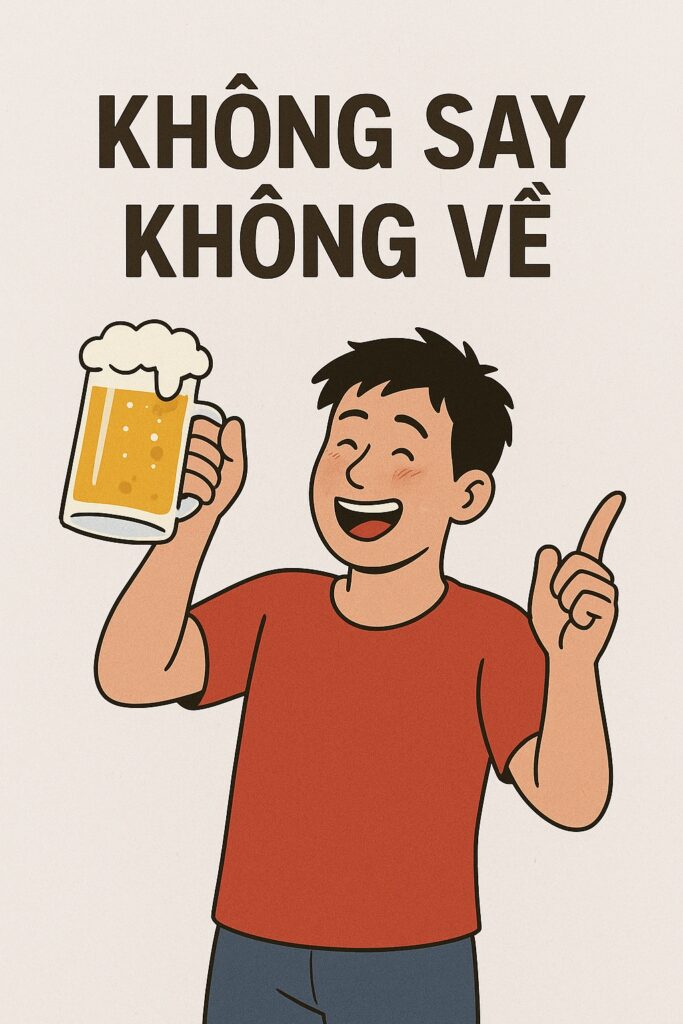
The second phrase, không say không về, has become almost proverbial, expressing the collective ethos of drinking together: “we won’t go home until we’re drunk.” Together, these idioms show how rhyme, exaggeration, and camaraderie shape Vietnamese informal speech, making each toast a miniature performance of cultural identity.
2. Drinking Culture and the Social Function of Speech
To understand these idioms, one must first grasp the role of drinking in Vietnamese social life. The practice of nhậu goes far beyond consumption. It is a ritual of equality, trust, and friendship. Whether in rural Mekong Delta villages or Hanoi beer stalls, men (and increasingly women) gather after work to share food, beer, and emotional release. Each toast — một trăm phần trăm! (“one hundred percent!”) — functions as a linguistic contract, affirming inclusion within the group.
Speech during nhậu follows a performative rhythm: teasing, storytelling, chanting short rhymes, and calling for another round. Language becomes playful, poetic, and sometimes nonsensical — not to obscure meaning but to deepen emotional connection. It is in this atmosphere that idioms like xỉn quắc cần câu and không say không về thrive. They are both declarations and jokes, compressed pieces of cultural theatre.
3. “Xỉn quắc cần câu”: Drunken Imagery and Rhythmic Exaggeration
Literal and figurative meanings
Xỉn quắc cần câu literally translates as “so drunk that even a fishing rod bends.” The humour lies in the absurd exaggeration: a bamboo fishing rod, naturally flexible, would not bend of its own accord. The phrase paints a vivid image of someone so intoxicated that they appear contorted, staggering, or “bent” by drink. The idiom captures the comic physicality of drunkenness — the way the human body becomes a caricature of itself.
In practice, this phrase is both descriptive and teasing. Friends might laugh and say “Nó xỉn quắc cần câu rồi!” — “He’s twisted like a fishing rod already!” The tone is rarely judgmental; it conveys affectionate amusement, an acceptance that drunkenness is part of the shared ritual.
Structure and sound
Phonetically, xỉn quắc cần câu has a rhythmic pattern that rolls off the tongue: a trochaic beat of alternating short, emphatic syllables. The sequence of xỉn – quắc – cần – câu combines tones and consonants in a way that feels percussive, almost musical. Vietnamese humour often exploits this rhythmic play. The pleasure comes as much from saying the phrase as from understanding it.
The word quắc itself is expressive — it suggests twisting, tightening, or curling up. Paired with cần câu (fishing rod), it forms an image of exaggerated, impossible flexibility. The more illogical the image, the funnier the effect. This nonsense imagery aligns with a broader Southeast Asian tendency to celebrate hyperbole in humour: laughter arises from saying something physically implausible yet emotionally true.
Cultural resonance
The idiom also embodies an implicit cultural value — tolerance and solidarity. To call someone xỉn quắc cần câu is not to shame them, but to include them in the shared narrative of the evening. Everyone, at some point, becomes that fishing rod. It is part of the cycle of conviviality. In this way, the phrase functions both as observation and initiation, reaffirming the communal nature of nhậu.
4. “Không say không về”: The Toast of Togetherness
Meaning and function
If xỉn quắc cần câu describes a state of being, không say không về expresses a collective vow. Literally “no drunk, no go home,” it is perhaps the most famous slogan of Vietnamese drinking culture. It is half-joke, half-promise: no one leaves until the group is thoroughly satisfied — or rather, thoroughly drunk.
This phrase captures the ritualistic side of nhậu. Each participant is bound by shared responsibility to stay, toast, and reciprocate. To leave early would be to break the rhythm of the evening, to step out of the communal frame. Thus, không say không về becomes both a toast and a moral statement: we are in this together until the end.
Rhyme and rhythm
As with the previous idioms, rhythm plays a central role. The symmetrical repetition of không say / không về forms a balanced, chant-like pattern. It is easy to shout in unison, which is precisely what people do. The expression is performative: by saying it, the group reinforces its cohesion. It is the linguistic equivalent of clinking glasses.
Social and emotional significance
In anthropological terms, không say không về symbolises what might be called the “ethics of conviviality.” Drinking together in Vietnam is not only leisure but an enactment of trust. Alcohol lowers formality and allows emotional expression between colleagues, friends, and even strangers. To insist on staying until one is drunk is not necessarily about excess; it is about commitment to the group.
Yet, like many cultural rituals, it carries ambivalence. Younger generations sometimes parody the phrase, aware of its humorous exaggeration. But even in jest, it remains an emblem of shared experience. Whether uttered earnestly or ironically, it binds participants through speech.
5. Language, Laughter, and Belonging
Across these three idioms, one sees the interplay of sound, sociality, and self-expression. Xỉn quắc cần câu demonstrates how easily Vietnamese humour slides between meaning and nonsense, between mockery and affection. Không say không về turns exaggeration into ritual. All depend on performance: they are meant to be spoken aloud, preferably amid laughter and clinking glasses.
From a sociolinguistic perspective, such expressions illustrate the oral nature of Vietnamese humour. Puns and rhymes rely on tonal variation and phonetic play rather than on fixed meaning. The pleasure lies in participation — in the shared recognition that language can be both precise and absurd.
For foreigners, these idioms offer an entry point into cultural empathy. They show that humour does not always arise from clever semantics but from communal rhythm and timing. Understanding why xỉn quắc cần câu is funny means understanding that in Vietnamese culture, to laugh at one’s own drunkenness is to affirm belonging.
Humour as cultural resilience
At a deeper level, these idioms exemplify how humour sustains social harmony. Vietnam’s long history of hardship has nurtured a national taste for laughter in adversity. To joke about one’s own inebriation (xỉn quắc cần câu) is to celebrate resilience through joy. Even không say không về — with its mock-heroic vow — transforms ordinary drinking into an act of solidarity.
6. Intercultural Implications
For foreigners, these expressions provide invaluable lessons in both language and culture. They show that mastering vocabulary and grammar is only part of understanding communication. The real challenge — and reward — lies in grasping pragmatic meaning: how people use language to perform social acts.
A literal translation of xỉn quắc cần câu may confuse or amuse an English speaker, but explaining its social usage reveals cultural patterns of tolerance, humour, and camaraderie. Likewise, không say không về illustrates how repetition and rhyme shape oral performance.
In intercultural training, these idioms can be used to discuss how cultures express group belonging through humour. Western learners often view “drinking culture” as excess, whereas in Vietnam it functions as social glue. Analysing these idioms helps challenge stereotypes and encourages empathy for local communication styles.
8. Conclusion
Xỉn quắc cần câu, and không say không về offer a vivid glimpse into Vietnamese social life. They are small linguistic windows onto a larger cultural landscape — one where laughter, sound, and camaraderie intertwine. Each expression balances between nonsense and truth, between exaggeration and sincerity.
These idioms demonstrate how humour operates as both lubricant and glue in Vietnamese culture: easing social tension, building trust, and affirming the joy of being together.
In the end, perhaps the most Vietnamese lesson of all is that meaning is less important than feeling. Whether praising beauty, describing drunkenness, or vowing not to go home sober, the real message is the same: we are here, together, and language — like life — is meant to be enjoyed.st nonsensical phrase can express the deepest sense of belonging.
Keywords
Vietnamese language; idioms; humour; drinking culture; sociolinguistics; intercultural communication; oral performance.