
June 8, 2025
An Essay Inspired by Pedro Miguel Echenique, Basque Theoretical Physicist and Professor of Condensed Matter Physics at the University of the Basque Country by Juan Inoriza
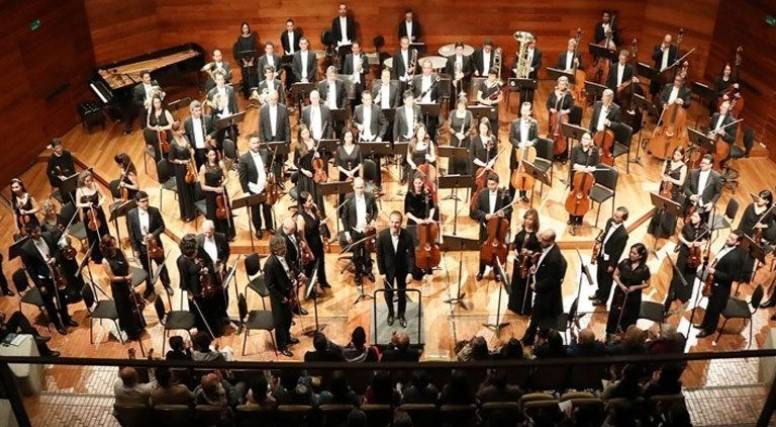
In his address to the General Assembly of ELKARGI, SGR, in March 2009, the distinguished Basque physicist Pedro Miguel Echenique delivered a masterfully constructed metaphor that continues to resonate with particular urgency in our contemporary world: the uneasy coexistence, and frequent conflict, between efficiency and creativity. Drawing upon a satirical yet profoundly revealing anecdote involving Schubert’s Unfinished Symphony, Echenique offered more than a humorous interlude; he presented a biting critique of managerial culture and its growing encroachment into domains where artistry, inquiry, and human potential ought to reign supreme.
The story he recounts is deceptively simple. A company president, unable to attend a performance of Schubert’s symphony, passes the ticket to his Director of Human Resources. The next morning, upon asking how the concert was, he received not a casual comment, but the promise of a full report. True to his word, the Director submits a document entitled “Report on the Attendance at the Concert of 20th November 2008. Piece No. 8, Schubert’s Unfinished Symphony.”
What follows is an absurd litany of recommendations rooted in a purely utilitarian and cost-cutting logic. The report suggests that the number of oboes be reduced due to their prolonged inactivity and that the violins, many of whom play the same notes, could be drastically trimmed, volume, it argues, might instead be achieved with electronic amplification. The semi-quavers, labelled as unnecessarily complex, should be rounded to crotchets, allowing for less skilled performers. Redundant repetitions, especially by the horns, should be eliminated to shorten the concert from two hours to twenty minutes. The concluding remark suggests that had Schubert adhered to these principles, he might have finished his symphony.
This anecdote, though comedic, serves as a powerful allegory. Echenique does not merely ridicule the Personnel Director’s philistinism. Rather, he exposes a far more insidious reality: the encroachment of efficiency metrics and business logics into the creative and intellectual foundations of society,education, science, innovation, and the arts. The Personnel Director’s worldview, in which artistic nuance is reduced to operational redundancy, exemplifies a managerial culture that threatens to flatten the complexity of human endeavour into the sterile simplicity of the spreadsheet.
Indeed, what gives Schubert’s symphony its transcendence is not its completeness, but its emotional depth, subtle orchestration, and unresolved mystery. The supposed inefficiencies,the rests, the repetitions, the intricacies,are precisely what give the work its soul. To impose industrial logic upon it is to utterly misunderstand its purpose. Echenique’s metaphor thus becomes a cautionary tale for all domains where creativity is essential but increasingly suffocated by demands for productivity and output.
He takes this argument further by explicitly framing the report as illustrative of a broader societal dilemma,one that has remained remarkably persistent: how do we structure the systems that shape our future? Do we prioritise control, standardisation, and efficiency, or do we cultivate curiosity, freedom, and complexity?
In education, the orchestral metaphor exposes the consequences of teaching to the test, the reduction of curricula to measurable outcomes, the marginalisation of the arts, and the undervaluing of critical reflection. Suppose learners are viewed as mere outputs, and teachers as delivery mechanisms. In that case, we end up with a system that may be efficient but fails to cultivate thinkers, dreamers, or citizens capable of navigating an uncertain future.
In science, the path to discovery is rarely linear. Like the oboes waiting silently or the violins playing in unison, meaningful research often involves repetition, apparent redundancy, or periods of dormancy. Innovation does not emerge on demand; it arises from deep inquiry, from the courage to pursue obscure questions without guaranteed results. To impose the logic of ROI, to eliminate so-called redundant basic research, is to replace the orchestra with an amplifier, noise without depth.
In creativity and innovation, the analogy is perhaps most stark. True innovation thrives on risk, ambiguity, and deviation from the norm, precisely those qualities dismissed as inefficiencies in the report. If our managerial culture demands that every idea yield immediate, market-ready results, we are left with safe, shallow outputs that mimic progress while avoiding its necessary turbulence. It is, as Echenique warns, akin to finishing Schubert’s symphony not by honouring his vision, but by amputating it for speed.
Ultimately, Echenique’s reflection is an urgent call to action. It demands that we defend the spaces where creativity, learning, and discovery can unfold without the deadening hand of premature optimisation. His elegant satire is not simply nostalgia for lost ideals; it is a principled stand against the instrumentalisation of human potential.
The question remains as relevant today as it was nearly two decades ago: Will we build a society governed by the rigid rhythms of the assembly line, or one animated by the unpredictable melodies of inquiry and imagination? The answer will determine not only the richness of our culture but whether we are capable of composing our future symphony, or whether, like Schubert’s, it will remain unfinished, yet infinitely more meaningful for it.
For if we force our symphony to comply with the rules of the Personnel Director’s report, we do not produce efficiency, we produce silence. Or worse, an amplified imitation devoid of meaning. Our collective future depends on our ability to recognise the difference.
Report on Attendance at the Concert of 20th November 2008. Piece No. 8: Schubert’s Unfinished Symphony, published on LinkedIn on 25 November 2018: https://www.linkedin.com/pulse/nuestro-futuro-educaci%C3%B3n-ciencia-creatividad-e-extracto-juan-inoriza