
Prologue
One Year Later
For months, the newspapers had treated the disappearances as separate stories. A man missing from Hậu Giang. Another from An Giang. A woman who had left home after accepting what seemed like an ordinary job. A van seen on a road leading towards the border. A family waiting for a telephone call that never came.
The reports rarely lasted more than a few days. Then another story replaced them. A raid somewhere in Cambodia. A group of foreign workers brought home. A border crossing closed temporarily. A warning about fraudulent employment offers: names appeared, then disappeared beneath newer headlines.
For most readers, they were unrelated events. For the families, they were not.
One year after the disappearance of Phong, another group of Vietnamese citizens was being returned from Cambodia. They crossed back into Vietnam under escort shortly before dawn. There were seven of them. Some carried small bags. One man had nothing except the clothes he was wearing. A woman kept asking whether her family had been informed. Another stared at the ground throughout the crossing.
Among them was a young woman from Trà Vinh. She was perhaps twenty-three, perhaps younger—the officers were not certain. She had lost weight. Her hair had been cut badly. There were old marks around one wrist and a healing wound near her temple. She answered questions when necessary, but often seemed unable to follow them.
Name. Age. Province. Family. The answers came slowly. Sometimes not at all.
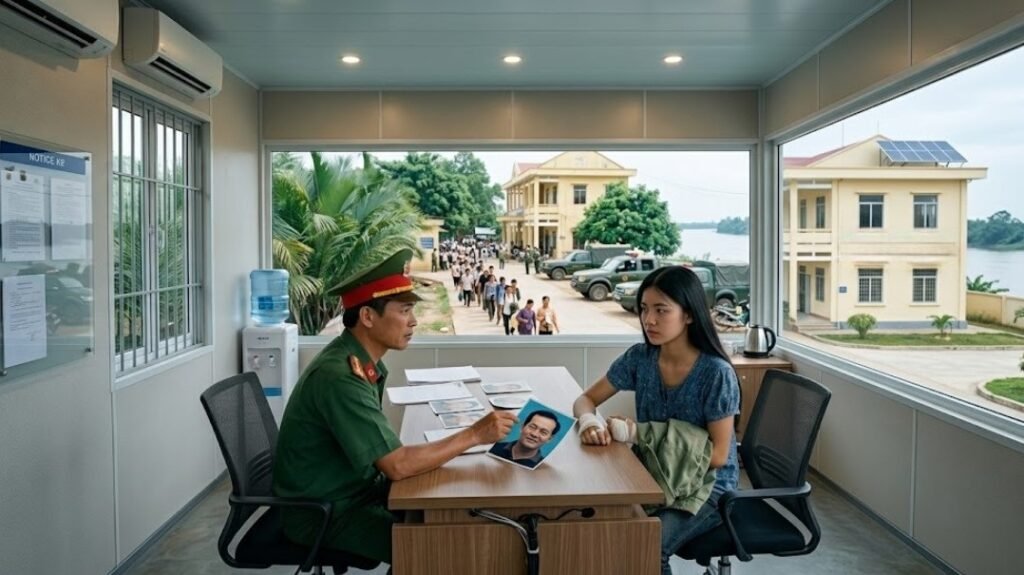
A Vietnamese officer sat opposite her inside the small interview room near the border checkpoint. On the table lay several files—photographs, names, dates, missing-person reports. He had been told not to press her. Not yet.
He began with questions she could answer easily.
“Your name?”
Liên.”
“Full name?”
She gave it.
“From Trà Vinh?”
She nodded. The officer wrote something down.
“How long were you outside Vietnam?”
Liên looked at him. Her eyes remained fixed on his face. “I don’t know.”
He did not correct her. “Do you remember where you were?”
Another pause. “Cambodia.”
“Where in Cambodia?”
She lowered her eyes. “I don’t know.”
The officer closed his notebook. He had seen this before. People remembered roads without knowing where they led. Buildings without knowing their names. Faces without knowing who they belonged to. Sometimes memory returned as a place. Sometimes as a sound. Sometimes as a single sentence.
He reached for the first photograph. “We have several missing-person cases from the Mekong Delta.” Liên did not react. “Some of these people may have travelled through the same area.”
He placed one photograph on the table, then another, then another. Liên looked at each one. A man from An Giang. A young woman from Đồng Tháp. A fisherman from Hậu Giang. Nothing.
The officer reached for the next photograph. He almost passed it over without thinking. The picture was older than the others—a Vietnamese man in his forties, short hair, ordinary clothes, an expression that belonged more to a family photograph than a police file.
PHẠM NGỌC PHONG.
Liên looked at the photograph. She did not touch it. Her eyes remained on the face.
The officer waited. Several seconds passed. Then something changed in her expression.
“Do you recognise him?”
Liên looked again. “I…” Her voice was barely audible.
The officer leaned forward. “You know this man?”
She shook her head. Then stopped. Her fingers tightened around the edge of the chair. “I think…” She looked at the photograph once more. “…I travelled with him.”
The officer said nothing.
Liên closed her eyes. For a moment, something returned—not a place, not a date. A van. Metal walls. The smell of sweat and fuel. A road she could not see. A man sitting opposite her. His hands were tied. He had spoken quietly. Told her not to panic. Told her to keep breathing. Told her that they would find a way.
She opened her eyes. “His name was Phong.”
The officer glanced at the photograph. “Are you sure?”
Liên stared at the face. “No.” The answer came immediately. Then, after another moment: “But I remember his voice.”
“What did he sound like?”
She searched for the description. “Vietnamese.”
The officer waited. “From where?”
Liên looked towards the closed door. “The Delta.”
“Which province?”
She shook her head. “Cần Thơ, perhaps.”
“Perhaps?”
“I don’t know.”
He let the question go. “Do you remember anything else?”
Liên’s gaze returned to the photograph. The van. The road. Phong speaking to her. Then the memory broke apart again. She lowered her head. “No.”
The officer looked down at his notes. For almost a year, Phong’s photograph had belonged to a case file—a missing man, a restaurant waiter, a husband, a father, a son. A name among many names.
Now, for the first time, someone who had been taken across the border with him had looked at that photograph and recognised the man everyone else had been unable to find. Not his whereabouts. Not what had happened to him. Only this: she had seen him. After he disappeared.
The officer carefully placed the photograph back among the others. Outside, the first light was beginning to reach the border road. The interview continued.
But somewhere inside the files of the Cần Thơ Criminal Police Department, an old case had acquired something it had never possessed before: a witness. Not an answer. Not even certainty. Just a memory of a man called Phong… and the sound of his voice.