
Countless years ago, during the Hong-Duc era in Vietnam, there lived a poor young man named Tú Uyên. He was a bright scholar with a deep love for reading, and people admired his wisdom. Yet, he had not passed any examinations and lived alone, as his parents had passed away.
One spring, Tú Uyên visited the festival at Ngoc Ho Pagoda. It was a lively affair, bustling with people from near and far. Tú Uyên hoped to meet someone special. After wandering for hours, he sat beneath a grand banyan tree to rest.
As he sat there, a small leaf fluttered down in front of him. Picking it up, he discovered a poem written on the back. The words seemed playful and teasing.
Tú Uyên glanced around, thinking someone might have dropped it, but no one was nearby. Just then, a group of people emerged from the pagoda, and among them was a strikingly beautiful young woman.
She caught his eye, and Tú Uyên felt his heart skip a beat.
Summoning his courage, he approached her. They began to talk, and Tú Uyên felt happier than he had ever been.
When they reached the summit of Quang Van together, the girl suddenly vanished. Tú Uyên stood there, utterly stunned, and returned home late that evening, unable to forget her.
From that day on, Tú Uyên could think of nothing else. He lost his appetite and could no longer focus on his studies. Desperate for guidance, he went to Bach Ma Temple, renowned for granting wishes, and prayed for help.
That night, Tú Uyên dreamed of a god who told him, “Go to Dong Temple tomorrow. You will hear good news.”
The next day, Tú Uyên followed the god’s advice and waited at Dong Temple. Hours passed, and he was unsure what to expect.
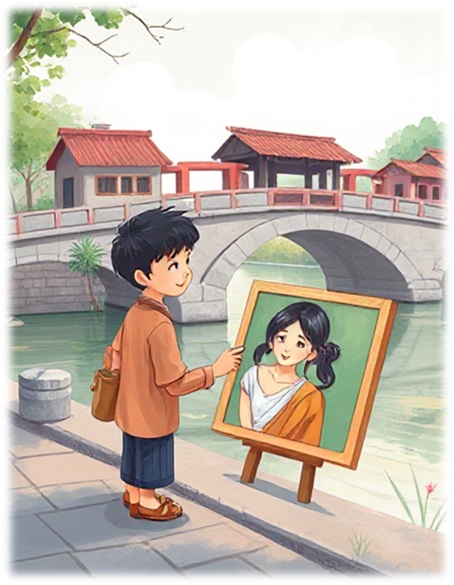
Finally, an old man selling paintings approached him. The old man showed him a portrait of a beautiful woman, and to Tú Uyên’s astonishment, it was the very girl he had met.
Tú Uyên immediately bought the painting and hung it in his room. He treated the painting as though it were alive, even setting an extra bowl at mealtimes for the girl in the picture. One day, he noticed something peculiar – the woman in the painting seemed to blush.
Soon after, Tú Uyên returned home to find delicious meals waiting for him. This happened every day, and though he did not know who was behind it, he was delighted.
Curious, Tú Uyên pretended to leave the house one day but stayed hidden outside to watch.
To his amazement, the woman stepped out of the painting, cleaned his home, and prepared his meals. Tú Uyên could hardly believe his eyes!
He rushed inside, took her hand, and said, “I’ve been waiting for you. Please, never leave me again!” He tore the painting from the wall so she could not return to it.
The woman, named Giáng Kiều, revealed that she had been sent to become his wife, bound by fate.
They married in a magical ceremony, and for a time, they were blissfully happy.
However, as time passed, Tú Uyên abandoned his studies, spending his days drinking and indulging in fine food, much to Giáng Kiều’s dismay.
Giáng Kiều warned him to change his ways, but he would not listen.
Over time, he grew careless and even shouted at her when drunk.
A few weeks later, after helping her drunken husband to bed, Giáng Kiều decided enough was enough. She returned to the heavens, leaving Tú Uyên alone.
When Tú Uyên awoke and realised she was gone, he was filled with remorse. He stopped eating and wept every day.
In his despair, he resolved to end his life. But as he prepared to hang himself, a gentle breeze filled the room, carrying a sweet fragrance.
Giáng Kiều appeared before him once more.
“I will forgive you,” she said, “but only if you change your ways.”
Tú Uyên vowed to stop drinking and become a better man. He kept his word and transformed completely, and the couple lived happily together once more.
Later, Giáng Kiều gave birth to a son, who grew to be exceptionally intelligent.
One night, two white cranes appeared in their garden. Giáng Kiều and Tú Uyên understood that their time on earth had come to an end. They bid farewell to their son, climbed onto the backs of the cranes, and flew to the heavens, leaving behind a legacy of love and redemption.