
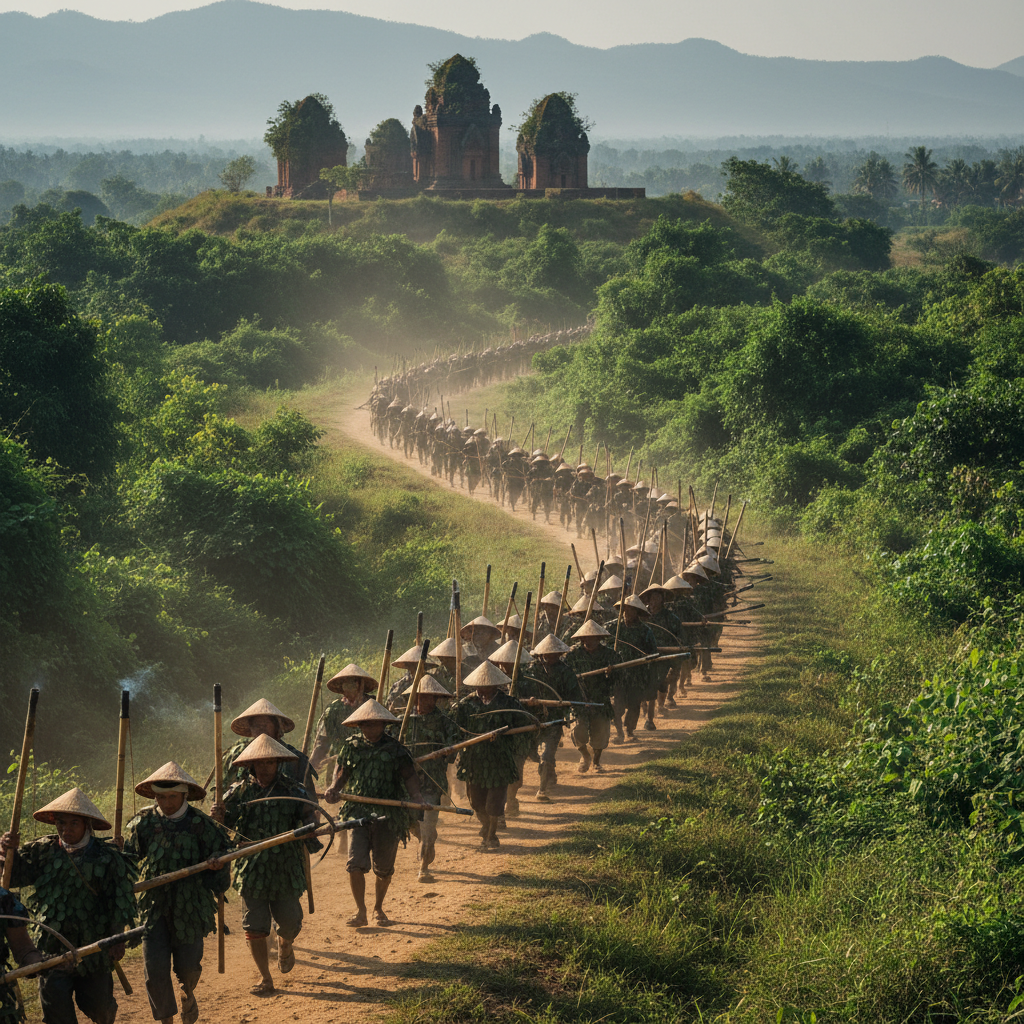
Chapter 3: Dynasties, Empires and Expansion South
If Vietnam couldn’t find peace, it would at least make history.
Independence is not an ending.
It is an invitation.
After nearly a thousand years under foreign rule, Vietnam did not simply reclaim its autonomy and settle into quiet stability. It stepped, somewhat breathless, into a far more complicated role: that of a kingdom defining itself in real time.
The struggle was no longer about survival alone.
It was about power, identity, expansion—and, inevitably, conflict.
“If Vietnam couldn’t find peace, it would at least make history.”
A capital is born
In 1010, a decision was made that would shape the course of Vietnamese history for centuries.
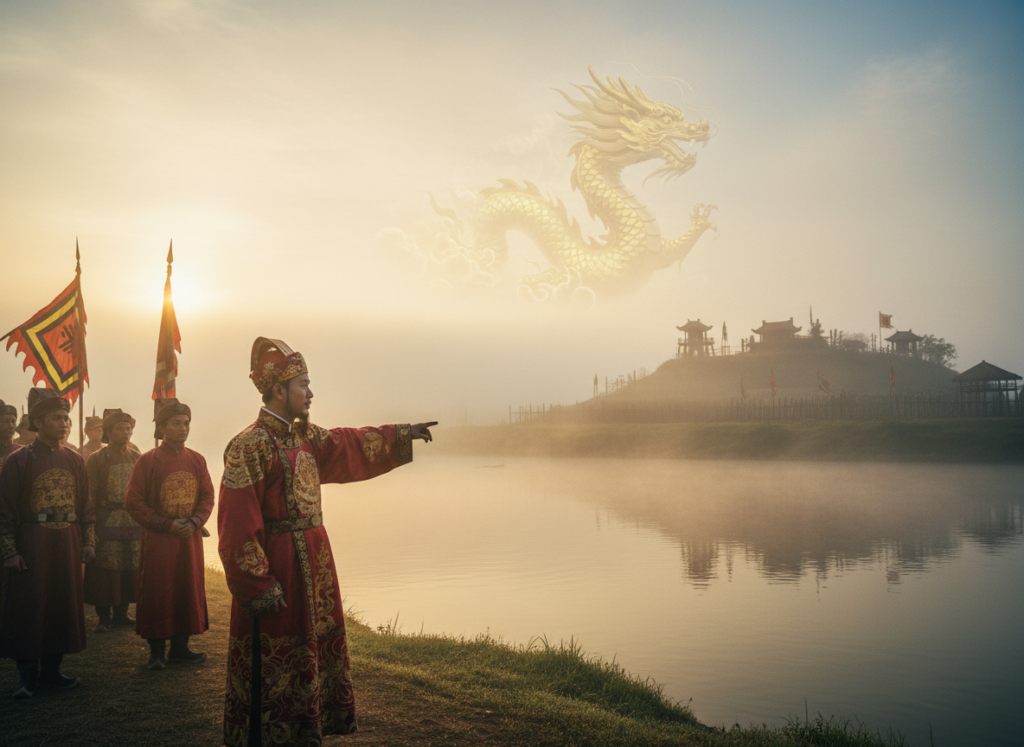
Lý Thái Tổ, founder of the Lý dynasty, chose to move the capital from Hoa Lư to a new location on the Red River plain. According to legend, he saw a dragon rising from the water—a sign of auspicious destiny.
He named the city Thăng Long—“Ascending Dragon”.
Modern readers will recognise it by another name: Hanoi.
The move was strategic. The Red River Delta offered better conditions for administration, agriculture, and communication. But it was also symbolic. After centuries of foreign domination, Vietnam was not merely governing itself—it was imagining itself.
A capital is more than a seat of power.
It is a statement.
Building a kingdom
Under the Lý dynasty, and later the Trần, Vietnam began to consolidate its structures of governance.
Borrowing, once again, from Chinese models—but now on its own terms—the state developed a system of administration grounded in Confucian principles. Scholars were trained. Officials were selected. A bureaucracy began to take shape.
These were the mandarins: educated elites who served the state, advised the ruler, and helped translate abstract ideals into practical governance.
Examinations—demanding, rigorous, and deeply competitive—became pathways to power. Knowledge was not merely valued; it was institutionalised.
And yet, beneath this formal structure, older patterns persisted.
Village autonomy remained strong. Local customs endured. The state was centralised—but not absolute.
Vietnam was learning to balance control with continuity.
The Mongols arrive
Just as Vietnam was finding its footing, a new threat appeared—this time not from the familiar north, but from a force that had already shaken much of the known world.
The Mongol Empire.
By the 13th century, Mongol armies had swept across vast territories, from China to Eastern Europe. Their reputation preceded them: swift, disciplined, and devastatingly effective.
Vietnam, now under the Trần dynasty, faced not one but three invasions.
And at the centre of the response stood one of its most revered figures: Trần Hưng Đạo.
Strategy over strength
If the Mongols excelled in open-field warfare, Vietnam chose not to meet them on those terms.
Instead, it returned to something familiar: adaptation.
Trần Hưng Đạo understood the terrain. Rivers, forests, climate—these were not obstacles, but allies. Vietnamese forces avoided direct confrontation when it was disadvantageous. They retreated when necessary, harassed supply lines, and waited.
It was not always glorious.
But it was effective.
The Mongols, accustomed to rapid victories, found themselves stretched, frustrated, and increasingly vulnerable.
And once again, the rivers would play their part.
Bạch Đằng, again
History, in Vietnam, has a habit of repeating itself—though never quite in the same way.
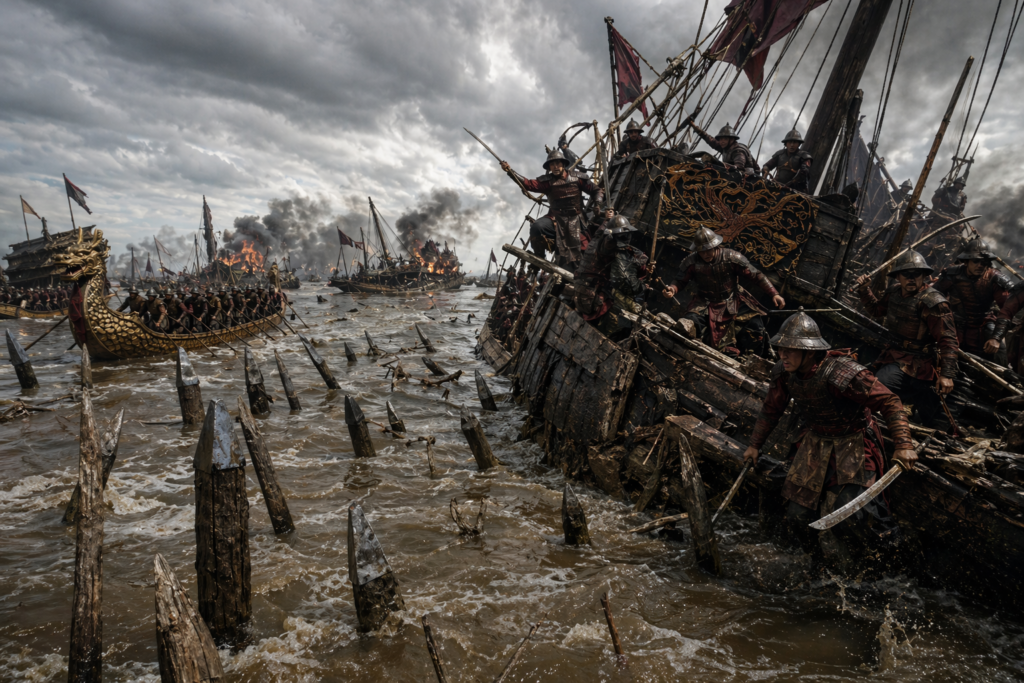
In 1288, during the third Mongol invasion, the Bạch Đằng River became the stage for another decisive encounter. The strategy echoed that of Ngô Quyền centuries earlier: hidden stakes planted in the riverbed, timed with the tides.
As the Mongol fleet advanced, the trap was set.
As the waters receded, it sprang.
Ships were immobilised. Chaos followed. Vietnamese forces attacked with precision.
The result was decisive.
The Mongols withdrew.
Once again, a vastly larger empire had been held at bay—not through brute force, but through understanding, patience, and a refusal to fight on unfavourable terms.
Expansion: the long march south
Victory, however, brings its own momentum.
With external threats temporarily contained, Vietnam turned its attention in another direction: south.
This process, known as Nam tiến—the “southward advance”—would unfold over several centuries and reshape the map of the region.
To the south lay the territories of Champa, a sophisticated civilisation with its own culture, religion, and history. Beyond that, the lands of the Khmer.
Expansion was not a single event, but a gradual movement—part migration, part conquest, part assimilation.
Settlers moved into new territories. Conflicts arose. Borders shifted.
And slowly, Vietnam extended its reach from the Red River Delta towards the Mekong.
It is tempting to frame this as inevitable. It was not.
It was contested, complex, and often violent.
But it was also transformative.
By the time the process was complete, Vietnam had become a long, narrow country stretching along the eastern edge of the Indochinese peninsula—a shape that still defines it today.
A kingdom divided
If external threats and expansion were not enough, Vietnam would also face a more familiar challenge: internal division.
By the 17th century, power had fractured between two rival families: the Trịnh in the north and the Nguyễn in the south.
The emperor, in theory, remained the central figure.
In practice, authority was split.
The country was effectively divided into two spheres of influence, each with its own administration, military, and ambitions. Conflict between them was intermittent but persistent.
It was, in many ways, a civil war stretched across generations.
And yet—life continued.
Trade flowed. Culture developed. Society adapted to a reality in which unity was more ideal than it was a fact.
Vietnam, it seemed, could withstand even itself.
Culture in a time of conflict
Amidst all this—wars, expansions, rivalries—something quieter continued to flourish.
Culture.
Literature, in particular, found its voice. Scholars composed poetry, philosophical texts, and historical works. The written word became both an artistic expression and a means of preserving identity.
Confucian ideals shaped education and governance, but they were interpreted through a distinctly Vietnamese lens.
Buddhism, too, played a significant role, influencing thought, art, and daily life.
Temples rose. Traditions deepened.
Even in times of instability, there was a persistent effort to understand the world—not just to control it.
Borrowed forms, distinct identity
One of the most striking features of this period is the way Vietnam engaged with external influences.
Chinese models of governance, education, and culture were not rejected. They were studied, adapted, and reinterpreted.
This was not imitation.
It was a transformation.
Vietnam developed a system that, while recognisably influenced by its northern neighbour, functioned according to its own priorities, its own rhythms.
Identity, once again, was not defined by isolation—but by selective adoption.
A pattern emerges
Looking across these centuries, a pattern begins to take shape.
External threat → adaptation → resistance → consolidation → expansion → internal conflict → cultural flourishing.
Not exactly peaceful.
But undeniably dynamic.
Vietnam was no longer a peripheral territory resisting domination. It was an active participant in regional politics, a kingdom capable of defending itself, expanding its borders, and shaping its own destiny.
It was, in every meaningful sense, an emerging power.
The cost of becoming
But becoming something larger always comes at a cost.
Expansion brings conflict. Power invites rivalry. Identity, once secured, must be continually negotiated.
By the time the early modern period draws to a close, Vietnam is stronger, larger, and more complex than ever before.
But it is also, in many ways, more vulnerable.
Divided internally. Stretched geographically. Entangled in regional dynamics.
The stage is set.
Towards a new era
The next chapter of Vietnam’s history will bring new challenges—ones that cannot be met with rivers and tides alone.
Foreign powers from far beyond the region will arrive, bringing with them new technologies, new ambitions, and new forms of control.
The patterns of resistance will return.
But the context will change.
For now, it is enough to recognise this:
Vietnam did not simply survive independence.
It used it.
To build.
To expand.
To define itself—again and again.
And if peace proved elusive…
It made history instead.