
Chapter 4: Colonisation, War and Reinvention
(From French colony to modern nation)
If the previous centuries were about becoming a kingdom, the 19th and 20th centuries were about something far more brutal: being turned into someone else’s territory—and refusing, in every possible way, to stay that way.
By the time French ships arrived in force in the mid-19th century, Vietnam was already a country shaped by expansion, internal tension, and hard-won identity. But what followed was a different kind of pressure altogether.
Not an invasion as a single event.
But colonisation as a system.
The arrival of French Indochina
French influence began gradually, through trade, missionaries, and diplomacy. But by the 1880s, it had become something far more concrete: French Indochina.
Vietnam was reorganised, renamed in parts, and absorbed into a colonial structure that also included Laos and Cambodia. Hanoi, Saigon, and other key cities were reshaped with European planning logic—boulevards, administrative quarters, new infrastructures layered over older urban life.
On paper, it was “modernisation”.
On the ground, it was control.
The French extracted rice, rubber, and resources to feed an empire half a world away. Railways were built, but not primarily for Vietnamese mobility. Schools existed, but access was uneven and politically filtered.
And yet—something familiar happened again.
Vietnam did not disappear into the system.
It adapted inside it.
Resistance begins to change shape
Earlier centuries of resistance had often been military, local, and immediate. Under colonial rule, resistance became more complex.
It was no longer just about battlefields. It was about ideas.
A new Vietnamese intelligentsia emerged—educated in both Confucian traditions and French systems. And from that tension, nationalism began to take form in a modern sense: not just loyalty to land or dynasty, but to a defined national identity.
Reformers, students, and revolutionaries began asking the same uncomfortable question:
What does it mean to be Vietnam under foreign rule?
Ho Chi Minh and the idea of independence
In this landscape, one figure becomes unavoidable: Ho Chi Minh.
He was not simply a leader, but a convergence point of global ideologies—communism, anti-colonialism, and Vietnamese nationalism. His path took him across continents, from Europe to the Soviet sphere, before returning to Vietnam with a single central objective: independence.
In 1945, in the aftermath of World War II and Japan’s collapse in Indochina, Ho Chi Minh declared the independence of Vietnam.
But declarations are one thing.
Recognition is another.
France returned. War followed.
The First Indochina War
The First Indochina War (1946–1954) was not a clean ideological confrontation. It was a long, grinding conflict between French forces and the Việt Minh, Ho Chi Minh’s independence movement.
It unfolded across jungles, villages, mountains, and supply lines stretched thin across impossible terrain.
And once again, Vietnam leaned into something it had learned over centuries:
Do not always meet strength with strength.
Outlast it.
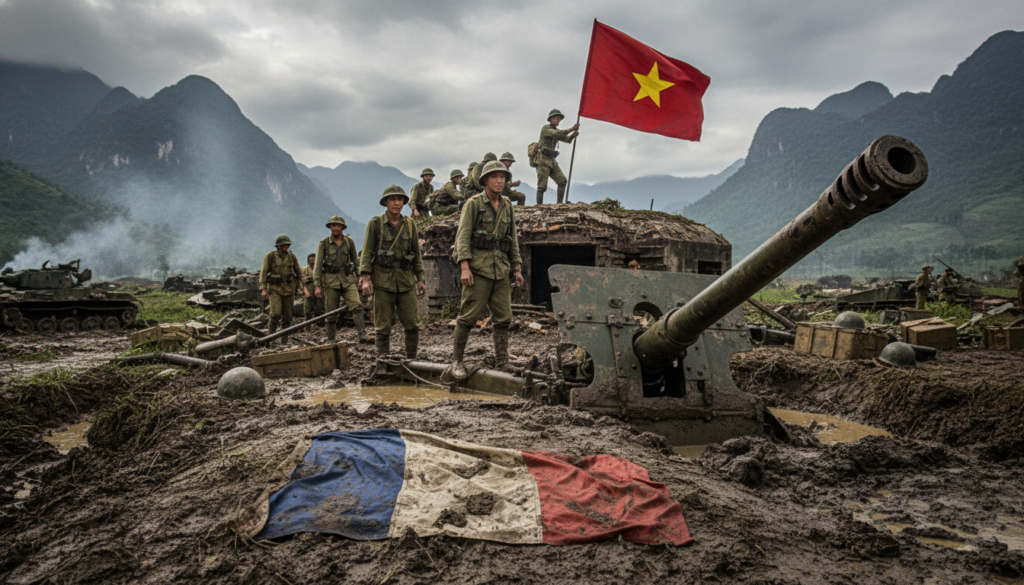
The turning point came at Dien Bien Phu, where French forces were decisively defeated in 1954.
Colonial rule ended.
But the country did not unify.
A divided nation
The Geneva Accords split Vietnam along the 17th parallel.
North and South. Two administrations. Two political visions. One unresolved question.
And into that gap stepped the Cold War.
What might have remained a post-colonial transition became something far larger: a global proxy conflict layered over a deeply local reality.
The Vietnam War (or the American War)
To call it one war is almost misleading. Many wars were happening at once:
A civil war.
A Cold War battlefield.
A struggle over identity, legitimacy, and survival.
The North, led by the Democratic Republic of Vietnam, sought reunification under its political system. The South, supported by the United States and allied forces, attempted to resist that outcome.
And between them: civilians, villages, landscapes that had already seen centuries of conflict in different forms.
Technology escalated. Bombing campaigns intensified. The scale of destruction became global news.
But even here, a familiar pattern reappeared.
Vietnam did not frame itself as a temporary actor in someone else’s conflict.
It framed itself as a long-term presence refusing erasure.
1975 — Reunification
In 1975, Saigon fell. The war ended.
Vietnam was reunified under a single government for the first time in decades.
But victory, as always, was not a clean conclusion. It was the beginning of another difficult phase: economic hardship, international isolation, and the immense task of stitching a fractured country back together.
War had ended.
Recovery had not yet begun.
Đổi Mới — the quiet transformation
By the mid-1980s, it became clear that ideological rigidity alone could not sustain development.
In 1986, Vietnam introduced Đổi Mới—a set of economic reforms that shifted the country towards a market-oriented system while maintaining political continuity.
It was not a dramatic rupture. It was something more Vietnamese in character: incremental, pragmatic, adaptive.
And it worked.
Slowly at first, then rapidly, Vietnam opened to global trade, investment, and technological development.
The country that had spent decades defined by war began to be defined by something else: growth.
Vietnam today
Modern Vietnam is not a postscript to war. It is something else entirely.
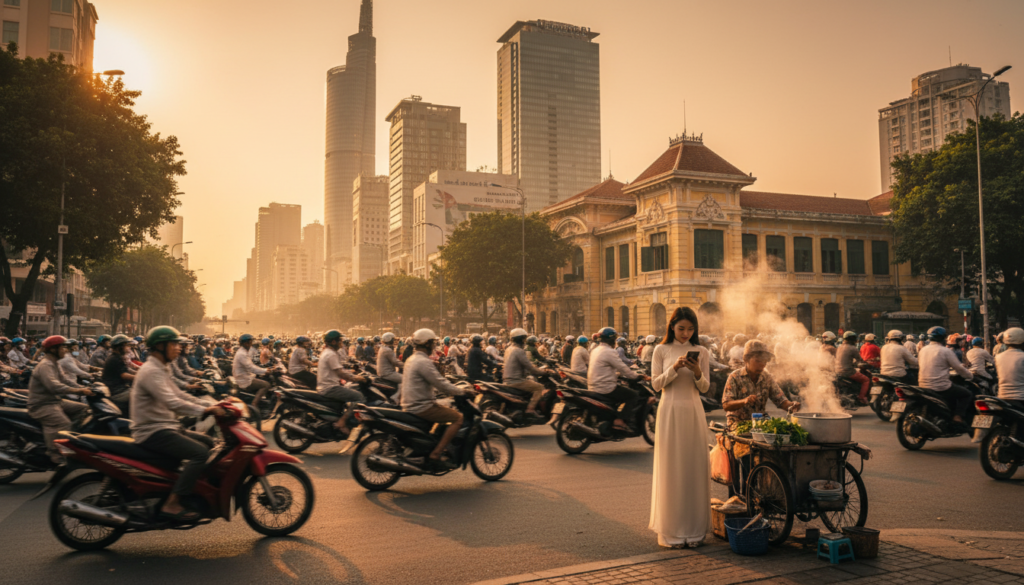
Cities like Hanoi and Ho Chi Minh City are dense, fast-moving, and increasingly global in outlook. Factories, startups, street vendors, digital platforms—all coexist in the same compressed urban rhythm.
A young population drives much of this change. Connected, ambitious, and deeply aware of global culture, yet still rooted in local identity.
There is no single narrative that fully contains Vietnam now.
It is not traditional.
It is not Westernised.
It is not frozen in its past.
It is all of these things at once—without fully belonging to any of them.
The final paradox
Vietnam’s modern history is often told through conflict: colonisation, war, division, reunification.
But that framing misses the deeper continuity underneath it all.
A country repeatedly redefined from the outside… that kept redefining itself from within.
Not by avoiding pressure.
But by transforming it.
And so the closing idea is not complexity for its own sake, but something simpler:
Vietnam did not simply survive the 20th century.
It outlasted it.